


Editorial
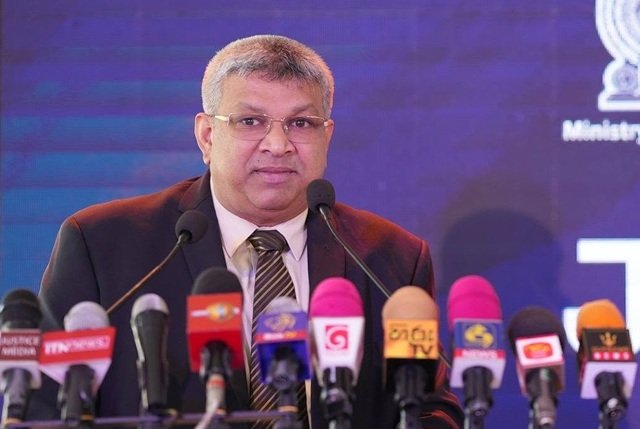
Justice Minister Harshana Nanayakkara has publicly accepted responsibility for the Negombo Prison tragedy. That statement cannot be treated as a symbolic gesture made during a moment of grief. In a country where political leaders have repeatedly avoided accountability after institutional failures, a minister’s admission of responsibility carries a serious constitutional and ethical consequence. If the Minister genuinely believes that the ministry under his authority bears responsibility for the deaths of prison officers and inmates, then the appropriate next step is clear: he should resign and allow an independent investigation to proceed without any question of political influence.
The speed with which the Minister accepted responsibility was highly unusual in Sri Lanka’s political history. Such immediate public acknowledgements are more commonly seen after major attacks, where extremist organisations such as ISIS or Al-Qaeda rapidly claim responsibility for acts they have committed. In contrast, it is exceptionally rare for a key political office-holder to publicly accept responsibility immediately after a state institutional failure. That is precisely why the Minister’s words carry such weight: a declaration of responsibility from a holder of public office cannot remain a symbolic statement; it must be followed by accountability.
This is not a demand based on emotion, revenge or political hostility. It is a basic principle of ministerial accountability. A minister is appointed not only to enjoy authority but to accept responsibility when institutions under his supervision fail. Resignation in such circumstances is not an admission of criminal guilt. It is an act of political integrity. It demonstrates that the search for truth and justice is more important than remaining in office.
The Minister cannot simultaneously claim ownership of the failure and continue to occupy the position responsible for overseeing the very system that must be investigated. Responsibility cannot be a public statement made before cameras and grieving families while power remains untouched. If the words “I am responsible” have genuine meaning, then they must be followed by action.
The most serious aspect of this tragedy is that prison officers themselves reportedly warned the Minister about failures that they believe contributed to the disaster. When the Minister visited and met grieving officials, they reportedly told him directly that the catastrophe could have been prevented if proper authority and emergency procedures had been available at the critical moment.
Their message was clear and disturbing: “We did not fire, sir; we asked for permission to fire. If we had been given the order, we could have stopped this.” They reportedly told the Minister that officers needed clear authority to act during emergencies and that delays in decision-making created a situation that became far more dangerous than it should have been.
They further warned that the consequences could have been catastrophic. According to their account, the situation could have escalated to the point where the entire prison population was at risk. They reportedly told the Minister: “This could have been prevented with a fingernail, sir. If only 1,500 had come out, the entire population would have been wiped out. That officer saved it.”
These statements raise questions that cannot be dismissed through sympathy, condolences or promises of future reform. They raise fundamental issues about command responsibility, emergency authority, security protocols and whether prison officers had the necessary powers and instructions to prevent loss of life.
The Minister has promised a formal investigation and stated that justice will be served. That investigation must happen. But the credibility of such an investigation depends on public confidence. A minister who has accepted responsibility for a disaster occurring within his own portfolio cannot remain in office and expect the public to believe that complete independence has been guaranteed.
Sri Lanka has already witnessed the Supreme Court establish that public officials can be held accountable when failures of state responsibility lead to grave consequences. The judgment relating to the Easter Sunday terrorist attacks made it clear that holding high office is not merely about exercising power; it is about fulfilling constitutional duties. Senior officials were held accountable because the state failed in its obligation to protect citizens.
The same principle must apply now. The victims of this tragedy include prison officers who died while performing their duty and inmates who remained under state custody. The Constitution does not recognise a hierarchy of whose life deserves protection. Every person under state authority has rights, and every failure by the state must be examined without political protection.
The Minister’s own words have created the standard by which he must now be judged. If he truly accepts responsibility, he must accept the consequence attached to that responsibility. Remaining in office while an investigation examines failures within his own ministry weakens public confidence and creates the perception that political authority is being placed above accountability.
Sri Lanka does not need another investigation followed by another cycle of excuses. It needs an example that public office still carries honour and consequences. The Justice Minister has a choice: protect his position or protect the credibility of the rule of law. If responsibility is genuine, resignation is the only consistent response.









