


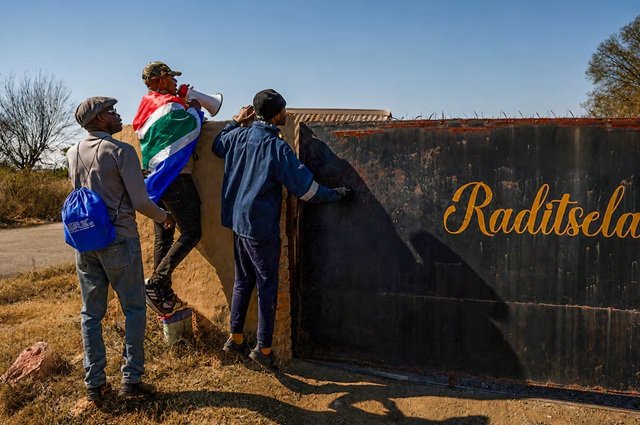
Anti-immigration groups in South Africa have shifted their campaign from large public demonstrations to door-to-door neighborhood searches targeting suspected undocumented migrants, marking a new phase in protests that organizers say will continue every Thursday until the government takes further action on irregular immigration.
The latest demonstrations took place across several parts of the country, including Johannesburg and Durban, but attracted significantly smaller crowds than those seen on June 30, when thousands reportedly participated after an ultimatum issued to President Cyril Ramaphosa’s government expired. Instead of large gatherings, groups of between several dozen and just over 100 protesters marched through working-class neighborhoods searching for homes believed to be occupied by foreign nationals.
In Katlehong, east of Johannesburg, protesters carrying wooden sticks and South African flags moved through residential streets chanting slogans against irregular immigration. Residents pointed out properties they claimed were occupied by migrants, prompting demonstrators to stop outside homes, strike gates with sticks, and call on occupants to leave the country. In several cases, no one responded before the groups moved on.
Patrick Dube, described as a community representative participating in the march, said the movement did not intend to harm anyone. According to Dube, protesters wanted undocumented migrants to return to their countries, obtain legal documentation, and then return through lawful channels. He also stated that previous assaults linked to similar demonstrations resulted from individuals who misunderstood the movement and took the law into their own hands.
The campaign has emerged after months of protests, threats, and attacks directed at foreign nationals. South African authorities, including President Cyril Ramaphosa, have repeatedly stated that immigration enforcement remains the responsibility of the state. While Ramaphosa has acknowledged challenges related to irregular immigration and pledged tougher management of the issue, he has also condemned vigilantism and said citizens cannot replace government institutions.
The movement is led by Jacinta Ngobese-Zuma, head of an organization known as March & March, which works alongside other anti-immigration groups. The organizations are demanding tighter border controls, faster deportations of undocumented migrants, and priority access to employment and public services for South African citizens. Speaking at a gathering in Durban, Ngobese-Zuma said the demonstrations would continue every Thursday until the government responded. She also rejected claims that the movement is xenophobic.
The protests have coincided with growing concern among neighboring countries. Malawi’s government said more than 38,000 of its citizens had returned from South Africa in recent weeks for security reasons, while Zimbabwean authorities reported that more than 60,000 nationals had returned since the crisis began.
Although some demonstrations remained peaceful, violence broke out in Dunnotar, where a large community of Ethiopian, Somali, Pakistani, and Bangladeshi migrants lives and operates small businesses. About 50 protesters reportedly threw stones and bottles at migrant-owned shops, leading to clashes before police intervened. Ali Hussein, a Bangladeshi supermarket owner who said he has lived in South Africa for nearly two decades and holds South African family ties, said three migrants sustained minor injuries and later filed police complaints. Hussein rejected accusations that migrants take jobs from South Africans, stating that foreign-owned businesses also employ local workers.
Police deployed multiple vehicles, officers, and a truck to separate protesters from migrant shopkeepers in Dunnotar. According to the account, tensions eased only after the police commander confronted advancing demonstrators and ordered them to retreat. Similar incidents were also reported in Soweto and Alexandra, where Reuters reported that protesters removed individuals from their homes after accusing them of being undocumented migrants before handing them over to police.
As the demonstrations continued, organizers in Katlehong said residents were helping identify homes occupied by migrants and suggested that future protests could also target companies accused of employing undocumented workers at lower wages. Dube said protesters wanted the law to be enforced, while Hussein maintained that he already complies with the law, reflecting the opposing positions that continue to define South Africa’s immigration dispute.









