Thousands of mourners gathered in Mashhad late into Thursday for the burial of Iran’s late Supreme Leader Ali Khamenei, with funeral ceremonies marked by calls for revenge and opposition to any compromise with the West as Iran and the United States exchanged new military attacks despite a recent ceasefire agreement.
According to the source text, Khamenei was killed in an Israeli strike in late February on the opening day of the US-Israeli war against Iran, ending more than three and a half decades as the country’s supreme leader. His burial at the Shrine of Imam Reza in Mashhad, the holiest site for Shia Muslims in Iran, concluded six days of funeral ceremonies held in Tehran, the religious city of Qom, and Iraq.
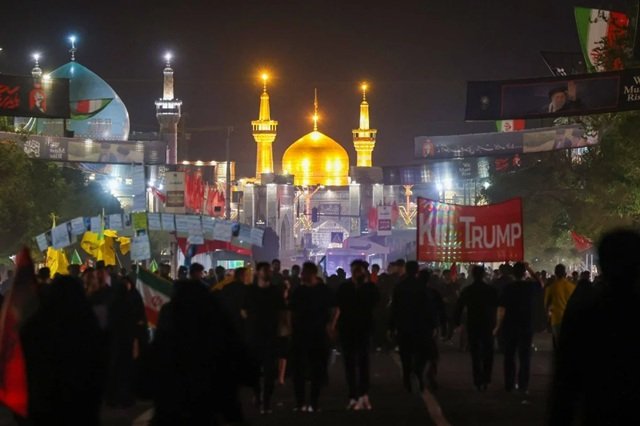
Mourners lined the route leading to the shrine, beating their chests, weeping, and chanting religious slogans as they waited for Khamenei’s coffin to arrive. Worshippers lit candles around the shrine while large crowds remained gathered into the evening. The final stage of the journey was completed by helicopter because authorities expected the main avenue leading to the shrine to be overcrowded.
The funeral took place as hostilities between Iran and the United States intensified once again. According to the source text, Iranian armed forces launched attacks on US military infrastructure in Gulf states on Thursday following US strikes on Iran’s southern coastal and eastern provinces, further weakening a ceasefire that had been reached three weeks earlier to end the conflict.
Iranian media later reported multiple explosions in southern Iran, including Bushehr, Konarak, Choghadak, and Bandar Abbas. Bushehr is home to one of the country’s nuclear power plants. A US official, according to the source text, said there had been no American strikes in recent hours.
The funeral also drew attention to Iran’s leadership succession. Observers had been monitoring for any public appearance by Mojtaba Khamenei, identified in the source text as the late leader’s son and successor, who was reportedly injured in the same strike that killed his father. While Khamenei’s elder son, Mostafa Khamenei, other relatives, and senior officials attended the ceremonies, Mojtaba did not appear during the funeral prayers.
Many mourners wore black clothing and carried red flags, which the source text said symbolize the pursuit of vengeance in Shia Islam. Participants chanted slogans against compromise with the United States and directed criticism at US President Donald Trump and Israeli Prime Minister Benjamin Netanyahu. A large banner displayed in English carried a threat directed at Trump, while other signs targeted Netanyahu.
Several mourners interviewed during the ceremonies said they rejected diplomatic engagement following Khamenei’s death. Hoda, a 35-year-old housewife, said only the deaths of Trump and Netanyahu would ease her grief and opposed any compromise following the agreement that ended months of fighting in mid-June. Mohammad Afsharian, a 41-year-old shop owner, said those attending the funeral were carrying red flags to express demands for revenge regardless of ongoing diplomatic efforts. Tahereh Rahmani, a 37-year-old school executive, also said revenge was the only response that could address the loss of the Iranian leader.
The source text said criticism expressed during the funeral echoed the position of Iranian hardliners who have opposed President Masoud Pezeshkian’s government’s pursuit of negotiations with Washington following Khamenei’s death.
The funeral procession also included families and children dressed in the colors of the Islamic republic. Large banners depicting Trump and Netanyahu were displayed near the shrine, including one showing a caricature of Trump with a bounty on his head and another carrying the message “There will be blood” beneath an image of Netanyahu.
According to the source text, Khamenei was buried alongside his infant granddaughter, his son-in-law, his daughter, and Mojtaba Khamenei’s wife, Zahra Haddad Adel, who were also reported to have been killed in the February 28 strikes.