


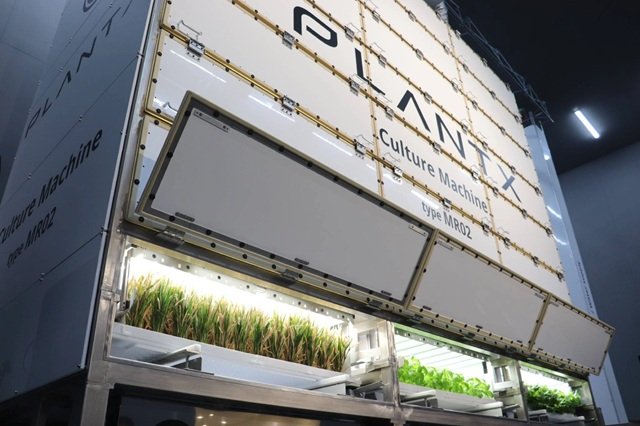
Tokyo-based agritech startup Plantx has opened a pilot facility featuring fully sealed vertical-farming systems, introducing what the company describes as the world’s first cultivation platform of its kind as Japan continues to invest in agricultural technology.
The new facility, located in Tokyo’s Koto Ward, consists of multiple fully sealed cultivation modules in which growing conditions, including water temperature, humidity, light, air, and water supply, can be controlled independently. According to Plantx, the modular design distinguishes the system from conventional vertical farms by allowing each cultivation unit to operate separately rather than managing an entire growing space under uniform conditions.
The company said the system enables precise control over the cultivation environment, allowing adjustments to nutritional values and sugar content in agricultural products. According to Plantx, the technology is intended to support the production of higher value-added vegetables and fruits through more accurate environmental management.
Japan’s Minister of Agriculture, Forestry and Fisheries, Norikazu Suzuki, attended the opening ceremony on Wednesday and described the technology as one that “will definitely become an essential technology in the future.”
Unlike traditional vertical-farming facilities that require climate control across large enclosed spaces, the Plantx facility stacks multiple sealed cultivation units, each equipped with independent environmental controls. According to the company, this approach allows growers to tailor conditions for individual crops while maintaining precise regulation of cultivation variables throughout the production process.
Plantx President Kosuke Yamada said overseas demand for agricultural automation is even greater than in Japan. He told reporters that the company intends to use the pilot facility to test automation technologies aimed at reducing labor requirements while also evaluating methods to lower electricity, water, and fertilizer consumption.
The pilot project is expected to serve as a research platform for improving operational efficiency and resource management in controlled-environment agriculture. The company said the testing will focus on technologies that can reduce production costs while supporting more sustainable cultivation practices.
Vertical farming and other food-technology initiatives form part of Japan’s broader industrial strategy for innovation. According to the source text, the food-technology sector has been designated as one of the 17 priority strategic areas identified by Prime Minister Sanae Takaichi’s administration for both public and private investment.
As part of that support, Plantx has received a government grant of ¥1.2 billion, equivalent to approximately $7.4 million, to advance the development of its technology. The funding is intended to support the company’s research and commercialization efforts as it develops automated cultivation systems designed for domestic and international markets.
The opening of the Koto Ward facility marks the latest step in Plantx’s efforts to develop precision-controlled indoor farming technologies as interest in automated agriculture continues to grow. According to the company, the pilot operation will provide a testing ground for future improvements in cultivation efficiency, environmental control, and resource conservation through fully sealed vertical-farming systems.









