
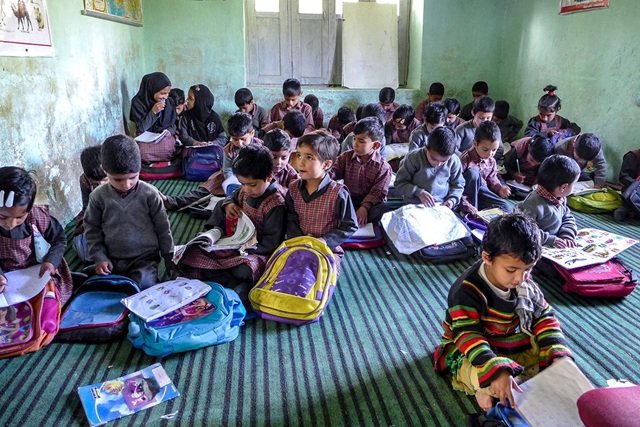
In early July 2026, a major controversy erupted in Jammu and Kashmir (J&K) when books supplied to government school libraries under the centrally sponsored Samagra Shiksha scheme were found to contain content glorifying convicted terrorists, separatist leaders, and anti-India narratives.
The Controversy erupted over two books-Personalities and Legends of J&K, authored by Dr. Hilal Ahmad and Santosh Meena and published by Oberoi Book Service in Jammu District, and Great Personalities of Jammu and Kashmir, authored by Dr. Sushant Giri and published by Anurag Prakashan in Delhi. The books were among 463 titles from 364 publishers approved for distribution to more than 18,000 government and PM SHRI schools across J&K. 123 copies of one of the books were supplied to Jammu, Ramban and Udhampur districts, and 128 copies of the other book were supplied to Jammu and Baramulla districts.
The objectionable content included the portrayal of Maqbool Bhat, the founder of the Jammu Kashmir Liberation Front (JKLF), who was convicted for murder and executed in 1984, as a “Shaheed,” “Shaheed-e-Azam,” revolutionary, and even the “father of the nation.” Separatist leaders such as Syed Ali Shah Geelani, Masarat Alam, Shabir Ahmad Shah, Mirwaiz Umar Farooq, and others were depicted as “great personalities,” “legends,” and “freedom fighters.” Books also repeatedly used terms like “Indian Occupied Kashmir” (IOK) or “Indian Held Kashmir” (IHK), language that aligns with external propaganda narratives against India. The Jammu and Kashmir Peoples’ Forum (JKPF) first raised the alarm, which quickly sparked widespread public outrage and political backlash.
In response, the administration of Lieutenant Governor Manoj Sinha responded, and the two controversial books were immediately withdrawn and banned from all government school libraries. The authors and publishers were blacklisted, with directives issued to remove any other works by them from educational institutions across the Union Territory (UT). Eight officials from the School Education Department were placed under suspension. They are: Fazil Imran Saddiqui, Coordinator (Library), Samagra Shiksha; Gurjeet Singh, Assistant Coordinator, Samagra Shiksha; Sanjeev Sharma, Principal, Government Higher Secondary School (GHSS), Kore Pannu, Kathua; Shazia Kouser (also spelled Shazia Kousar), Academic Officer, SCERT Jammu; Imtiyaz Ahmad Mir (also spelled Imtiaz Ahmad Mir), Lecturer, Boys Higher Secondary School (BHSS), Wathoora, Budgam; Niranjan Sharma, Lecturer, Government Higher Secondary School (GHSS), Badhat, Kishtwar; Renu Mengi, Lecturer, DIET Jammu; and Rajmohini, Lecturer, Government Girls Higher Secondary School (GGHSS), Poonch. Additionally, the services of contractual employee Sheikh Suheel Ahmad, a Computer Assistant attached to the Library Coordinator under Samagra Shiksha, were terminated with immediate effect. J&K Police (Counter Intelligence Wing) registered an FIR under the Bharatiya Nyaya Sanhita (BNS) and the Unlawful Activities (Prevention) Act (UAPA). Raids targeted the publishers’ premises, with seizures of documents and other materials. One author’s identity was reportedly under scrutiny.
In the immediate follow-up, on July 10, 2026, the J&K Government ordered the forfeiture of 25 additional books suspected of promoting secessionism, glorifying terrorism, distorting history, and endangering India’s sovereignty and integrity. This action, based on intelligence and investigations, targeted works seen as radicalising youth and spreading false narratives. The proscribed titles include Kashmir in Conflict by Victoria Schofield, The Kashmir Dispute: 1947-2012 by A.G. Noorani, books by Sumantra Bose (Kashmir at the Crossroads, Contested Lands), Colonising Kashmir by Hafsa Kanjwal, Azadi by Arundhati Roy, and works by Maulana Abul A’la Maududi, Christopher Snedden and Essar Batool, among others.
On July 9, 2026, the Directorate of School Education Kashmir (DSEK) issued a circular directing all government schools, recognised private institutions, and coaching centres in the Kashmir Valley to comprehensively screen books and study materials in classrooms, libraries, offices, and staff rooms. Heads of institutions were asked to identify and report any content deemed inappropriate, offensive to religious sentiments, contrary to law, harmful to national interests, or inconsistent with National Education Policy (NEP) 2020 values. Detailed reports (including titles, authors, publishers, and copy count) and compliance certificates were required.
Previously, in August 2025 (August 5-7), the Jammu and Kashmir administration under Lieutenant Governor Manoj Sinha issued a major notification ordering the forfeiture of 25 books, citing their alleged role in propagating false narratives and secessionism, glorifying terrorism and militants, distorting historical facts, vilifying security forces, and promoting religious radicalisation, alienation, and pathways to violence. Notable titles included Azadi by Arundhati Roy, The Kashmir Dispute 1947-2012 by A.G. Noorani, Kashmir in Conflict by Victoria Schofield, Kashmir at the Crossroads and Contested Lands by Sumantra Bose, Colonizing Kashmir: State-Building under Indian Occupation by Hafsa Kanjwal, Independent Kashmir by Christopher Snedden, Do You Remember Kunan Poshpora? by Essar Batool and others, In Search of a Future (The Story of Kashmir) by David Devadas, A Dismantled State by Anuradha Bhasin, along with works by Maulana Maududi (e.g., Al Jihadul fil Islam), Imam Hasan Al-Banna, and several others. Police conducted raids on bookshops across the Kashmir Valley (Srinagar, Anantnag, and other districts) to seize copies. The ban applied to publication, sale, circulation, and possession in the UT. This 2025 crackdown on literature perceived as threatening national integrity and public order was referenced in July 2026 coverage as context for the school library controversy, demonstrating a consistent policy approach.
The individuals praised in the books – such as Maqbool Bhat and various Hurriyat-linked separatist leaders – are viewed by Indian authorities as figures associated with militancy, Islamist radicalism and separatism. The episode highlights ongoing challenges regarding the vetting of educational materials and the need for scrutiny to ensure that school content supports national integration and does not promote radicalisation or alienation among students. It also underscores the critical role of unchecked content in potentially fostering radicalisation and alienation among the youth.