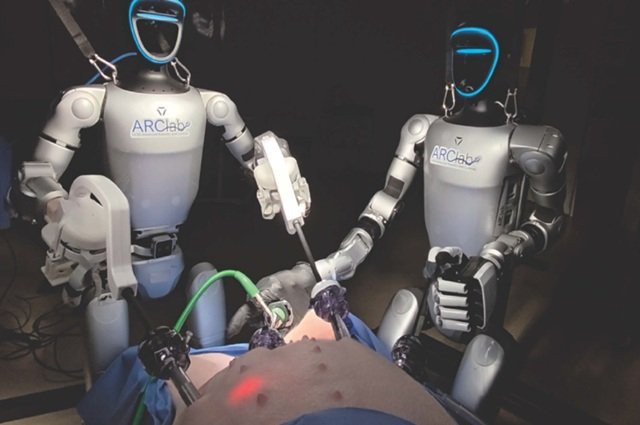
A US research team has used a Chinese-made humanoid robot to complete minimally invasive surgery on live animals, marking what researchers described as the first successful demonstration of a humanoid robotic system performing a complete laparoscopic surgical workflow.
The study, published in Nature and reviewed by the Global Times, involved the use of Unitree’s G1 humanoid robot to perform standard laparoscopic cholecystectomies, commonly known as gallbladder removal procedures, on two live pigs. The robot was remotely controlled by a surgeon to manipulate conventional laparoscopic instruments during the operations.
Researchers developed a teleoperation framework that allowed the humanoid robot to carry out surgical tasks using manual wristed instruments. According to the study, the Unitree G1 was selected because it represents a commercially available and relatively economical general-purpose humanoid platform rather than a specialised medical robot designed exclusively for surgery.
A Unitree spokesperson confirmed that the robot used in the research was from the company’s G1 series. The spokesperson told the Global Times that if the reported surgery results were accurate, the demonstration showed that a humanoid robot had achieved the level of precision required to perform surgical procedures on pigs.
Chen Jing, vice president of the Technology and Strategy Research Institute, told the Global Times that the experiment represented a significant development because it demonstrated a possible alternative path to traditional surgical robotics. He said the research suggests that general-purpose humanoid robots could potentially be adapted for medical applications without requiring entirely separate hardware systems.
The development could challenge the current model of surgical robotics, which relies heavily on dedicated platforms built specifically for medical procedures. The study highlighted that general-purpose humanoid robots may eventually provide a more flexible approach by allowing the same robotic systems to be adapted for multiple environments and tasks.
The cost difference between existing surgical platforms and humanoid robots was also highlighted. According to publicly available information cited in the report, the da Vinci surgical system, one of the most widely used robotic surgery platforms, originally cost between $1.5 million and $2.5 million, with annual maintenance expenses estimated at around $175,000. In comparison, Unitree’s official website lists a basic G1 humanoid model with a starting price of 85,000 yuan and a weight of 35 kilograms.
Chen said Chinese robotics companies have advantages in areas including commercially available platforms, dexterous robotic hands, open-source teleoperation systems, cost efficiency and adaptation for general-purpose applications. He added that the broader robotics research community supporting these platforms could further accelerate development.
During the experiments, two pig surgeries were performed using the humanoid robot. According to the study, each procedure followed a standard laparoscopic workflow involving a console surgeon and a bedside assistant. A senior surgeon performed all procedures from the robotic console using the humanoid platform, while assistants managed camera control, tissue retraction, exposure and other adjustments during surgery.
Researchers also tested the use of a second humanoid robot during a short period of the first procedure to assist with camera holding and retraction. Both operations were completed using the robotic system without requiring conversion to traditional laparoscopy or open surgery.
The first procedure was completed without major complications. During the second case, researchers reported minor biliary spillage and bleeding from the liver bed, which were controlled using suction and electrocautery.
The study also compared the humanoid robot’s performance with existing surgical robotics platforms. In an O-ring replacement task, a standardised robotic skill test, inexperienced operators using the humanoid robot achieved error rates comparable to the da Vinci Research Kit, a recognised surgical robotics research platform, and performed significantly better than manual operation.
In a more challenging Fundamentals of Laparoscopic Surgery peg-transfer task, the humanoid robot achieved intermediate results. Researchers found that it exceeded manual performance in speed and accuracy but remained behind the more established dVRK system.
Researchers described the procedures as an early benchmark for evaluating humanoid robots in live surgical environments. However, they also noted that technical feasibility does not yet equal clinical readiness. Surgeon feedback identified limitations involving range of motion, force control and the need for frequent system recalibration, which increased operational complexity.
The study stated that once clinically ready, humanoid platforms could help address some limitations of current robotic surgery systems by providing more flexible and potentially lower-cost solutions. Such systems could eventually expand access to robotic-assisted surgical care.
Chen said that combining humanoid robotic surgery technology with virtual programming could allow rapid deployment in remote areas or field hospitals in the future. However, he estimated that the technology may still require five to ten years before entering operating rooms. In the near term, humanoid robots are more likely to serve as remotely controlled assistants for tasks such as camera operation and tissue retraction rather than independently performing complex surgery.
Experts noted that established surgical robotic systems such as the da Vinci Research Kit have benefited from more than two decades of development. Humanoid robots will require further advances in precision, communication speed, sterile design and autonomous decision-making before they can become routine clinical tools.