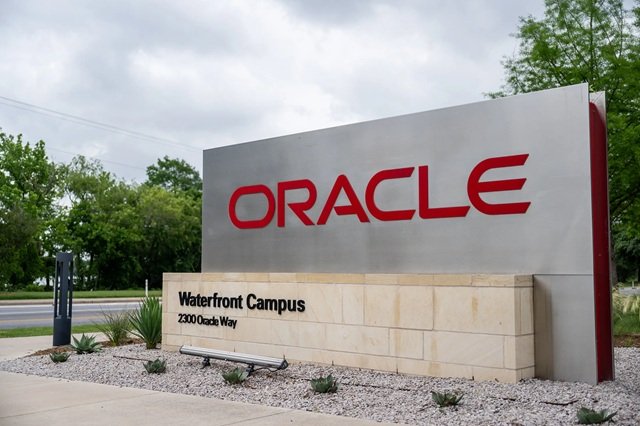
Oracle has emerged as the leading contender to provide Japan with top-secret cloud computing services, according to a Financial Times report citing multiple people familiar with discussions, as the United States intensifies pressure on Tokyo to strengthen the protection of classified information against growing cyber threats.
The Financial Times reported that the Texas-based technology company is ahead of Amazon Web Services (AWS), Microsoft and Google in negotiations to supply an “air-gapped” cloud system designed to store and process highly classified government data. Such systems operate independently of the internet and are intended to offer stronger protection against cyber intrusions while allowing secure information sharing through specialised gateways.
According to the Financial Times, Japan’s preference for a U.S. cloud provider followed extensive discussions with Washington and a conversation in March between U.S. President Donald Trump and Japanese Prime Minister Sanae Takaichi. The report said the United States has long urged Japan to reinforce its cyber security infrastructure, arguing that existing government systems remain vulnerable to Chinese cyberattacks.
The issue has gained greater urgency as Washington encourages Tokyo to increase defence cooperation, including the co-production of military equipment, while strengthening regional deterrence against China. According to the Financial Times, U.S. officials also believe stronger cyber security is necessary if Japan is to have a realistic opportunity of joining the Five Eyes intelligence-sharing alliance, which includes the United States, the United Kingdom, Australia, New Zealand and Canada.
The Financial Times reported that discussions surrounding the United Kingdom and Japan’s joint development of a next-generation fighter aircraft have further increased pressure on Tokyo to establish more secure infrastructure capable of handling classified information. One person familiar with the discussions told the publication that concerns raised by partner governments influenced Japan’s decision to pursue an air-gapped cloud, describing the country’s existing cyber systems as being “in the dark ages.”
According to the Financial Times, Oracle became the leading candidate after indicating early in the process that it was prepared to deliver a fully air-gapped solution. The report said Microsoft and AWS, despite having significant experience deploying similar systems, argued that commercial cloud alternatives would provide sufficient security and were less willing to pursue an air-gapped model for commercial reasons. People familiar with their positions told the Financial Times that both companies were frustrated by the U.S. assessment that Japan required an air-gapped system.
Oracle, Microsoft, Google and the Japanese Prime Minister’s Office declined to comment to the Financial Times. AWS rejected the publication’s reporting, stating that it offers fully air-gapped cloud solutions for customers handling classified information and works with clients, including the Japanese government, to design security architectures that meet operational and sovereignty requirements.
The Financial Times reported that Japan has not reached a final decision and could still divide the contract among multiple providers. According to people familiar with the discussions, Tokyo could initially construct an air-gapped cloud for top-secret information before expanding its infrastructure with commercial cloud technology to manage less-sensitive classified data.
The report said U.S. Ambassador to Japan George Glass is overseeing a working group coordinating discussions between the Japanese government and the competing technology companies. However, critics cited by the Financial Times argue that building an air-gapped cloud would be expensive, require the construction of new domestic data centres and could create additional strategic targets in the event of a conflict involving China.
The Financial Times also reported that concerns remain within Japan about technological sovereignty and dependence on a U.S. provider, particularly after the Trump administration temporarily prohibited the export of Anthropic’s Mythos artificial intelligence model. Although some policymakers have advocated for a Japanese technology company to partner fully with a U.S. provider, supporters of that approach have acknowledged that domestic firms currently lack the technical capabilities required to lead the project.
Pamela Phan, former U.S. deputy assistant secretary of commerce for Asia, told the Financial Times that Japan’s decision to classify cloud technologies as critical products under its 2022 economic security law reflected its view that cloud infrastructure has become a strategic national security capability. She added that the rapid development of generative artificial intelligence has heightened concerns that reliance on foreign-controlled cloud infrastructure could expose government services, critical infrastructure and sensitive data to increased risk. According to the Financial Times, one Japanese government adviser also said Tokyo remains cautious about becoming overly dependent on a U.S. company as recent developments have affected confidence in Washington’s approach toward its allies.