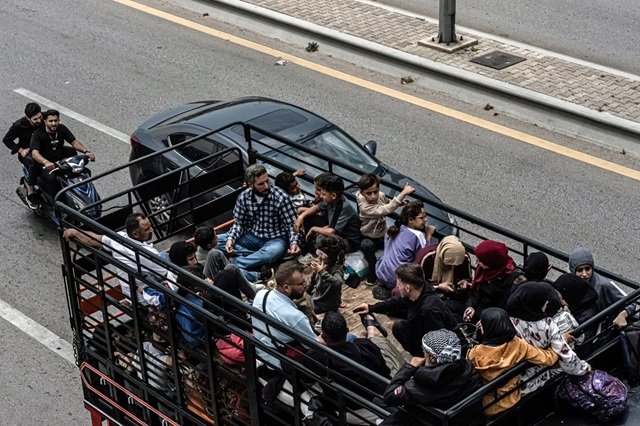
The fragile pause in fighting has opened the way for thousands of displaced Lebanese to return to the country’s southern border region, but the homecoming has unfolded in landscapes marked by destruction rather than relief. Across villages that Israel continues to regard as a combat zone in its conflict with Hezbollah, residents are returning to shattered homes, damaged infrastructure, and communities still living under the shadow of renewed violence. For many, the return is less an emotional reunion than a practical assessment of what, if anything, remains.
Among those making that journey is 42-year-old Youssef Mohammad Abbady, who stands amid the rubble of what was once his family home in the village of Kafra. Speaking from the debris where he had lived with his children, he describes little emotional reaction to the loss. Years of repeated hardship, he says, have left him unable to fully process the destruction. His experience reflects the reality facing hundreds of thousands of Lebanese whose displacement has stretched across months of conflict.
According to the United Nations, around 730,000 people have returned to their homes or what remains of them since June. Yet roughly one-third of the 1.2 million people displaced after the latest phase of open warfare began in March remain unable to return. Residents of 68 municipalities that continue to be occupied by Israeli forces are still barred from going back, while many others only make brief visits to inspect damaged properties before returning to temporary shelters.
Even with parallel ceasefire arrangements in place, the conflict has not entirely subsided. Israeli strikes continue in parts of southern Lebanon, where homes, businesses, water systems, and electricity networks have suffered extensive damage. The uncertainty surrounding the ceasefires has added another layer of instability for families trying to decide whether rebuilding is possible or whether another displacement may soon follow.
Two separate diplomatic tracks have emerged in an effort to halt the fighting, though they reflect different priorities. One agreement reached between the United States and Iran, Hezbollah’s principal backer, emphasizes ending the Israeli occupation of Lebanese territory. A second arrangement announced days later between the governments of Lebanon and Israel, under U.S. mediation, places the disarmament of Hezbollah ahead of any Israeli withdrawal. The differing approaches have highlighted divisions over how the conflict should be resolved.
Those divisions are particularly visible in villages such as Kafra, located near the occupied border zone. Many residents interviewed there reject negotiations with Israel and instead continue to support Hezbollah, viewing the movement as the only force capable of defending southern Lebanon. Abbady says he would accept being displaced again if it meant Israeli forces were eventually forced to leave. Speaking about Hezbollah, he describes the organization as “the resistance” and expresses support for its continued role despite the heavy cost borne by civilians.
Abbady’s own home was destroyed in an Israeli airstrike in March. Five people were inside at the time, including one individual he describes as close to Hezbollah, though not a member of the organization. The attack killed one person and left another with life-changing injuries. During their displacement farther north, Abbady says his family also struggled with soaring rents demanded by landlords despite the broader humanitarian emergency. Back in Kafra, he now operates a small café powered by a generator while sleeping at the business premises instead of rebuilding his house. Nearby, other residents have chosen to reconstruct shops before repairing their own homes, spending nights inside parked vehicles as they work.
The physical destruction extends throughout the village. Municipal worker and rescue volunteer Ismail Abbady walks through Kafra pointing to neighborhoods where buildings and trees alike have disappeared. Having spent months participating in rescue operations, he recalls one strike that killed three young girls and two adults. A second bombardment, he says, prevented rescuers from reaching the victims. Lebanon’s Health Ministry reports that more than 4,300 people have been killed since the latest phase of the war began in March, with the total death toll since 2023 exceeding 8,000.
Not every resident presents the conflict in identical terms. One woman, speaking anonymously, acknowledges that Hezbollah members had been present in Kafra. After returning, she found remnants of fiber-optic cables linked to drones used by the group during operations against Israeli forces. She says fighters typically waited until civilians had fled before entering homes and points to a destroyed villa that she believes had been used by militants. Tank fire heard nearby underscores the continuing proximity of Israeli forces and the persistence of armed exchanges.
The political debate surrounding Hezbollah’s future has become increasingly contentious. Lebanese President Joseph Aoun and Prime Minister Nawaf Salam have pursued negotiations that include proposals for the militia’s disarmament, a policy supported by parts of the Lebanese population outside the country’s Shiite community. In Rome, Israeli and Lebanese officials have resumed talks focused on creating pilot zones where Israeli troops would eventually withdraw after Lebanese state forces establish control in place of Hezbollah under conditions that have yet to be fully defined.
In southern Lebanon, however, skepticism toward that process remains widespread. Hezbollah, founded in 1982 with Iranian backing, has developed into both an armed movement and a political and social institution with deep roots across much of the region. Many residents credit the group with defending the south during previous confrontations with Israel, and some view efforts to disarm it before a full Israeli withdrawal as unacceptable. Municipal official Youssef Ezzeddine questions proposals for pilot zones, arguing that Hezbollah’s members are part of the local community and asking where they would be expected to go if stripped of their role.
The broader regional atmosphere has further complicated confidence in negotiations. Israeli officials have made statements about expanding security measures along the border, while comments by senior ministers regarding the scale of destruction in southern Lebanon have reinforced fears among many residents that military operations could continue. United Nations officials and independent experts have also raised concerns over the humanitarian consequences of the conflict, even as legal proceedings involving Israel continue in international forums.
At a temporary cemetery near Tibnin, paramedic Mohammed Namer Baydoun oversees the burial of victims brought from surrounding communities. Wearing the vest of Hezbollah’s medical services, he speaks while standing among newly dug graves that include fighters, civilians, and emergency workers. He says Israeli operations have killed numerous paramedics since March and recounts months spent recovering bodies ranging from children to elderly residents. Among those buried is his 27-year-old son Hussein, whom he says died fighting against Israeli forces. Despite his personal loss, Baydoun continues his work from an ambulance that has become both his workplace and his shelter.
As thousands of Lebanese cautiously return to the south, they confront not only damaged homes but an uncertain future shaped by continuing military activity, unresolved political negotiations, and competing visions of security. Across villages reduced to rubble, residents continue rebuilding businesses, clearing debris, burying the dead, and preparing for a future that many believe remains inseparable from the possibility of another round of conflict.