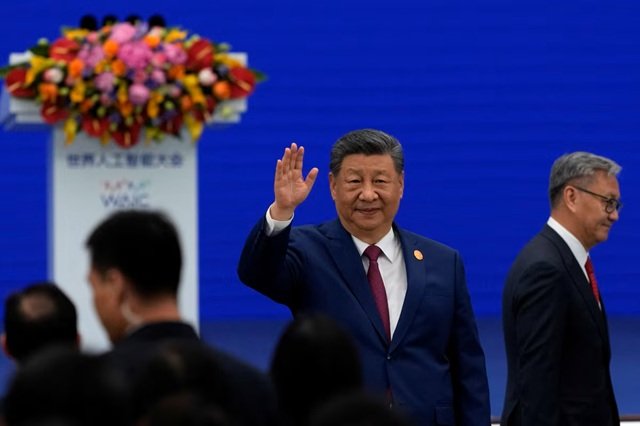
Chinese President Xi Jinping has positioned China as a leading force in shaping the future of artificial intelligence governance, using a major technology conference in Shanghai to promote open-source AI development and challenge the influence of the United States in setting global rules for the fast-growing sector.
Speaking at the opening ceremony of the World Artificial Intelligence Conference (WAIC) on Friday, Xi urged countries to take advantage of what he called a “rare and historic opportunity” presented by open-source AI. He said China would support developing nations in building artificial intelligence capabilities and warned that unequal access to the technology could create “new historical injustices.”
The remarks represented Xi’s most direct statement so far on China’s ambitions to influence international AI governance. Beijing presented open-source AI models as a global resource and promoted its approach as an alternative to the U.S. vision for managing the technology’s development.
Xi compared the importance of artificial intelligence to previous transformative inventions such as the steam engine and electricity. He outlined a strategy in which China would share AI expertise and technology with countries in the Global South while taking part in efforts to establish international standards for the emerging industry.
The Chinese leader’s comments came as competition between Washington and Beijing intensifies over technological influence. Xi promoted China’s AI coalition as a competing model to the U.S.-led “Pax Silica” initiative, which focuses on securing global AI and critical mineral supply chains, although he did not directly mention the United States in his speech.
China’s push for greater influence comes as Chinese open-weight AI models make rapid advances against proprietary systems developed by U.S. companies including OpenAI and Anthropic. Beijing-based startup Moonshot AI on Friday introduced Kimi K3, which it described as the world’s largest open AI model by parameter count. The announcement followed the U.S. government’s decision a month earlier to remove Anthropic’s frontier-class AI models over security concerns.
Xi also addressed concerns about artificial intelligence risks, calling for AI systems to remain under human control. He urged countries to establish early-warning and emergency-response mechanisms to manage potential dangers, including scenarios in which autonomous systems could operate beyond human oversight.
China also highlighted its expanding international AI partnerships. Xi said the China-created World AI Cooperation Organisation (WAICO), which added 29 member countries on Thursday, represented a milestone in global AI development and responded to calls from developing nations for greater involvement in AI decision-making.
Beijing plans to provide AI training and establish cooperation centres with BRICS members, ASEAN countries, Latin American nations and African Union states, according to Xi. The initiatives align China’s AI diplomacy with regions where it has already developed significant economic and political ties.
“Xi’s message is clear: China is not going to follow anyone on both AI technology and standards. Instead, China is going to lead the world in both aspects,” said George Chen, Chair in Digital Practice at consultancy The Asia Group.
The WAIC conference, running from July 17 to July 20, is taking place as China and the United States prepare for their first government-level AI talks under U.S. President Donald Trump’s administration. The event has become a key stage for Beijing to present its approach to international AI competition and governance.
The two countries recently outlined contrasting positions during a United Nations AI dialogue. U.S. officials argued that excessive regulation could slow innovation, while China promoted lower-cost, open-source AI models as a way to reduce global inequality in access to artificial intelligence.
The Shanghai conference includes representatives from major Chinese technology companies as well as international figures including United Nations Secretary-General Antonio Guterres, Kazakhstan’s President Kassym-Jomart Tokayev and Thailand’s Prime Minister Anutin Charnvirakul.