


Editorial
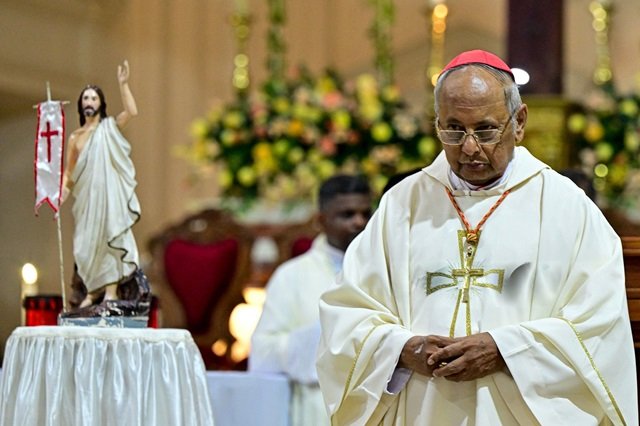
There is a maxim older than the Prevention of Terrorism Act, older than Sri Lanka’s constitution, older even than the Vatican’s claim to stand as conscience-keeper of nations: he who seeks equity must come with clean hands. Cardinal Malcolm Ranjith does not come with clean hands. He comes instead with a memory conveniently foreshortened, a principle quietly inverted, and a moral ledger that now reads differently depending on whose name appears in the docket.
Let the record show two dates, because a verdict requires evidence, not sentiment.
November 2022: the Cardinal declares, in terms neither vague nor accidental, that the PTA is being wielded in an “abusive and unjustified manner” against protesters and human rights defenders. He invokes international human rights standards. He condemns prolonged detention without proper accusation. He asks the world to watch. These are not the words of a man confused about the law. They are the words of a man certain of it.
July 2026: the same Cardinal appears before the Court of Appeal, not as a bystander but as an intervener, urging dismissal of retired Major General Suresh Sallay’s writ against his own detention under that identical statute. The law he once called an instrument of abuse has become, in this telling, an instrument of justice. Nothing about the PTA has changed. Only the name on the file has.
In any court worth the name, this would be called estoppel: the rule that bars a party from asserting one position when convenient and its opposite when convenient again, simply because the cast of characters has changed. There is no canon-law exemption for cardinals. There is no theological carve-out permitting moral positions to expire the moment they become inconvenient. If a law was oppressive in 2022, it does not acquire virtue in 2026 merely because the detainee now wears a different uniform.
To be exact about what is, and is not, on trial here: the guilt or innocence of Major General Sallay is not before this column, and should not be decided by press or pulpit. Nor is the urgency of accountability for the Easter Sunday massacre remotely in question — the murder of worshippers and civilians in April 2019 remains a wound the nation has not been permitted to close, and no one disputes the state’s duty to pursue every avenue to the truth. That is not the charge. The charge is narrower, and graver: that a moral authority has applied one standard to the detained he sympathized with and another to the detained he does not, and has done so under cover of a law he himself once put in the dock.
George Orwell gave this condition a name — doublethink — the capacity to hold two contradictory beliefs simultaneously and insist that both be accepted without so much as a blush. Sinhala gave it a name centuries earlier: කබරගොයා තලගොයා කිරීම, turning a kabaragoya into a talagoya — the art of reshaping a fact until it resembles whatever the moment requires. Whichever language one prefers, the offense is identical, and it is not a small one. It is the quiet, incremental corrosion of the idea that principles mean anything at all.
A cardinal is not a private citizen entitled to the ordinary human privilege of changing his mind without consequence. When he speaks on matters of justice and state power, he speaks as a moral tribunal in his own right — one that claims jurisdiction over the conscience of a nation precisely because it claims to answer to a law higher than convenience. A judge who rules one way for the defendant he favours and the opposite way for the defendant he does not is not a judge. He is a partisan who has borrowed the robes of impartiality. The same indictment applies with equal force to a cleric who borrows the language of universal rights only until universality becomes inconvenient.
The Gospel the Cardinal is sworn to preach offers no escape clause for this conduct. “Let what you say be simply ‘Yes’ or ‘No’; anything more than this comes from evil” (Matthew 5:37) does not read “Yes, unless the accused is unpopular.” “You shall know the truth, and the truth shall make you free” (John 8:32) does not read “the truth, selectively applied.” These are not decorative verses. If the Cardinal takes his own office seriously, they are binding precedent.
None of this diminishes the moral weight of Easter Sunday, nor should it be read as sympathy for any individual accused of complicity in that atrocity. It is, instead, a warning about method: justice extracted through a law recognised as oppressive when applied to others does not become clean justice merely because the target has changed. A conviction built on a discredited process is not a conviction that will hold — not in a court of law, and certainly not in the court of public conscience the Cardinal claims to preside over.
The Cardinal is entitled — obligated, even — to demand accountability for the Easter Sunday dead. No one asks him to abandon that demand. What is asked, what justice itself demands, is that he pursue it without abandoning the very principle he once staked his authority upon. He cannot, with any credibility, be both the PTA’s chief accuser and its chief defender, depending only on who stands accused.
Cardinal Ranjith remains in office beyond the customary age of retirement, his resignation still pending before the Pope. A tribunal awaiting its own verdict on jurisdiction might reflect on the irony of presiding over one for others while its own standing remains unresolved. Moral authority, unlike political power, cannot be inherited, decreed, or extended by delay. It is earned only by consistency — and consistency, on this record, is precisely what has gone missing.









