


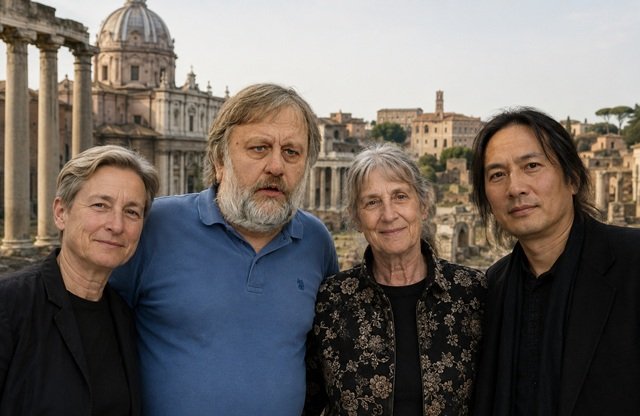
From Judith Butler’s standing-room-only appearance in Madrid to the enduring influence of figures such as Slavoj Žižek, Byung-Chul Han, Thomas Piketty and Yuval Noah Harari, a growing group of contemporary thinkers has transcended academic circles to attract devoted public followings. Drawing on reporting by El País and insights from philosophers, editors and literary curators, this phenomenon reveals how complex ideas are increasingly communicated, marketed and embraced in an era defined by uncertainty, rapid media circulation and a public search for meaning.
The world of contemporary philosophy has long been associated with specialist seminars, academic conferences, scholarly journals and essays read primarily by experts. Yet a select group of thinkers has crossed those traditional boundaries, reaching audiences far beyond universities and transforming themselves into cultural figures capable of inspiring extraordinary public enthusiasm. As reported by El País, this shift was vividly illustrated on 26 September 2025, when Judith Butler, one of the defining figures of contemporary thought and a foundational voice in queer theory, appeared at Madrid’s Museo Reina Sofía in conversation with journalist Joseba Elola to mark the tenth anniversary of the newspaper’s Ideas supplement.
The response to Butler’s appearance resembled the reception typically reserved for celebrated performers rather than philosophers. Large queues formed well before the event, many attendees were unable to gain entry, and those inside listened in attentive silence punctuated by repeated applause and even fan-like cheers. At the conclusion of the discussion, the entire audience rose to its feet. El País summarised Butler’s intervention with the headline: “Estamos viviendo una restauración del patriarcado y el racismo.” The occasion demonstrated how certain intellectuals now command a level of public engagement rarely associated with academic discourse.
Butler belongs to a diverse group of contemporary authors whose influence extends well beyond scholarly communities. Alongside her are figures including Slavoj Žižek, Byung-Chul Han, Thomas Piketty and Yuval Noah Harari, while the late Mark Fisher has experienced remarkable posthumous success. Although their intellectual interests, writing styles and philosophical traditions differ considerably, they share an unusual capacity to connect with broad audiences and cultivate loyal followers. The question posed by El País is therefore not simply why these thinkers have readers, but why they have fans.
Their popularity cannot be explained solely by originality or intellectual depth. The ability to produce concepts that resonate during periods of uncertainty, communicate beyond academic language and remain visible within broader cultural life also plays a significant role. Stefano Micali, in his recent essay Cómo tener éxito en filosofía. Estilos y estrategias para convertirse en un pensador influyente, argues that philosophers increasingly operate like small enterprises competing within what he describes as the marketplace of ideas. His assessment suggests that visibility has become almost as important as scholarship itself in determining a thinker’s public influence.
Micali identifies three principal paths through which influential thinkers achieve prominence. One is represented by philosophers such as Byung-Chul Han and Giorgio Agamben, whom he characterises as prophets of a forgotten dystopia. According to this model, these thinkers present themselves as those who have recognised that society has already entered an unacknowledged catastrophic dystopia, with conditions steadily deteriorating.
A second route is embodied by Slavoj Žižek through spectacular public performance. This approach involves prolific production across a wide range of subjects, an improvisational style likened to jazz, the blending of high and popular culture, the combination of multiple intellectual traditions and an ever-present engagement with current affairs. Žižek’s well-known jokes and distinctive public persona form part of this broader performance, making his appearances as recognisable as his philosophical arguments.
The third model, according to Micali, is becoming a brand, a category in which he places Judith Butler. In this framework, an individual’s name becomes inseparable from a major social issue. Micali compares Butler’s association with gender questions to Nike’s association with athletic footwear. The “thinker-brand”, he writes, necessarily addresses pressing contemporary issues such as ecology or gender identity while creating the impression of fundamentally reshaping the terms of public debate. These approaches, however, are not mutually exclusive, and many prominent intellectuals combine elements of more than one strategy.
For Giselle Etcheverry, a curator specialising in literary and philosophical projects, these authors succeed because they produce broad narratives that resonate across different layers of society while maintaining a steady flow of concise and accessible publications capable of capturing what she describes as the spirit of the times. She points to the constant stream of short essays produced by Han and Žižek’s ability to publish books analysing current events almost before they unfold.
Etcheverry also highlights the important role played by publishers in shaping intellectual reputations across different countries. Byung-Chul Han, she observes, receives a level of attention in Spain that differs from other regions, while figures such as Slovenian sociologist and philosopher Renata Salecl and Belgian philosopher of science Vinciane Despret enjoy considerable recognition throughout Latin America. Such differences, she argues, reflect the work of publishing houses as much as the authors themselves. Social media has further expanded their reach, with short videos, widely shared quotations and internet memes helping circulate concise concepts that can spread rapidly among audiences unfamiliar with their longer works.
Javier Correa Román, editor at the philosophy magazine Filosofía&Co and founder of the political essay bookshop malaletra, believes these thinkers succeed because they offer readers practical conceptual tools for understanding the present. By moving beyond specialised academic language, they provide diagnoses that readers can recognise in everyday life, enabling them to interpret contemporary events in ways that feel both insightful and personally relevant.
He notes that popular culture has become an especially effective field for philosophical interpretation. Rather than treating mass entertainment as intellectually empty, contemporary thinkers examine the underlying forces shaping cultural phenomena. Correa Román suggests that even a programme such as La isla de las tentaciones can be analysed to reveal deeper social questions. Mark Fisher, whose concept of capitalist realism has become one of the most frequently cited ideas in contemporary critical thought, similarly grounded much of his work in analysing popular culture, contributing significantly to his lasting influence.
Micali also describes several rhetorical techniques frequently employed by influential thinkers. Among them is inversion, reversing dominant assumptions surrounding a particular issue. Others include claiming to be the first to grasp the true essence of a subject or criticising fellow intellectuals from an unmistakably superior position. “El tono debe ser perentorio”, Micali writes, arguing that successful public intellectuals often present assertions not as arguments requiring proof but as self-evident facts. Combined with distinctive personal characteristics—Žižek’s hurried speech and restless gestures, Han’s enigmatic image and fascination with his garden and pianos, or Butler’s non-binary identity—these traits make such figures immediately recognisable within an increasingly crowded intellectual landscape.
Beyond these internationally recognised names exists a broader constellation of respected scholars whose influence remains concentrated within more specialised fields. Etcheverry points to Donna Haraway’s work on cyborg thought, Wendy Brown’s critique of neoliberalism and Rosi Braidotti’s contributions to posthumanism as examples of intellectuals whose authority remains profound within particular disciplines. She also references the notion of “collective intellects” presented by McKenzie Wark in compilations of twenty-first-century thinkers published in Spain by La Caja Books, emphasising forms of knowledge that emerge through cooperation rather than individual celebrity.
Despite their commercial success, international tours, awards and strong book sales, these high-profile thinkers frequently encounter scepticism within academia. Their critics sometimes argue that public recognition exceeds their scholarly contribution or question aspects of their academic practice. Correa Román considers such criticism unfair, suggesting that highly visible intellectuals face a level of scrutiny that many of their peers would struggle to withstand. As El País concludes, in an age characterised by an overabundance of ideas, opinions and experts, these authors continue to offer narratives that help readers understand the world and their place within it, transforming philosophy into a form of public engagement capable of inspiring admiration that extends well beyond the classroom.











Han is worth reading for his reflection on being human in a technologically-saturated society. He has, however, no deep answers to the problems he raises. I reviewed his book, The Crisis of Narration, at The Christian Post.