The history of the Sri Lanka Navy, which completed 75 years in 2025, is both eventful and fascinating. The Navy Act was passed by our first Parliament on 9 December 1950. This day is regarded as our Navy Day and is celebrated every year.
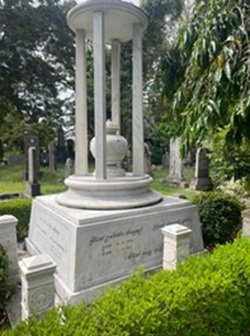
Presenting the Navy Act to our first Parliament, Sir Ukwatte Jayasundara, KCMG, KBE, QC—the first General Secretary of the United National Party (UNP), a prominent criminal lawyer, and Chairman of the Senate—famously said, “As an independent country, we have an Army and an Air Force. Now we should have a Navy too!”
The legendary naval historian, the late Instructor Lieutenant Commander Somasiri Devendra, wrote a book on the genesis of our Navy in 2015, which was launched on the 65th Navy Day—ten years ago, on 9 December 2015. Fortunately, I was the Commander of the Navy at the time, and this book is a must-read for all our trainees at the Naval and Maritime Academy, Trincomalee. The book, titled We Must Have a Navy, is available as a free e-book on the Ministry of Defence (MoD) website. As Instructor Lieutenant Commander Devendra told me before his passing, “Ravi! The younger generation is keen on reading e-books on their computers and iPhones! So, make my book available online free!” How true those words were. Thank you, dear Sir!
The events and chronological history of the Royal Ceylon Navy from 1950 onwards are well documented, thanks to naval officers such as Admiral Rajan Kadiragamar, Commander E. P. Wickramasinghe, Admiral Clancy Fernando, Instructor Lieutenant Commander Devendra, Admiral Mohan Samarasekara, Admiral Thissera, Admiral of the Fleet Wasantha Karannagoda, Admiral Thissara Samarasinghe, and Rear Admiral Shermal Fernando, who all took a keen interest in recording our history.
However, the contributions and duties performed by the volunteer officers and sailors of our Navy during the Second World War were not well documented. My effort here is to tell some of the fascinating stories of the Ceylon Royal Naval Volunteer Reserve (CRNVR), fondly known as the “Okapi Navy”.
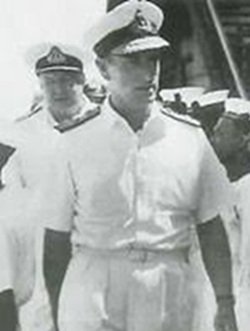
The Ceylon Royal Naval Volunteer Reserve (CRNVR) served as the naval volunteer reserve of the Crown Colony of Ceylon from 1938 to 1950. It was established as the Ceylon Naval Volunteer Force (CNVF) on 1 January 1938, prior to the outbreak of the Second World War. It consisted of volunteers from Colombo’s mercantile sector, comprising 12 officers and 18 sailors, under the command of the newly commissioned Commander W. G. Beauchamp. Its headquarters was established at Kochchikade, Colombo, on 14 June 1939, just before the outbreak of the war. In April 1939, the Governor of Ceylon, Sir Andrew Caldecott (1937–1944), requested the British Admiralty to include these officers on the Royal Navy List, and the request was approved.
CNVF personnel were mobilised for active service on 31 August 1939, at the outbreak of the Second World War, and these weekend sailors were trained as full-time sailors under the command of Royal Navy officers for minesweeping and anti-submarine warfare. The Board of Ministers of the State Council approved their pay and allowances. The CNVF formed a flotilla for the defence of Colombo Harbour. Its personnel also manned the Colombo Port Signal Station, the Port War Signal Station (PWSS), Chapel Hill in Trincomalee, and the headquarters of Vice Admiral Lord Mountbatten in Kandy.
Among the motor vessels and Arctic trawlers converted for minesweeping duties was HMS Overdale Wyke (FY 338), a steam turbine trawler, better known as “OW”. She assisted HMS Hector in extinguishing fires after the ship was struck by Japanese dive bombers during the Easter Sunday air raid on 5 April 1942. Later, on 14 September 1942, Overdale Wyke participated in the surrender of the Italian naval vessel Eritrea off Colombo Harbour.
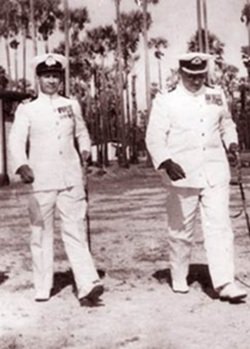
Even more than HMS Overdale Wyke, the older generation of naval sailors remember three Antarctic whaling trawlers that were converted into minesweepers and deployed off Colombo Harbour. They were Her Majesty’s Trawlers (HMT) Okapi, Semla, and Sambhur. These trawlers and their crews worked tirelessly throughout the Second World War to ensure that the approaches to Colombo Harbour and its shipping channels remained free of naval mines.
So, when we joined the Sri Lanka Navy more than 45 years ago, in 1980, we often met elderly sailors proudly declaring that they were from the “Okapi Navy”.
As mischievous cadets, we used to jokingly reply that they were from the “(Hu)kapi Navy”!
The officers and sailors of the Okapi Navy are the genesis of our present-day Navy.
Almost all of them have now passed away.
May they rest in peace.