


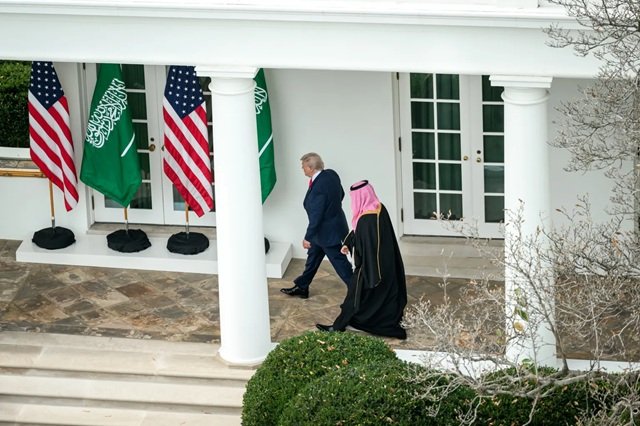
The excitement over the US-Saudi nuclear deal has proved to be short-lived. Apparently, the US President Donald Trump himself poured cold water into it by adding a caveat within 24 hours on Thursday that in order for the deal to be advanced, Saudi Arabia must first join the Abraham Accords. That is, as things stand, the US may seem like asking for the moon.
However, it’s all but certain that Trump allowed the Saudi deal to be signed only after consulting Israeli Prime Minister Benjamin Netanyahu as a last throw of dice to pin down Saudi Arabia as a participant / collaborator alongside Israel (and the UAE) for the upcoming all-out war against Iran that might at some point entail ground operations, which is not possible without first getting Riyadh on his side firmly, irrevocably.
If Saudi Arabia dissociates from Tump’s upcoming war and disallows the US to use the Saudi bases or work out the logistics accordingly, Pentagon generals will be hard-pressed to conduct the war. In political terms too, Saudi stance will influence other regional oligarchies in the Persian Gulf in their own attitudes towards Iran, which is striding like a colossus on the Arab street. The timing of the July 15 meeting of Trump with the visiting pro-American prime minister of Iraq Ali al-Zaidi also needs to be factored in here. Simply put, Iraq has become a frontline in the US-Iran conflict.
Saudis are fuming at the prospect of Iran emerging as a towering regional power. On its part, Iran is also closely watching the Saudi mood swings stemming out of its compulsions not to annoy Trump who is in a position to to play a helpful role in the event of the succession issue coming to the fore in Riyadh at any time. Of course, this is apart from the profound petrodollar linkages critical to both protagonists.
Meanwhile, the recent Pakistani advisory to Tehran to steer clear of targeting Saudi Arabia, the Houthi threat to Saudi Arabia and the potential closure of Strait of Bab el-Mandeb — all these are tell-tale signs of latent tensions between Tehran and Riyadh, although both sides are maintaining a semblance of normalcy.
Most certainly, Trump’s remark on Thursday making the nuclear deal conditional on the Saudis normalising relations with Israel has thrown the deal as such into question. Is it a Trumpian U-turn or is the episode just another confusing rollout that has become the trademark of Trump’s presidency? The truth could be somewhere in between.
According to an AP report, the White House press secretary Karoline Leavitt told reporters in a briefing yesterday that Trump has said if the Saudis don’t join the Abraham Accords, “the deal is off.” When asked why the condition wasn’t mentioned Wednesday when the Energy Department announced that the deal was signed, Leavitt said it was because Trump “is always the final dealmaker.”
My own reading is that Trump is backtracking according to a script. He could have taken credit for the condition on Abrahams Accords, had it been a part of the deal. But it is within his ingenuity to try to increase his leverage with the Saudis by adding the caveat openly: that might even improve the deal in certain respects such as enrichment or verification clauses, for instance.
The Saudis appear to have been taken by surprise on Wednesday when US Energy Secretary Chris Wright signed the decades-long, multibillion-dollar deal with his Saudi counterpart, Prince Abdulaziz bin Salman, Saudi Arabia’s Minister of Energy but that doesn’t have to be taken at face value. The deal reportedly includes a “123 Agreement” and an accompanying “bilateral safeguards agreement,” and the two agreed to a two-year study to see whether enrichment is necessary. This seems like kicking the can down the road. Interestingly, Netanyahu’s office said Saudis joining of the Abraham Accords “would be an historic leap forward for peace in the Middle East.”
On the whole, Trump has a deal here with both Riyadh and Tel Aviv. The caveat of Abraham Accords implicit in the deal may serve to delay the agreement from coming to fruition unless and until their Saudi jettison their bottomline linking normalisation with Israel. On the other hand, Trump has the leverage insofar as the Saudis now have to address whether they want to normalise relations with Israel, depending of course on the trajectory /outcome of the war with Iran that lies ahead.
Indeed, the Saudis too are getting an optimal deal here, which doesn’t expressly block reprocessing and enrichment and doesn’t allow for the International Atomic Energy Agency to do its inspections. The Saudis have apparently got away with not having the customary additional protocol, which would have ensured there is no cheating and the deal will stay on track as a peaceful programme. On Truth Social, Trump maintained on Thursday that “there will be no enrichment of material,” but added that the US is “not opposed to Civil (Non-Enriched) Nuclear Facilities.” Conceivably, the US may have control of a Saudi enrichment facility and also keep a military / security presence.
The Congress will be able to review the deal in a 90-day window. Lawmakers do not need to approve it, but they could oppose it, although that is unlikely. (See a Congressional Research Report Prospects for U.S.-Saudi Nuclear Energy Cooperation, March 11, 2026) All in all, the chances are of the agreement “staying in place and nothing substantive happening until Saudis agree to something” regarding Israel, to quote Bryan Clark, a senior fellow at the Hudson Institute, an influential pro-Trump DC-based think tank.
The most bizarre coincidence of the entire sequence of developments since Wednesday is the shadow this deal could potentially cast on the US-Iran agreement that is on the horizon. But that is only hypothetical, right? If Trump intends to launch an all-out war with Iran, there will be no more negotiations to be had on a nuclear deal with Tehran pending the outcome of the war.
Saudis, being stakeholders, may no longer resist Trump’s entreaties to collaborate with the war effort going forward, whose objective would be to destroy Iran comprehensively with all the military might at Washington’s command. The Saudi Crown Prince Mohammed bin Salman has said in the past that if Iran obtained a nuclear weapon, the kingdom would have to follow suit.
In such a scenario of complex interplay of moving parts, Netanyahu has decided that there will be no conceivable reason for Israel at the present juncture to try to kill the US-Saudi deal that is struggling to be born.











