


A significant ruling by the Civil Appellate High Court of the Western Province, sitting in Colombo, has established an important judicial precedent in Sri Lanka’s property sector by ordering a developer to hand over interim possession of a condominium unit to an elderly purchaser before the conclusion of the main trial. The consolidated judgment, delivered on 17 July 2026, addresses the increasingly contentious issue of developers seeking additional payments from purchasers after construction delays and rising project costs, while reaffirming the equitable powers of the courts to protect buyers from irreparable harm.
The decision arose from two consolidated appeals, COL/HCCA/FA/00026/2026 and COL/HCCA/FA/00028/2026, heard before H.S. Ponnamperuma, Judge of the High Court (Civil Appeal), and Chinthaka Srinath Gunasekera, Judge of the High Court (Civil Appeal). The court dismissed the developer’s challenge to an existing interim injunction preventing the disposal of the disputed property and simultaneously allowed the purchaser’s appeal seeking a mandatory interim injunction that granted her immediate possession of the apartment pending the final determination of the action. The petitioner was represented by Mr. M.U.M. Ali Sabry, President’s Counsel, instructed by Ramzi Bacha Associates.
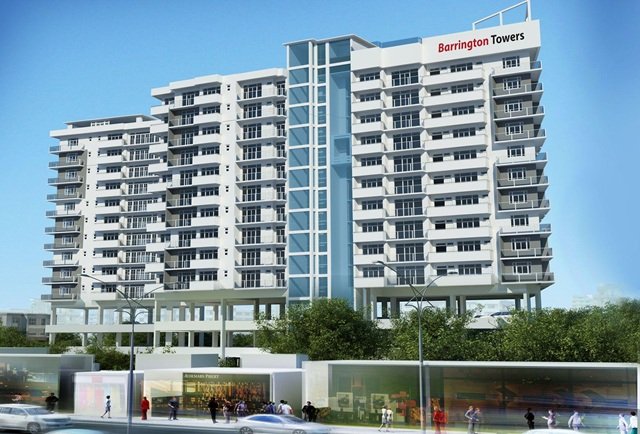
The dispute centres on a Sale and Purchase Agreement dated 15 September 2016 between Fathima Ferdouse Bakir and Barrington Global (Pvt) Ltd concerning a condominium unit in the “Barrington Tower One” development. Under the agreement, the developer undertook to hand over possession by 30 November 2018, with a six-month grace period after which compensation of Rs. 20,000 per month would become payable for delays, subject to force majeure provisions.
According to the court record, the purchaser fulfilled the first four instalments under the agreement, paying Rs. 16,957,500, representing approximately 80 per cent of the agreed purchase price of Rs. 19,950,000. The remaining balance of Rs. 2,992,500 was intended to be settled upon completion and handover of the apartment.
The project, however, was not completed within the contractual period ending 30 May 2019. The developer subsequently demanded additional payments through letter “P14”, citing cost escalations arising from the 2022 economic crisis and taxes introduced in 2024, while warning that the agreement could be unilaterally terminated if the purchaser declined to comply.
The purchaser rejected the demand, maintaining that she had fulfilled her contractual obligations well before the events relied upon by the developer occurred and that she therefore fell outside the category of buyers who might be affected by later construction cost adjustments. She commenced proceedings before the District Court of Colombo seeking both a prohibitory interim injunction preventing the apartment from being transferred or otherwise encumbered, and a mandatory interim injunction requiring the developer to place her in possession upon depositing the outstanding contractual balance with court.
Following an inquiry, the District Court granted the prohibitory injunction restraining the developer from alienating the property but did not rule in favour of the application for mandatory interim possession. Both parties appealed different aspects of that decision, resulting in the consolidated proceedings before the High Court.
In considering the appeal against the prohibitory injunction, the High Court examined the established principles governing interim equitable relief. The judgment reaffirmed that courts must first determine whether a plaintiff has established a strong prima facie case and then assess where the balance of convenience lies, drawing upon longstanding authorities including Felix Dias Bandaranaike v. The State Film Corporation and Another (1981) 2 S.L.R. 287, Jinadasa v. Weerasinghe (31 N.L.R. 33), Mohinudeen v. Bank of Ceylon (2001) 3 S.L.R. 25, Preston v. Luck and Hubbard v. Vosper.
The judges found it undisputed that the purchaser had complied with her obligations under the agreement until the developer demanded additional payments. They further noted that the developer admitted construction had not been completed within the agreed timeframe. The court observed that proceedings before the Magistrate’s Court of Mount Lavinia indicated construction had been temporarily halted because the developer failed to comply with environmental pollution standards imposed by the Central Environmental Authority and the relevant local authority.
Importantly, the court concluded that neither the 2022 economic crisis nor the tax measures introduced in 2024 occurred during the original contractual period for completion. It further found that the developer had failed to establish that the delay resulted from any event falling within Clause 29 of the agreement governing force majeure. Having already paid the substantial majority of the purchase price while being deprived of the use of the property, the balance of convenience was found to rest firmly with the purchaser.
The High Court therefore dismissed Appeal No. COL/HCCA/FA/00026/2026, affirming the District Court’s prohibitory injunction and ordering the developer to pay costs fixed at Rs. 100,000.
The more significant aspect of the judgment concerned the purchaser’s appeal seeking a mandatory interim injunction. The court undertook an extensive review of Sri Lankan and English jurisprudence governing mandatory injunctions, tracing the evolution of the remedy from its historically restrictive application to its modern role in compelling positive acts where justice demands immediate intervention.
The judgment considered authorities including Thamodaram Pillai v. Arumugam, Muthaliff v. Mansoor, Isenberg v. East India House Estate Co. Ltd, Gnanamuttu v. Chairman U.C. Bandarawela, Kathri Thanthri Hewage Jayatissa Peiris v. Happuarachchige Nanda Kumuduni Perera, Halsbury’s Laws of England, Spry on Principles of Equitable Remedies and Justice J.F.A. Soza’s authoritative work, The Interim Injunction in Sri Lanka. The court also referred to Vijay Srivastava v. Mirahul Enterprises, observing that disputes over liability for escalated prices could ultimately be resolved during the full trial without denying interim protection where circumstances warranted.
Applying those principles, the judges concluded that the purchaser’s circumstances justified exceptional relief. They noted that she was in her eighties, had already paid 80 per cent of the agreed purchase price before the contractual deadline, and was willing to deposit the outstanding contractual balance of Rs. 2,992,500. While the prohibitory injunction prevented the apartment from being transferred to another party, the court recognised that the unit would otherwise remain vacant throughout the litigation while the purchaser risked permanently losing the opportunity to enjoy the property during her lifetime.
Describing the dispute as “a fit and proper case” for the exercise of the court’s equitable jurisdiction, the High Court allowed Appeal No. COL/HCCA/FA/00028/2026 and directed the District Court of Colombo to issue a mandatory interim injunction compelling Barrington Global (Pvt) Ltd and the other defendants to place the purchaser in interim possession of the apartment upon her depositing the contractual balance with court. The appeal was allowed without costs.
The consolidated judgment represents a notable development in Sri Lankan property law because mandatory interim injunctions that alter the status quo by granting physical possession before trial have traditionally been granted only in exceptional circumstances. By carefully applying established equitable principles while weighing the purchaser’s substantial contractual performance, the developer’s admitted delay, and the risk of irreparable prejudice, the Civil Appellate High Court has reaffirmed that interim relief remains available where it is necessary to ensure that the final outcome of litigation is not rendered ineffective. The ruling is likely to be closely examined in future disputes involving delayed construction projects, contractual cost escalations and the equitable protection of purchasers who have substantially performed their contractual obligations while awaiting the completion of residential developments.









