The Paradox of Intelligent Automation
Artificial intelligence (AI) has become the defining technological phenomenon of the twenty-first century. Governments extol its capacity to stimulate economic growth; industries regard it as the indispensable engine of operational efficiency; and academic discourse increasingly portrays it as an inexorable force capable of redefining the relationship between humans and work. Yet, beneath this optimistic narrative lies an irony of considerable significance. While AI is universally promoted as a mechanism that liberates human beings from repetitive labor and enhances productivity, emerging empirical evidence suggests that the technology often produces precisely the opposite result. Rather than diminishing work, AI intensifies it. Rather than simplifying professional responsibilities, it multiplies them. Rather than reducing cognitive burdens, it frequently transfers those burdens into more complex forms of supervision, verification, validation, and accountability.
Although this article focuses on aviation, particularly air traffic management, air navigation services, and airport operations, the observations advanced herein possess a far broader relevance. They apply with equal force to healthcare, law, finance, education, public administration, manufacturing, and every other domain in which AI increasingly functions as an indispensable decision-support system. Aviation merely provides the most illuminating example because it is an industry in which efficiency can never be pursued independently of safety, and where every technological innovation must ultimately satisfy the uncompromising demands of human judgment and operational resilience.
The prevailing assumption that automation necessarily improves productivity is not a novel proposition. During the latter decades of the twentieth century economists grappled with what became known as the “productivity paradox.” Despite unprecedented investments in information technology, measurable improvements in organizational productivity often failed to materialize. Nobel laureate Robert Solow famously encapsulated this anomaly in his observation that “you can see the computer age everywhere but in the productivity statistics.” The paradox lay not in the failure of computers to perform tasks more rapidly, but in the mistaken assumption that technological capability alone would transform organizational performance. Productivity depended not merely upon technological innovation, but upon corresponding transformations in institutional design, organizational culture, and managerial philosophy.
The Productivity Paradox
Artificial intelligence presents an analogous paradox, albeit in a more sophisticated guise. Its capacity to generate text, analyze data, predict outcomes, optimize schedules, identify anomalies, and simulate complex operational environments has encouraged organizations to expect unprecedented gains in efficiency. Yet these capabilities simultaneously generate new categories of work that were previously unnecessary. Human operators must evaluate AI-generated recommendations, distinguish reliable outputs from hallucinations, reconcile conflicting analyses, ensure regulatory compliance, and remain accountable for decisions whose intellectual origins increasingly reside within opaque computational architectures. Consequently, AI rarely replaces professional responsibility; it redistributes and often amplifies it.
This phenomenon is compellingly articulated by Aruna Ranganathan and Xingqi Maggie Ye in their important article, “AI Doesn’t Reduce Work—It Intensifies It,” published in the Harvard Business Review on 9 February 2026. Examining organizational behavior across multiple industries, the authors challenge the conventional wisdom that AI automatically reduces human labour. Instead, they conclude that increased efficiency frequently becomes the justification for assigning additional work rather than reducing existing workloads. As technological tools enable employees to complete routine functions more rapidly, organizations respond by elevating performance expectations, expanding responsibilities, and accelerating operational tempo. AI therefore becomes not an instrument of liberation but a catalyst for work intensification.
Ranganathan and Ye observe that the initial productivity gains associated with AI frequently prove deceptive. Employees indeed complete tasks more rapidly, but the resulting surplus of available time is seldom preserved for reflection, strategic thinking, innovation, or professional development. Rather, it is immediately absorbed by additional assignments, increased communication demands, expanded reporting obligations, and heightened managerial expectations. Productivity improvements therefore become self-consuming. Every gain in efficiency becomes the foundation for even greater demands upon the individual worker.
Aviation
This insight assumes particular significance in aviation. Aviation has historically regarded technological innovation as a principal means of enhancing safety and efficiency simultaneously. Fly-by-wire aircraft, satellite navigation, digital communication systems, performance-based navigation, collaborative decision-making platforms, and increasingly sophisticated surveillance technologies have collectively transformed the operational landscape. More recently, AI has emerged as the next evolutionary step in this progression, promising predictive maintenance, optimized air traffic sequencing, intelligent airport management, autonomous inspection systems, adaptive weather forecasting, and increasingly sophisticated operational decision support.
The attraction is obvious. Aviation remains one of the world’s most complex socio-technical systems, requiring the continuous coordination of airlines, airports, air navigation service providers, meteorological agencies, security authorities, regulators, manufacturers, and countless ancillary organizations. Every improvement in operational efficiency has measurable economic consequences. Delays cost billions of dollars annually; inefficient airspace management increases fuel consumption and environmental emissions; poorly coordinated airport operations diminish passenger satisfaction and constrain capacity. AI therefore appears to offer precisely the analytical capabilities required to reconcile growing traffic demand with finite operational resources.
Yet the paradox identified by Ranganathan and Ye suggests that such expectations require careful scrutiny. The introduction of AI into aviation seldom eliminates professional work. Instead, it transforms the nature of that work. Air traffic controllers may receive AI-generated conflict predictions, but they must continuously evaluate whether those predictions accurately reflect dynamic operational realities. Airport operations managers may receive sophisticated forecasts concerning passenger flow, gate allocation, and turnaround performance, but they remain responsible for determining whether unforeseen circumstances justify departing from algorithmic recommendations. Engineers may employ predictive maintenance systems capable of identifying incipient equipment failures, yet they continue to bear legal and professional responsibility for determining whether maintenance interventions are warranted. In every instance, AI creates an additional layer of intellectual supervision rather than eliminating human accountability.
The paradox therefore assumes both operational and legal dimensions. Efficiency may increase while responsibility remains unchanged—or indeed becomes greater. The professional is no longer required merely to perform a task. He or she must also evaluate the reasoning of the machine performing that task. This supervisory obligation constitutes genuine work, although it frequently escapes traditional productivity metrics. Organizations may celebrate reductions in processing time while overlooking the increased cognitive demands imposed upon those responsible for validating algorithmic outputs.
This observation resonates profoundly with the foundational philosophy of aviation safety. Modern aviation has never relied upon technology alone. Its remarkable safety record has been achieved through the continuous interaction between sophisticated technological systems and disciplined human judgment. Checklists, Crew Resource Management (CRM), Threat and Error Management (TEM), Safety Management Systems (SMS), Just Culture, and independent regulatory oversight all embody the same principle: technology assists, but human judgment remains decisive. AI does not alter this principle. On the contrary, it renders it even more indispensable.
Indeed, one may argue that AI introduces a new category of operational complexity. Historically, aviation professionals managed uncertainty arising from weather, mechanical reliability, human performance, and environmental conditions. AI introduces epistemic uncertainty—the uncertainty associated with determining whether an apparently authoritative recommendation is genuinely correct. This uncertainty cannot be resolved merely through computational sophistication. It requires critical reasoning, professional skepticism, contextual awareness, and the willingness to challenge technological outputs when operational circumstances so require.
Legal Issues
The legal implications are equally profound. International civil aviation law has consistently attributed responsibility to identifiable human actors. Whether under the Chicago Convention of 1944, national aviation legislation, or established principles of negligence and professional accountability, legal responsibility ultimately rests with persons and institutions capable of exercising judgment. AI neither possesses legal personality nor bears moral responsibility. Consequently, every algorithmic recommendation accepted by an aviation professional remains, in law as well as in ethics, a human decision. As AI becomes increasingly integrated into operational environments, the paradox becomes unmistakable: technological autonomy expands while legal accountability remains resolutely human.
This emerging reality requires a fundamental reconsideration of what constitutes productivity. Conventional metrics emphasize speed, volume, and efficiency. Yet aviation has always recognized that these objectives are subordinate to a more fundamental value: safety. Productivity cannot be measured solely by the number of aircraft accommodated within a given airspace, the rapidity of baggage handling, or the efficiency of runway utilization. Genuine productivity must encompass resilience, reliability, sound judgment, and the capacity to anticipate and mitigate unforeseen risks. AI undoubtedly contributes to these objectives, but only when it strengthens rather than supplants human cognition.
It is therefore submitted that the aviation industry stands at a pivotal moment in its technological evolution. The question is no longer whether AI should be incorporated into aviation systems—that transition is already well underway. The more profound question is whether aviation governance can preserve the primacy of human judgment while simultaneously embracing computational intelligence. The answer to that question will determine not merely the operational efficiency of future aviation, but the integrity of the safety culture upon which international civil aviation has been painstakingly constructed over the past century.
Intelligent Automation and the Transformation of Aviation Work
The aviation industry has historically been a theatre in which technological advancement and human expertise have existed in a delicate and dynamic relationship. From the earliest days of flight, aviation has embraced innovation not as an alternative to human capability but as an extension of it. The aircraft cockpit, the control tower, the airport terminal, and the airspace management system have all evolved through successive waves of automation. Each technological transformation promised greater efficiency, increased capacity, and reduced human workload. Yet, as experience has repeatedly demonstrated, automation rarely eliminates human involvement. Rather, it transforms the character of human involvement.
Artificial intelligence represents the most profound stage of this evolution because it does not merely automate physical or mechanical processes; it increasingly participates in cognitive processes traditionally associated with professional expertise. Unlike earlier generations of automation, which generally performed predetermined functions according to programmed instructions, AI systems can analyze patterns, generate recommendations, identify anomalies, and produce solutions in environments characterized by complexity and uncertainty. This capability creates unprecedented opportunities for aviation. It also introduces unprecedented challenges.
The central issue is that aviation professionals are not simply operators of technology; they are custodians of safety. The air traffic controller, the flight dispatcher, the airport operations manager, and the aviation safety officer do not merely execute instructions. They interpret circumstances, assess risks, reconcile competing objectives, and exercise judgment under conditions where incomplete information is often unavoidable. The introduction of AI therefore does not eliminate the human role. It changes the human role from direct execution to intelligent supervision.
This distinction is crucial. A reduction in physical workload does not necessarily translate into a reduction in cognitive workload. Indeed, the opposite may occur. When machines undertake routine functions, humans are frequently required to perform more complex supervisory tasks. They must monitor the machine, understand its limitations, detect errors, challenge inappropriate recommendations, and intervene when circumstances exceed the parameters within which the system operates. The human becomes the final guardian of reliability.
This phenomenon is particularly evident in air traffic management (ATM).
Artificial Intelligence and Air Traffic Control: From Control to Oversight
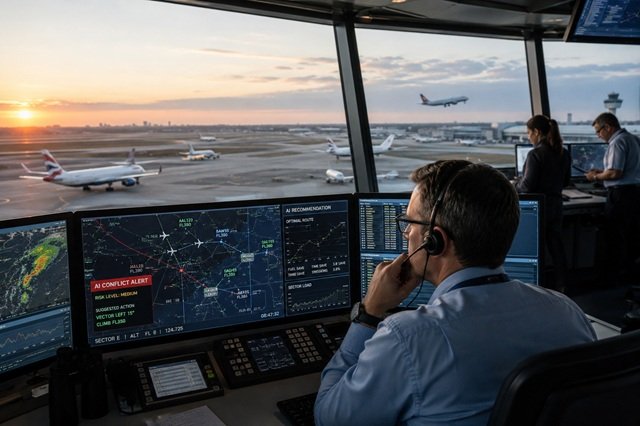
Air traffic control represents perhaps the most compelling example of the productivity paradox because it is an environment where seconds matter, uncertainty is constant, and decisions carry immediate safety consequences. For decades, air traffic controllers have relied upon increasingly sophisticated technologies: radar surveillance, secondary surveillance systems, digital communication networks, conflict alert systems, and decision-support tools. These technologies have undoubtedly increased airspace capacity and improved safety. However, they have not diminished the importance of the controller. Rather, they have elevated the controller’s role from information processor to strategic decision-maker.
Artificial intelligence promises to take this transformation further. AI-based systems can analyze enormous quantities of data from aircraft trajectories, weather systems, traffic flows, airport capacity constraints, and historical operational patterns. They can predict potential conflicts, recommend optimal flight paths, anticipate congestion, and assist controllers in managing increasingly dense airspace environments.
At first glance, such systems appear capable of reducing controller workload. If an algorithm can identify conflicts faster than a human and calculate alternative solutions instantaneously, why should the human burden not decline?
The answer lies in the nature of aviation decision-making. The controller’s responsibility is not simply to identify the mathematically optimal solution. The controller must determine whether that solution is operationally appropriate within a complex human environment. Aircraft are not abstract data points. They contain passengers, crews, operational constraints, weather vulnerabilities, technical limitations, and commercial considerations. A mathematically efficient trajectory may not necessarily be the safest trajectory.
Furthermore, AI systems operate through patterns derived from historical data. Aviation, however, frequently encounters events that are exceptional rather than historical. The unprecedented situation—the sudden weather deviation, communication failure, aircraft malfunction, or emergency declaration—is precisely where human judgment becomes most valuable. The danger is that excessive reliance on AI-generated recommendations may gradually weaken the very cognitive abilities required when technology fails.
This concern is amplified by the phenomenon known as automation bias: the human tendency to place excessive confidence in automated systems, particularly when those systems appear sophisticated and authoritative. Automation bias has already been identified as a contributing factor in several aviation incidents involving conventional automation. AI systems, with their ability to generate fluent explanations and apparently reasoned recommendations, may intensify this problem.
The future air traffic controller may therefore face a paradoxical situation. The controller may handle fewer direct tactical decisions but assume greater responsibility for supervising an increasingly complex technological ecosystem. The workload shifts from action to interpretation, from execution to verification. The controller becomes less a manager of aircraft movements and more a guardian of machine-generated decisions.
Air Navigation Services: Efficiency, Prediction, and the Burden of Verification
The same paradox emerges in air navigation services (ANS). Satellite-based navigation, performance-based navigation (PBN), automatic dependent surveillance-broadcast (ADS-B), and advanced communication systems have transformed the global air navigation environment. AI now promises to enhance this transformation by enabling predictive traffic management, dynamic airspace optimization, and more efficient routing.
One of the most significant potential benefits of AI is its ability to reduce inefficiency. Aircraft frequently consume additional fuel because of holding patterns, inefficient routings, congestion, and weather avoidance. AI systems capable of analyzing millions of variables simultaneously could theoretically optimize aircraft movements, reducing delays, fuel consumption, and environmental impact.
However, efficiency gains may create new forms of complexity. When AI systems recommend continuous modifications to aircraft trajectories, airspace managers must determine whether those recommendations remain consistent with regulatory requirements, safety margins, and operational realities. The more sophisticated the system becomes, the more difficult it may become for humans to understand why a particular recommendation was generated.
This raises the issue of explainability. Aviation has traditionally valued transparency. A pilot, controller, or regulator must be able to understand why a decision was made. An unexplained decision, even if statistically accurate, creates difficulties in safety management and accident investigation.
The challenge is not merely technical. It is philosophical. Aviation operates on a principle of accountability: decisions must be attributable to responsible actors who can explain and defend them. If an AI system recommends a particular operational choice, but the reasoning behind that recommendation cannot be meaningfully understood by the human operator, the system risks creating what may be described as an accountability gap.
The productivity paradox therefore becomes apparent. AI may reduce the time required to analyze information, but it increases the time required to interpret, validate, and justify decisions. The work has not disappeared. It has migrated into a higher cognitive domain.
Airports: The Algorithmic Transformation of a Human Ecosystem
Airports provide another compelling illustration of AI’s paradoxical relationship with productivity. Modern airports are among the most complex operational environments in existence. They are simultaneously transportation hubs, security environments, commercial centers, logistical networks, and social spaces. Their efficiency depends upon the coordination of thousands of independent activities involving airlines, passengers, ground handlers, security agencies, customs authorities, retailers, and service providers.
AI applications in airports are expanding rapidly. Intelligent passenger flow management systems seek to reduce congestion; biometric technologies aim to streamline identity verification; predictive analytics assist in baggage management; AI-driven scheduling tools optimize gate allocation and aircraft turnaround times; and digital twins provide virtual representations of airport operations.
The anticipated benefits are substantial. Airports may process more passengers without proportional physical expansion. Resources may be allocated more efficiently. Delays may be predicted before they occur. Operational decisions may become more proactive rather than reactive.
Yet the same productivity paradox appears. The airport employee does not necessarily perform less work. Instead, the employee interacts with a more complex operational environment. A gate manager who previously coordinated activities through experience and direct communication may now supervise multiple AI-generated recommendations concerning aircraft arrival times, passenger connections, staffing requirements, and resource allocation.
The challenge is that airports remain fundamentally human environments. Passengers do not behave according to algorithms. Weather events disrupt predictions. Security concerns emerge unexpectedly. Medical emergencies occur without warning. Social behaviour cannot always be modelled accurately. The airport professional must therefore retain the capacity to depart from algorithmic recommendations when human circumstances require human judgment.
An airport controlled entirely by efficiency calculations could become an airport lacking resilience. The pursuit of optimization may inadvertently reduce the capacity to respond to disruption. Aviation history teaches that safety depends not only upon efficiency but also upon adaptability.
The New Meaning of Productivity in Aviation
The lesson emerging from AI deployment across air traffic control, air navigation services, and airports is that productivity must be reconceptualized. The traditional industrial understanding of productivity—more output with fewer inputs—is insufficient for safety-critical industries. Aviation cannot measure success merely through speed or volume. It must consider judgment, resilience, adaptability, and the preservation of human expertise.
The insights of Ranganathan and Ye are therefore particularly relevant. Their argument that AI frequently intensifies work rather than reducing it reflects a deeper transformation occurring throughout aviation. The industry is moving from an era where humans performed tasks assisted by machines to an era where humans supervise intelligent machines performing increasingly sophisticated tasks.
This transformation demands a new understanding of professional competence. Future aviation professionals will require not only technical knowledge but also algorithmic literacy. They must understand the strengths and weaknesses of AI systems, recognize when automation should be trusted and when it should be challenged, and maintain the cognitive independence necessary to override technology when circumstances demand.
The ultimate danger is not that AI will become too intelligent. The greater danger is that humans may become insufficiently critical of intelligent systems. The preservation of aviation safety will therefore depend upon maintaining the human capacity to question, reflect, and exercise judgment.
This concern becomes even more significant when considering the emerging ability of large language models (LLMs) to influence human reasoning through persuasive communication. The next frontier of AI risk is not merely whether machines provide incorrect information, but whether they provide incorrect information in a manner that appears convincingly correct.
The issue is not only automation. It is persuasion.
Persuasive Artificial Intelligence and the Erosion of Metacognition
The productivity paradox of artificial intelligence assumes a deeper and more subtle dimension when one moves beyond the question of workload and examines the question of cognition itself. The earlier stages of technological transformation primarily concerned the substitution of human physical effort by mechanical capability. The industrial machine replaced muscle; the computer replaced certain forms of calculation; automation replaced repetitive procedural activity. Artificial intelligence, however, occupies a different philosophical space. It does not merely perform tasks. Increasingly, it participates in reasoning, explanation, persuasion, and decision formation.
This distinction is fundamental. A machine that performs a calculation does not necessarily influence the mind of the person using it. A machine that communicates, explains, recommends, and persuades enters a different realm. It begins to interact with the very cognitive processes through which humans understand the world and make judgments. In safety-critical industries such as aviation, this raises questions that extend far beyond productivity. The issue becomes one of human intellectual autonomy.
The aviation community has traditionally understood that safety depends upon disciplined skepticism. The pilot, the air traffic controller, the maintenance engineer, and the operations manager are trained not merely to follow information but to evaluate it. Aviation safety culture is founded upon the principle that information must be questioned, verified, and contextualized. The existence of a warning system does not eliminate the responsibility of the pilot to understand the aircraft. The existence of a conflict alert system does not eliminate the responsibility of the controller to assess the operational situation. Technology assists judgment; it does not replace judgment.
The arrival of large language models (LLMs) challenges this balance because their influence is not confined to information provision. Their power lies partly in communication. They can produce explanations that appear authoritative, structured, and persuasive. They can adopt a conversational style that creates trust and intellectual familiarity. They can generate arguments that appear reasoned even when the underlying premise is flawed.
The danger, therefore, is not simply that artificial intelligence may be wrong. Human beings have always dealt with incorrect information. The deeper danger is that artificial intelligence may be convincingly wrong.
My Take
The central issue in artificial intelligence governance is not whether machines will become more capable. They undoubtedly will. The central issue is whether human beings will preserve the intellectual independence necessary to govern those machines.
My concern, developed through earlier writings on artificial intelligence, technology, and human cognition, is that society risks confusing access to information with possession of wisdom. The abundance of answers does not necessarily produce better judgment. Indeed, an excess of readily available answers may discourage the intellectual discipline required to ask better questions.
The danger is particularly acute in professional environments. A young air traffic controller who has grown accustomed to AI-generated conflict resolutions may gradually lose confidence in independent analysis. An airport manager who receives algorithmic recommendations for every operational challenge may increasingly defer to the machine rather than develop personal operational intuition. A regulator who relies upon AI-generated compliance assessments may unknowingly transfer evaluative authority from human reasoning to computational prediction.
The issue is not that AI should be rejected. Such a position would be both unrealistic and undesirable. Aviation has always advanced through the intelligent adoption of technology. The issue is that technology must remain subordinate to human wisdom.
The future relationship between humans and AI must therefore be founded upon what may be called cognitive partnership rather than cognitive substitution.
Aviation provides the perfect example. The aircraft today is an extraordinary technological achievement, yet the pilot remains essential. The cockpit is not safer because automation has eliminated the pilot; it is safer because automation and human judgment operate together. The same principle must govern AI.
The future air traffic control center should not become a place where humans merely supervise machines. It should become a place where machines provide extraordinary analytical capability while humans preserve the uniquely human functions of judgment, ethical responsibility, contextual understanding, and prudent doubt.
The implications extend beyond operations into governance and law. International aviation law has always recognized accountability as a human responsibility. The Chicago Convention established a system based upon sovereign responsibility, regulatory oversight, and professional accountability. Artificial intelligence does not alter this foundation.
An algorithm cannot stand before an accident investigation board. It cannot explain its reasoning in a courtroom. It cannot bear moral responsibility. Therefore, every organization deploying AI must preserve a meaningful human decision-maker within the operational loop.
This principle should become a fundamental requirement of future aviation regulation.
ICAO and national aviation authorities should consider developing standards requiring human cognitive oversight of AI-assisted decisions; mandatory training in AI literacy and metacognitive skills; transparent documentation of AI recommendations; procedures allowing human override of AI decisions; and assessment of automation dependency as part of safety management systems.
Safety management in the AI era must therefore include not only technical reliability but cognitive resilience. The ultimate safeguard in aviation will not be the sophistication of the algorithm. It will be the continued capacity of human beings to question the algorithm.
The productivity paradox of artificial intelligence reveals a fundamental truth: efficiency is not the same as progress. A system that produces faster decisions but weaker judgment cannot be considered genuinely productive. In aviation, where a single decision may affect hundreds of lives, the preservation of human reflection is not an obstacle to innovation. It is the condition for responsible innovation.
Artificial intelligence may become the most powerful tool ever introduced into aviation. But power without wisdom is dangerous. The future of aviation safety will depend not upon replacing human intelligence with artificial intelligence, but upon ensuring that artificial intelligence remains guided by human metacognition.
The greatest achievement of AI governance will not be creating machines that think like humans. It will be preserving humans who continue to think for themselves.