The funeral of Republican Senator Lindsey Graham evolved into more than a national farewell, becoming an extraordinary moment of diplomacy that briefly brought together some of the most consequential figures in global politics. As reported by the German newspaper Die Zeit, the ceremony provided Ukrainian President Volodymyr Zelenskyy and Israeli Prime Minister Benjamin Netanyahu with a valuable opportunity to meet US President Donald Trump at a time when both leaders face mounting uncertainty over continued American engagement in their respective conflicts.
Few members of the US Congress receive the level of recognition accorded to Graham. The funeral service, held with full military honours in Washington, D.C., lasted more than two hours and drew thousands of mourners. Trump personally addressed the congregation, describing Graham as one of the most influential senators the United States had ever produced.
“Nothing of significance has happened in this capital for more than 30 years without Lindsey Graham knowing about it,” Trump said. “Nothing of significance has happened anywhere in the world without Lindsey Graham having an opinion on it. And no bill has passed in the most extraordinary republic in human history without Lindsey Graham having had something to say about it.”
Beyond the tribute itself, Trump paid perhaps his greatest political homage by receiving Zelenskyy and Netanyahu separately at the White House on the morning of the funeral. According to Die Zeit, such meetings reflected precisely the role Graham had long played as a trusted intermediary between the Republican administration and two of America’s closest international partners.
For both Ukraine and Israel, Graham had been one of the most influential advocates in Washington. Few Republican lawmakers had championed their interests as consistently. Ukraine, in particular, had remained central to his foreign policy engagement. Graham had returned from Ukraine only shortly before his death, having visited the country ten times since Russia launched its full-scale invasion. His final political initiative was reportedly to continue working towards another package of US sanctions against Russia.
The Oval Office meetings unfolded in a markedly different atmosphere from previous encounters. According to information released afterwards, the White House described both discussions as “positive and productive”. Netanyahu later characterised his conversation with Trump in a video message as “one of the best conversations” he had ever held with the US president. It marked their first meeting since the outbreak of the Iran war, following a lengthy wait for such an opportunity.
For Zelenskyy, the meeting represented an equally notable change in tone. Little remained of the confrontation more than a year earlier that had ended with his dramatic departure from the White House after a heated exchange involving US Vice-President JD Vance. Instead, Zelenskyy emerged with a tangible diplomatic outcome after securing Trump’s agreement that his special envoys, Steve Witkoff and Jared Kushner, would travel to Kyiv for the first time since the Russian invasion began more than four years ago. Their mission, according to the source material, will be to explore how new peace negotiations might be structured.
The cordial atmosphere was far from guaranteed. Trump currently faces increasing pressure from two international conflicts that have proved longer and more complex than anticipated. Both the war in Ukraine and the conflict involving Iran continue to test his administration as public opinion in the United States shows growing signs of fatigue with prolonged overseas involvement.
The Iran conflict has become particularly sensitive politically. With important midterm elections approaching in roughly three months, Republican candidates are increasingly concerned that continued military engagement abroad could carry electoral costs. Trump himself has repeatedly warned Netanyahu against reigniting regional tensions.
Shortly before their meeting, Trump suggested his patience with the Israeli prime minister had limits after reports emerged that Netanyahu intended to present evidence alleging that Iran was pursuing nuclear technology development at its underground Pickaxe Mountain facility. Speaking to Fox News, Trump remarked: “Well, Bibi doesn’t have to tell me that. Bibi tells me that because he wants me to stay involved.”
Zelenskyy has similarly encountered scepticism in Washington. In recent months, members of the America First wing of the Republican Party have repeatedly questioned the value of sustained US involvement in Ukraine and have criticised Kyiv over what they view as insufficient progress towards peace with Russia.
Those tensions, however, appeared absent during Tuesday’s events. Both Netanyahu and Zelenskyy were welcomed as honoured guests at the National Cathedral by numerous Republican figures, including Defence Secretary Pete Hegseth. The Israeli and Ukrainian leaders, who had not met in person for three years, exchanged at least a brief conversation during the ceremony. Although plans for a longer bilateral meeting were reportedly considered, they were ultimately abandoned. According to the Times of Israel, Zelenskyy showed greater interest in such a meeting than Netanyahu.
Following the funeral service, Zelenskyy travelled directly to the US Capitol, where he watched from the visitors’ gallery as senators voted overwhelmingly in favour of a sanctions package named after Lindsey Graham. The measure received the backing of 86 of the Senate’s 100 members, providing a rare display of bipartisan cooperation in an increasingly polarised political environment.
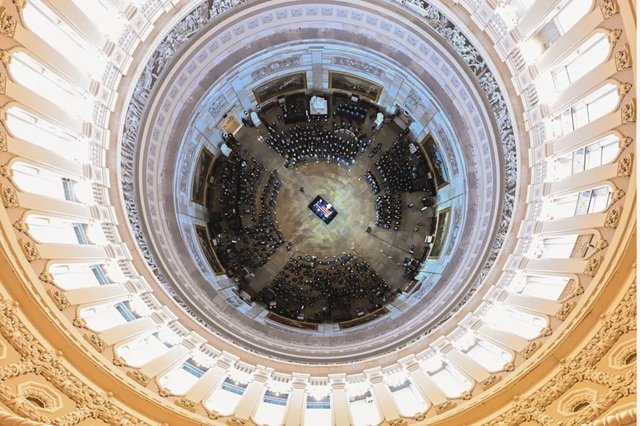
Later that evening, Trump also characterised his meetings with both leaders as having gone “very well” in a post on Truth Social. According to Die Zeit, the absence of television cameras inside the Oval Office and the fact that Vice-President Vance did not participate in the meeting with Zelenskyy may have contributed to the more constructive atmosphere. At the same time, Vance was delivering a eulogy for Graham in the Capitol Rotunda—a coincidence that the newspaper suggested the late senator himself could scarcely have orchestrated more effectively.
Whether the day’s diplomatic warmth signals a genuine shift in Washington’s approach or merely reflects an exceptional moment created by Graham’s funeral remains uncertain. Trump is well known for changing his positions rapidly, while neither the war in Ukraine nor the conflict involving Iran appears close to the peaceful resolution he has pledged to achieve.
Graham’s funeral offered Netanyahu and Zelenskyy an unusual opportunity to secure Trump’s attention. With that channel now gone, both leaders are likely to face a more difficult challenge in finding new ways to influence the US president as two of the world’s most consequential conflicts continue.