


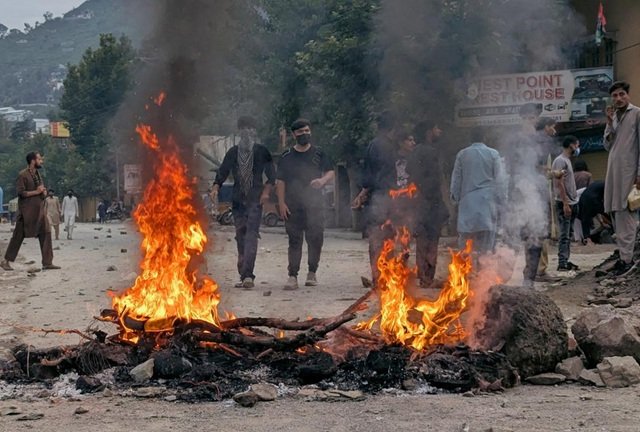
More than 40 people were reportedly been killed and over 70 injured, internet and mobile services remained suspended across large parts of Pakistan-occupied Jammu and Kashmir (PoJK) for up to 54 days, and approximately 14,000 Police personnel from Pakistan’s Punjab Province were deployed to maintain order. Against this backdrop, the three-phase elections to the 53-member PoJK Legislative Assembly have emerged as one of the most contentious electoral exercises in the territory’s history. What was projected as a democratic process has instead been overshadowed by violence, political unrest, allegations of electoral manipulation, and a widening confrontation between the authorities and the Jammu Kashmir Joint Awami Action Committee (JAAC).
The current unrest is rooted in a broader political movement that predates the elections. JAAC emerged in 2023 as a coalition of traders, transporters, lawyers, students and civil society organisations protesting rising electricity tariffs, inflation, wheat prices and governance failures. By October 2025, the organisation adopted a 38-point charter demanding economic reforms, improved public services and greater accountability. While the regional government claimed that most demands had been accepted, JAAC rejected the assertion and launched an indefinite protest campaign in June 2026. Over time, the movement evolved beyond economic grievances to challenge Islamabad’s political control over the territory and demand greater local representation.
The immediate trigger for the latest crisis was the controversy surrounding the 12 Assembly seats reserved for refugees from Jammu and Kashmir who migrated to Pakistan after 1947 and 1965. These constituencies are located outside PoJK, in Pakistan’s provinces, but elect representatives to the PoJK Legislative Assembly. JAAC argues that the arrangement enables Pakistan’s mainstream political parties to influence government formation through representatives who neither reside in nor directly represent the local population. Pakistani authorities maintain that the seats protect the political rights of displaced Kashmiris and can only be altered through constitutional amendment.
The confrontation escalated sharply after June 5, 2026, when the regional government banned JAAC under Section 12 of the Azad Jammu and Kashmir Anti-Terrorism Act, 2014, and arrested several of its leaders. Four days later, demonstrations in Muzaffarabad led to large-scale clashes between protesters and Security Forces (SFs) following a judicial decision upholding the constitutional validity of the refugee seats. Since then, Rawalakot and adjoining areas have remained the principal centres of confrontation, witnessing repeated protests, security operations and communication restrictions. According to JAAC, at least 30 people were killed during two days of election-period protests, while independent estimates place the overall death toll linked to the unrest since early June at more than 40 fatalities, including both civilians and security personnel.
The deteriorating security environment compelled the Election Commission to abandon the traditional single-day polling model and divide the elections into three phases. The Legislative Assembly comprises 53 members, including 45 directly elected representatives and eight reserved seats allocated after the elections. Approximately 3.8 million voters are registered, including around 439,000 voters in the 12 refugee constituencies. A simple majority requires 27 seats.
The first phase of polling, conducted on July 27, 2026, across the 13 constituencies of the Mirpur Division, immediately demonstrated the challenges facing the electoral process. Campaigning before polling remained unusually subdued because communication services had been suspended across much of the territory for more than seven weeks. Candidates complained that internet and mobile shutdowns prevented effective outreach to voters, while fears of violence discouraged public meetings. Reports of intimidation, attacks on political workers and vandalism targeting campaign offices further contributed to an atmosphere of insecurity.
Polling day witnessed several violent incidents. In Bhimber District, clashes between rival political workers reportedly resulted in the seizure and burning of a ballot box, destroying votes already cast. Elsewhere, at Nakyal in Kotli District, Pakistan Peoples Party (PPP) worker Mukhtar Younus was killed in an altercation between rival political groups. PPP further alleged that armed persons entered polling stations in Mirpur during the counting process and attempted to manipulate the outcome. Simultaneously, confrontations between JAAC supporters and SF personnel continued outside the electoral process, particularly in Rawalakot, where JAAC alleged that security personnel opened fire on demonstrators.
Despite these disruptions, preliminary results gave the ruling Pakistan Muslim League-Nawaz (PML-N) a decisive advantage, winning nine of the 13 seats contested in the Mirpur Division, while the Pakistan Peoples Party (PPP) secured the remaining four. PPP leaders rejected the outcome, alleging that several victories had been “gifted” to the ruling party through misuse of the state machinery. Government representatives, however, maintained that the elections had been largely peaceful and fair.
The second phase, held on August 2, 2026, covered eight constituencies of the Muzaffarabad Division and all 12 refugee constituencies. More than 300 candidates contested 20 seats. However, the voting process again unfolded amid severe political tensions. Campaigning had already been constrained by communication restrictions, restrictions on public gatherings and the continuing crackdown on JAAC leaders and activists. Independent candidates argued that the communication blackout disproportionately affected their ability to campaign in remote constituencies. PML-N and the PPP are contesting the 2026 Legislative Assembly elections separately, despite being coalition partners at the Federal Level in Pakistan.
Violence again marked polling day. The most serious incident occurred in Legislative Assembly-31 (Muzaffarabad-V), where clashes between workers of the PML-N and the PPP, resulted in the death of local PPP leader Syed Mushtaq Shah, while at least three others were injured. The incident underscored the growing intensity of political competition despite extensive security arrangements. 843 candidates are contesting the Legislative Assembly elections. Election symbols have been allotted to candidates representing 26 registered political parties and independent candidates.
The electoral process also triggered sharp reactions from the principal political stakeholders. Following the violence during the second phase, PPP Chairman Bilawal Bhutto Zardari accused the ruling PML-N of attempting to influence the electoral outcome through intimidation and violence. Referring to the attack on PPP regional president Chaudhry Latif Akbar and the killing of Syed Mushtaq Shah, Bilawal alleged that the ruling party was “robbing the votes of the people through bullets, batons and coercion.” The PPP subsequently submitted formal complaints to the PoJK Election Commission, alleging widespread administrative irregularities, including polling stations operating with only a single official stamp, discrepancies in voter lists and serial numbers, and procedural lapses that could potentially affect more than 1,100 registered voters. The party demanded an extension of polling hours, separate polling materials and immediate corrective measures, although election authorities had not publicly responded to these complaints.
PPP had also challenged the outcome of the first phase. Senior PPP leader Nayyar Bokhari alleged that victories in at least seven constituencies had been “gifted” to the PML-N through the misuse of state machinery. In contrast, Prime Minister Shehbaz Sharif’s adviser Rana Sanaullah defended the conduct of the elections, asserting that the polls had been conducted in a generally peaceful and fair manner and that incidents of violence were isolated.
Meanwhile, Pakistan Tehreek-e-Insaf (PTI), which had secured an outright majority in the 2021 PoJK Legislative Assembly elections, boycotted the 2026 electoral process, arguing that conditions for free and fair elections no longer existed. PTI Secretary General Mir Atiq ur Rehman described the elections as “the worst kind of mockery” and urged voters to reject what he characterised as a manipulated exercise. He also condemned the use of force against demonstrators, asserting that political disputes could not be resolved through coercion or violence. The boycott substantially altered the electoral landscape, effectively reducing the contest to one primarily between the PML-N and the PPP, while raising broader questions regarding the representative legitimacy of the Assembly.
The political developments also attracted international attention. On July 17, United Nations High Commissioner for Human Rights Volker Türk called for prompt, impartial and independent investigations into all deaths linked to the unrest and criticised the use of anti-terrorism legislation against JAAC. India also rejected the electoral process, describing it as a “cosmetic electoral exercise” intended to legitimise Pakistan’s control over the territory while diverting attention from human rights violations.
Attention has now shifted to the third and final phase, scheduled for August 10, covering the 11 constituencies of the Poonch Division, including Rawalakot, the epicentre of the ongoing agitation. Security is expected to remain exceptionally tight, with around 14,000 police personnel deployed from Punjab Province to reinforce local forces. Final results for the Assembly will only be announced after polling concludes and the eight reserved seats – for women, technocrats, religious scholars and overseas Kashmiris – are allocated. Numerically, the PML-N appears well positioned to emerge as the single largest party, aided by its strong showing in the first phase and its perceived advantage in the refugee constituencies. Nevertheless, irrespective of the final seat tally, the legitimacy of the incoming government is likely to remain contested because of the PTI boycott, the continuing JAAC agitation and persistent allegations of electoral manipulation.
The 2026 PoJK Legislative Assembly elections have consequently evolved into much more than an electoral contest. The phased polling, communication blackout, persistent allegations of malpractice, boycott by the principal opposition party, the ban on JAAC and the continuing confrontation between protesters and the security establishment, have collectively exposed deeper structural tensions concerning governance, political representation and Islamabad’s role in the administration of the territory. Irrespective of the outcome after the August 10 polling, the elections are unlikely to end the ongoing cycle of unrest unless these underlying grievances are addressed through sustained political engagement rather than coercive measures.











