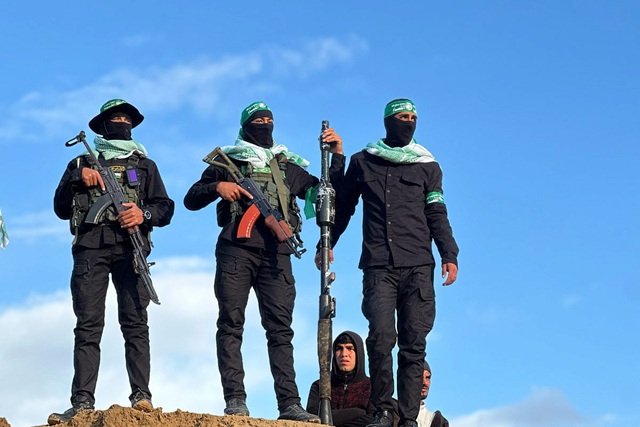
A new U.S.-backed roadmap that commits Hamas and other armed groups in Gaza to disarm has been presented by President Donald Trump as a landmark step towards regional stability, but unresolved disputes over implementation, Israeli withdrawal, and the future balance of power in Gaza leave the agreement facing formidable political and security challenges.
Facing a prolonged and expanding conflict against Iran, U.S. President Donald Trump has sought to reposition the diplomatic landscape in the Middle East by announcing what he described as a breakthrough agreement under his “20 Point Peace Plan for Gaza.” Central to the initiative is a commitment by Hamas and other armed groups in Gaza to disarm, a development Trump hailed as a “step toward lasting peace and security” and one that U.S. officials argue could reshape regional dynamics.
According to analysis by The Soufan Center, the disarmament agreement represents one of the most consequential elements of the broader U.S.-backed peace initiative. If implemented, it could remove one of Iran’s most significant non-state allies from the regional battlefield while creating conditions for governance reform and the eventual reconstruction of Gaza. Yet despite the ambitious vision outlined in the agreement, the roadmap remains burdened by unresolved disputes that cast doubt over whether its provisions can be fully realised.
Trump announced that the “Board of Peace”—the multilateral organisation established under the October “20 Point Peace Plan”—had secured a pledge from Hamas and other armed factions in Gaza to surrender their weapons. The commitments are detailed in a document entitled “A Roadmap for Completing the Implementation of President Trump’s Comprehensive Peace Plan in Gaza,” released by the Board of Peace. The roadmap proposes a phased process intended to end armed factional control of Gaza while facilitating political transition, international stabilisation, and reconstruction.
For the United States, the agreement carries significance beyond Gaza itself. Officials have portrayed Hamas’ willingness to disarm as a strategic setback for Iran, whose regional influence has long depended on its network of allied armed movements known collectively as the “Axis of Resistance.” Washington argues that weakening Hamas would reduce Tehran’s capacity to project influence through non-state partners, particularly as Iran continues to rely on allied organisations, including the Houthi movement in Yemen and Iran-aligned militia units in Iraq, to extend the conflict across the region and demonstrate its ability to disrupt global economic stability.
According to the assessment, Iranian leaders viewed a Hamas disarmament agreement as diminishing Tehran’s bargaining position and unsuccessfully urged Hamas to reject the proposal. The weakening of Iran’s regional partners, particularly Hamas and Hezbollah, is also presented as one factor behind Tehran’s continued resistance to any agreement with Washington that would reduce its control over the Strait of Hormuz, described as one of Iran’s most important sources of strategic leverage.
Despite these broader geopolitical implications, the roadmap has been met with widespread scepticism because it leaves unresolved one of the conflict’s most contentious issues: the sequencing of Hamas’ disarmament and Israel’s military withdrawal from Gaza. The agreement requires Israel to withdraw from nearly 70 per cent of the territory it currently occupies as a buffer zone, while simultaneously expecting Hamas to surrender its weapons. However, each side insists that the other move first. Israel maintains that Hamas must disarm before any withdrawal can occur, whereas Hamas insists that Israeli forces must leave before it relinquishes its arsenal.
Israeli Prime Minister Benjamin Netanyahu, who discussed the emerging Gaza proposal with Trump in Washington earlier in the week, has not publicly commented on the roadmap. Other Israeli officials have expressed reservations without formally rejecting it. Israeli policymakers have consistently argued that previous commitments under the Trump peace plan could not proceed because Hamas refused to disarm, while political opinion across Israel remains deeply sceptical that Hamas would voluntarily surrender either its military capability or its indirect influence over Gaza.
That distrust is reflected in Israel’s insistence that its forces will remain inside the buffer zone until Gaza is fully administered by independent Palestinians working alongside U.S.-led international stakeholders. The roadmap attempts to address these concerns by establishing the National Committee for the Administration of Gaza (NCAG) as the territory’s sole governing authority.
The document states that Gaza “shall be governed according to the principle of One Authority, One Law, One Weapon. NCAG shall operate in accordance with Palestinian laws, relevant international standards and the principles of good governance.” It further specifies that, following completion of the security provisions outlined in the roadmap, “only NCAG shall hold, store or control weapons in Gaza.” Police weapons are to be transferred to the authority of the NCAG, with light arms allocated to the post-Hamas police force.
Questions nevertheless remain over the fate of heavier weaponry. Israeli officials have objected to what they regard as vague provisions governing heavy weapons, arms production facilities and the extensive tunnel network that has played a central role in Hamas’ military operations.
Those concerns were reinforced when Ghazi Hamad, a member of Hamas’s negotiating team, told The Wall Street Journal that Hamas would not surrender its heavy weapons but instead place them in storage under NCAG supervision. “We didn’t say disarmament, we didn’t say handing over the weapons, and we didn’t agree on any Israeli involvement,” he said, adding that Hamas’ cooperation depended upon Israel ending military operations in Gaza and permitting greater humanitarian assistance. Other Hamas leaders have further stated that surrendering heavy weapons remains contingent upon the eventual establishment of a Palestinian state.
Even with these uncertainties, the roadmap outlines an ambitious framework for political transition. Following completion of a timetable and implementation mechanism within fourteen days, the fifteen-member NCAG, headed by Palestinian statesman Nabil Shaath, would deploy from its Cairo base into Gaza. Established in January 2026, the committee has remained outside Gaza because of continued fighting, Israeli objections and Hamas’ previous refusal to disarm. Hamas’ decision in early July to transfer political authority to the NCAG is presented as the breakthrough that enabled the Board of Peace to finalise the current agreement.
Under the roadmap, Hamas and other armed factions affirm that the NCAG “shall enjoy full independence in carrying out its responsibilities and that the factions shall not interfere in NCAG affairs during the transitional period, in accordance with UNSC Resolution 2803 (2025).” Nevertheless, Israeli and some international officials continue to suspect that Hamas could retain substantial informal influence even after formally relinquishing authority.
The agreement also provides the framework for a significantly expanded International Stabilization Force (ISF), intended to oversee security arrangements, facilitate Israel’s withdrawal, monitor compliance with the ceasefire, protect humanitarian deliveries and train Palestinian police. Although international participation has so far remained limited because of continuing instability, Israel recently approved a pilot deployment of a 200-person ISF contingent near Rafah following U.S. pressure. Morocco, Kosovo, Albania and Uganda are identified as contributors to the force.
The roadmap envisages the ISF eventually deploying across Gaza, separating Israeli forces from NCAG-controlled territory while deliberately avoiding routine policing functions within Palestinian society. Instead, its mandate focuses on maintaining ceasefire compliance, supporting humanitarian operations and assisting the NCAG when requested.
According to The Soufan Center’s analysis, the advancement of the Board of Peace initiative modestly improves the prospects for Gaza’s eventual reconstruction after nearly four years of conflict following the October 7 Hamas attack. Major international donors, including the Arab Gulf monarchies, have thus far withheld reconstruction funding pending confidence that the conflict has definitively ended. The roadmap provides that reconstruction and financing will proceed according to plans jointly prepared and supervised by the Board of Peace and the NCAG in accordance with relevant laws and international standards.
Whether the agreement ultimately fulfils that ambition now depends less on the declarations contained within the roadmap than on whether its deeply contested provisions can be translated into action by parties that continue to view one another with profound mistrust.