Each year on 5 August, Pakistan observes Youm-e-Istehsal, a day of solidarity marking the anniversary of India’s 2019 decision to revoke Article 370 of its constitution, the clause that had granted Indian-administered Jammu and Kashmir a measure of special autonomous status since 1949. For Islamabad and for many Kashmiris, the day is intended to keep international attention focused on what they describe as an illegal and unilateral alteration of the status of a long-disputed territory.
A Disputed Legacy from Partition
Pakistan’s position holds that the Kashmir dispute represents unfinished business from the 1947 partition of the subcontinent, and that the original accession of the princely state to India, signed by Maharaja Hari Singh, was concluded under conditions of duress rather than free choice. When Jawaharlal Nehru brought the dispute to the United Nations Security Council, the Council responded with Resolution 47 of 21 April 1948, calling for a plebiscite to determine the wishes of the Kashmiri people. Pakistan and Kashmiri advocacy groups frequently cite early statements by Indian leaders in support of this position, including Mahatma Gandhi’s remarks at a prayer meeting in October 1947 describing accession as provisional pending an impartial plebiscite, and Nehru’s own correspondence with Pakistan’s prime minister in November and December of that year affirming support for a UN supervised vote. Critics of India’s current position argue that describing these Security Council resolutions as outdated ignores that the United Nations itself predates them.
Article 370 had allowed Jammu and Kashmir a degree of legislative autonomy, with the exception of defence, foreign affairs and a small number of other domains, and it barred non-residents from purchasing land in the territory. A companion provision, Article 35A, reinforced these protections by defining permanent residency and the rights attached to it. Supporters of the pre-2019 arrangement argue that no Indian government had altered this special status in the seven decades it stood, and that the 2019 decision reflected the political priorities of the ruling Bharatiya Janata Party rather than a change dictated by legal or security necessity. Critics of the move, including the Mumbai based constitutional scholar A. G. Noorani, have described the manner of its passage, undertaken while the region was under central rule following the collapse of the Mufti government, as legally questionable and open to challenge.
Competing Claims on the Ground
New Delhi has consistently presented the abrogation as a transformative step that reduced terrorism, curbed infiltration, revived tourism and economic activity, and integrated the territory more fully into the Indian union, citing figures such as a decline in terrorism related incidents from 143 in 2018 to 28 in 2021. Critics of this narrative, drawing on local economic and human development data as of mid-2026, describe a markedly different picture.
On tourism, the Kashmir Valley had drawn close to a million visitors annually during its 2011 to 2014 peak. Following the 2019 lockdowns and prolonged communications restrictions, visitor numbers reportedly fell sharply, before rebounding in subsequent years. Even so, 2025 saw a decline from the record levels of 2024, a drop attributed in part to security incidents including the Pahalgam attack and subsequent closures affecting adventure tourism. The Kashmir Chamber of Commerce and Industry has estimated substantial job losses in tourism and handicrafts since 2019.
Unemployment in the region is reported to remain notably above the national average, with youth and women particularly affected. The apple industry, a major pillar of the local economy supporting several million people, has faced repeated setbacks from weather events, highway closures and market disruptions, with growers at times destroying or abandoning produce in protest. Small and medium enterprises have also seen significant closures, which observers attribute to continued militarization and weak private investment in the territory. In Ladakh, protests have emerged over unmet employment commitments made at the time of the region’s reorganization.
Security, Rights and Demographic Change
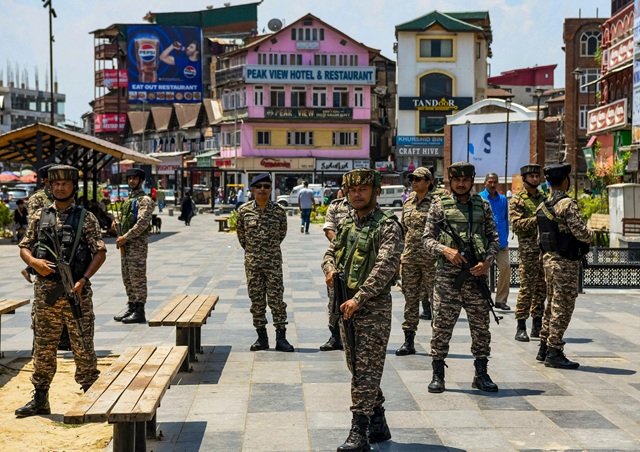
IIOJK remains among the most heavily militarized regions in the world, with estimates of security personnel ranging into the hundreds of thousands drawn from the army, paramilitary forces and local police. Search and cordon operations have continued in the years since 2019, alongside thousands of arrests under laws such as the Public Safety Act and the Unlawful Activities Prevention Act. Human rights organizations and local observers have documented allegations of extrajudicial killings, custodial deaths, disappearances and the use of excessive force, with disputed incidents reported in several districts. Critics argue that legal frameworks such as the Armed Forces Special Powers Act shield security personnel from accountability.
The Jammu and Kashmir Reorganisation Act of 2019 repealed or amended a large number of laws that had previously protected local land, employment and residency rights. New domicile rules, along with expanded eligibility for non-residents to vote and purchase land, have raised concerns among Kashmiri political and civil society groups about long-term demographic change, with some estimates suggesting a substantial increase in the non-local voter base. Religious leaders and figures associated with the Hurriyat have faced periodic detention, and changes affecting the administration of religious endowments and educational policy have been described by critics as threats to Kashmiri cultural and religious identity. The 2019 ban on Jamaat-e-Islami and the closure of an associated network of schools left thousands of students without access to their previous institutions.
A Rare Political Convergence
By mid-2026, discontent over the post-2019 arrangement had brought together a broad cross section of Kashmiri political and civil society actors. Civil society representatives gathered in Srinagar in July to call for the restoration of full statehood, while mainstream parties including the National Conference and the Peoples Democratic Party joined rallies in Srinagar, Jammu and Delhi during the parliamentary session that month. Leaders such as Farooq Abdullah, Mehbooba Mufti and Mirwaiz Umar Farooq have pressed for demands extending beyond statehood to include restoration of Articles 370 and 35A, the release of political prisoners and the lifting of the ban on Jamaat-e-Islami, framing the campaign as a defence of constitutional guarantees.
It is worth noting that this account reflects the perspective advanced by Pakistan and allied Kashmiri political voices, many of whose statistics come from local business associations, opposition politicians and advocacy sources rather than independent verification. India’s government continues to maintain that the 2019 changes were a lawful exercise of parliamentary authority, that security conditions and economic indicators in the territory have genuinely improved, and that periodic elections since then reflect a functioning democratic process within the Indian constitutional framework. As with much of the broader Kashmir dispute, the competing claims made by each side remain difficult to independently reconcile, and the debate over the region’s status continues to divide opinion within India, Pakistan and the international community alike.