More than three years after civil war broke out in Sudan, the southern Egyptian city of Aswan has become a place of prolonged uncertainty for thousands of Sudanese refugees who remain stranded in increasingly precarious conditions, facing legal obstacles, limited humanitarian assistance and diminishing prospects for rebuilding their lives.
In the weeks following the outbreak of conflict in Sudan in mid-April 2023, newly arrived refugees were a common sight throughout Aswan, Egypt’s largest city near the Sudanese border. Many gathered around the railway station, bus terminals, cafés and inexpensive hostels, attempting to recover from the shock of fleeing the violence while deciding what to do next.
Today, while Sudan’s conflict continues unabated and has developed into what the source describes as the world’s largest humanitarian crisis, the situation in Aswan has changed. Refugees continue to arrive, although in smaller numbers, according to a Sudanese diplomatic source. Those who remain say the refugee population has become less visible as displaced families have increasingly been pushed to the margins of the city.
The reduction in funding from major international donors, combined with more restrictive policies adopted by host countries, has left many Sudanese refugees increasingly vulnerable. In Aswan, that vulnerability is compounded by the fact that many refugees lack both the financial means and the security required to travel to larger Egyptian cities where services are more readily available.
“Aswan is the gateway to Egypt [for those from Sudan], so this is where humanitarian organizations should be more present,” one Sudanese refugee living in the city told EL PAÍS, requesting anonymity for security reasons. Another refugee said that many families had fled in search of stability, education and healthcare, only to discover that “we found nothing”.
Legal status remains one of the most pressing challenges. When the war began, Egypt required visas only for Sudanese men aged between 16 and 50. Within weeks, however, the requirement was extended to all Sudanese nationals. According to the source material, many have subsequently paid hundreds or even thousands of dollars to intermediaries in order to obtain the security clearances needed to enter Egypt.
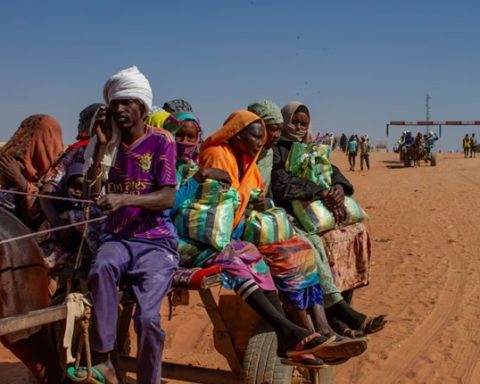
As legal entry became more difficult, increasing numbers of Sudanese resorted to crossing the border through desert smuggling routes. According to Member of Parliament Reham Abdel Nabi, hospitals in Aswan province have recorded dozens of refugee deaths, most caused by heatstroke, although the total number of fatalities during the journey remains unknown. Refugees interviewed for the report also warned that those using irregular routes face risks including arrest, deportation, robbery and kidnapping for ransom. One refugee described the crossing as “not a smuggling route, it’s a death route”.
According to Sudanese Consul Abdelqader Abdalah, around 10,000 Sudanese families are currently living across southern Egypt. Many who entered the country irregularly face another obstacle upon reaching Aswan: there is no office of the United Nations High Commissioner for Refugees (UNHCR) in the city because Egypt has not authorised the agency to establish one there, according to a source familiar with the matter.
As a result, refugees seeking official registration must travel around 1,000 kilometres to Cairo or Alexandria while still lacking legal immigration status and risking arrest along the journey. Several refugees said they often travelled part of the route by car before continuing by train, where bribes were frequently demanded. As one refugee summarised: “If you have money, you get through; if not, you don’t.” For many, the financial and legal risks mean they never leave Aswan.
Even refugees who entered Egypt legally on tourist visas struggle to regularise their status. According to one former lawyer from Sudan, residency renewal often requires a registered rental contract, yet many landlords refuse to provide the necessary documentation. Without valid residency, contracts cannot be legalised, creating a cycle that many refugees cannot break without travelling to Cairo.
Economic hardship further compounds these legal difficulties. Although Aswan remains less expensive than Cairo or Alexandria, refugees say landlords frequently charge Sudanese tenants higher rents than Egyptian citizens, forcing multiple families to share accommodation or move to more isolated neighbourhoods. One refugee suggested introducing legal limits on rents to protect displaced families from exploitation.
Access to education has also become increasingly difficult. Children wishing to attend public schools must be registered with UNHCR and possess valid residency permits. Those unable to meet those requirements can attend only private educational centres, which many families cannot afford and which are not officially recognised as schools. According to an Egyptian activist working closely with the Sudanese community, Aswan had only nine such centres.
One refugee said his two children, now aged 10 and 11, attended school during the first year after the conflict began but have since remained out of education because he can no longer afford annual costs of around €450. “They haven’t gone for three years,” he said, adding that no realistic alternative exists.
The situation worsened on 25 July when Aswan Governor Amr Lashin ordered the closure of all unlicensed Sudanese educational institutions, stating that the measure was intended to protect students by ensuring access to accredited educational services. For many refugee families, however, those centres had represented their last opportunity to provide children with even a basic education.
Humanitarian assistance available to Sudanese refugees has also become increasingly concentrated in Cairo and Alexandria, where major aid organisations maintain their operations. Refugees in Aswan say this leaves them largely without support. “We want services and for them to be easy to access, not for us to end up needing connections for everything,” said another refugee, a mother of two daughters.
Several refugees and an Egyptian activist also criticised what they described as the excessive centralisation of community affairs by the Sudanese consulate in Aswan, saying it had fostered feelings of arbitrariness and a lack of transparency. Consul Abdalah rejected those claims, maintaining that the consulate merely coordinates assistance rather than distributing aid itself.
Despite the deteriorating conditions, none of the Sudanese refugees interviewed said they intended to return voluntarily to Sudan. One mother showed video footage on her mobile phone of a recent bombing in her hometown in the Darfur region, where bodies lay scattered across the streets. “Where are we supposed to go?” she asked. “Should I go back there? With my daughters?”