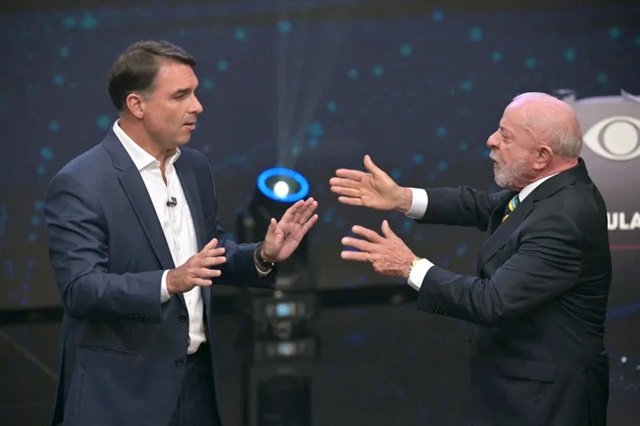
Brazilian President Luiz Inácio Lula da Silva and far-right Senator Flávio Bolsonaro ended their final televised debate before Sunday’s presidential run-off without either candidate establishing a clear advantage, as they sought to win undecided voters in an exceptionally close contest.
Broadcast live by TV Globo from its studios in Rio de Janeiro on Friday night, the debate lasted more than two hours. The latest Datafolha poll, published on Thursday, put both candidates on 50% of valid votes. Bolsonaro, the son of former president Jair Bolsonaro, had won the first round with 47%, ahead of Lula’s 45%.
The debate was more measured than their previous encounter on Sunday, with both candidates generally allowing each other to finish speaking and focusing on their proposals. The format included a new rule against mocking an opponent, introduced after Lula’s campaign complained that Bolsonaro had gestured behind the president while he was speaking during the earlier debate. However, the calmer exchanges gave way to accusations of corruption and dishonesty during the final stages.
Public security emerged as one of the most contentious issues. Bolsonaro accused Lula of being too lenient towards criminals and promised tougher penalties, including eight years in prison for mobile phone theft. He also proposed lowering the age of criminal responsibility to 14 and introducing chemical castration for rapists. He accused Lula of defending drug-trafficking groups, while promising to classify criminal militias and drug-trafficking factions as terrorist organisations if elected.
Lula challenged Bolsonaro over his defence of a police officer accused of killing five-year-old Ana Clara Gomes during a shooting in Niterói, Rio de Janeiro, in 2021. The girl’s mother attended the debate. Bolsonaro said the case should be clarified and questioned whether the fatal bullet had come from the officer, who had not been convicted. He argued that criminal organisations would not have such influence if Lula’s government were more effective in combating them.
The candidates also clashed over corruption allegations and their personal finances. Lula questioned how Bolsonaro had acquired a mansion worth 10 million reais and challenged him to disclose his bank statements. Bolsonaro accused Lula of concealing assets and referred to a 2018 conviction that was subsequently annulled by Brazil’s Supreme Federal Court. Lula rejected the accusations and demanded transparency from both campaigns.
Other allegations surfaced during a particularly heated exchange involving Banco Master and its jailed banker Daniel Vorcaro. Bolsonaro referred to a reported conversation about a whisky worth 500,000 reais allegedly intended for Lula, while Lula raised allegations involving Bolsonaro and a supposed payment of 134 million reais connected to a biographical film about his father. The claims formed part of the candidates’ competing corruption accusations.
Economic policy and household debt also featured prominently. Bolsonaro criticised Lula’s public spending and tax policies, promising measures to reduce debt and support small businesses, including entrepreneurs in poorer urban neighbourhoods. Lula pledged to renegotiate household debts, expand access to secondary education and increase economic output. He defended his decision to prohibit online sports betting, arguing that it had contributed to financial distress among families. Bolsonaro countered by accusing Lula of making promises he could not fulfil.
In their closing appeals, both candidates sought to present themselves as the more credible choice. Bolsonaro asked voters for a “vote of confidence” and paid tribute to his father, promising: “I will never promise what I cannot do.” Lula drew on his working-class background, recalling that he had begun working at the age of 12 before becoming a metalworker and eventually president.
Lula warned voters: “Either we keep democracy functioning or we will have a militiaman governing this country.” Bolsonaro denied ever having been investigated for involvement with militias and reiterated his pledge to take a tougher approach to organised crime.
The debate concluded with neither candidate clearly prevailing. With campaigning about to enter its final stage, nearly 159 million eligible Brazilian voters were due to decide the run-off on Sunday.