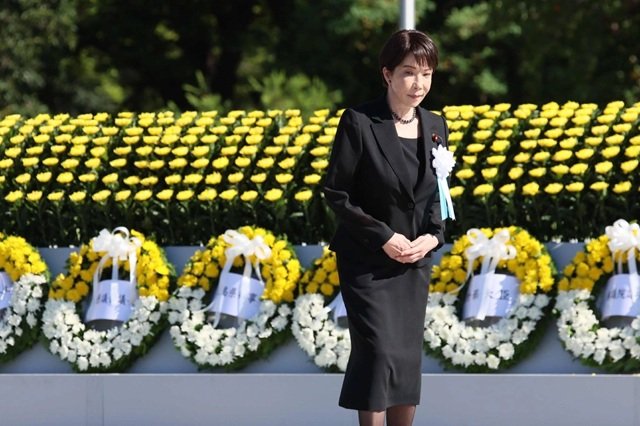
Japan marked the 81st anniversary of the atomic bombing of Hiroshima on Thursday with solemn commemorations led by Prime Minister Sanae Takaichi, who reaffirmed the country’s commitment to its long-standing non-nuclear principles while leaving open the possibility of future policy discussions amid an increasingly challenging security environment.
Takaichi joined atomic bomb survivors, bereaved families, foreign dignitaries and local officials at Hiroshima Peace Memorial Park, where participants observed a minute of silence at 8:15 a.m., the exact moment when the United States dropped the atomic bomb on the city on 6 August 1945.
The attack killed an estimated 140,000 people by the end of that year. Three days later, a second atomic bomb was dropped on Nagasaki, resulting in a further estimated 74,000 deaths by the end of 1945.
“The devastation caused by the atomic bombings of Hiroshima and Nagasaki, and the indescribable suffering endured by so many people, must never be repeated,” Takaichi said during the memorial ceremony.
“I pledge to devote every effort to achieving a world without nuclear weapons and lasting peace,” she added, reaffirming that Japan continues to uphold its long-standing “three nonnuclear principles”.
However, immediately after reiterating that commitment, the Prime Minister noted that the global security environment “is becoming increasingly severe”, remarks that have fuelled continued debate over the future of Japan’s nuclear policy.
The ceremony marked Takaichi’s first appearance at Hiroshima as Japan’s Prime Minister and came as her government prepares to revise the country’s key national security documents later this year. That review has prompted questions over whether the three non-nuclear principles could also be reconsidered.
Under those principles, Japan commits not to possess, manufacture or permit the introduction of nuclear weapons into the country.
Although Takaichi’s administration maintains that the government continues to adhere to the policy, she has previously referred to a 2010 position adopted by then Foreign Minister Katsuya Okada, under which a government facing a national emergency could decide whether to permit temporary port calls by vessels carrying nuclear weapons.
The debate has also been encouraged by the Japan Innovation Party, the junior partner in the governing coalition, which submitted a policy proposal to the government in June calling for what it described as a “realistic examination” of the third principle concerning the introduction of nuclear weapons into Japan.
During Thursday’s ceremony, Hiroshima Mayor Kazumi Matsui also warned against the growing role of nuclear weapons in international politics, criticising military aggression and what he described as heavy-handed actions by major powers that disregard international law.
“We continue to see military aggression in which nuclear weapons are used as instruments of intimidation around the world, as well as heavy-handed actions by major powers that disregard international law,” Matsui said.
He warned that such developments were creating a cycle of mistrust that could “take us back to the era of World War II, when naked ambitions were allowed to run unchecked.”
The annual commemoration also highlighted the rapidly diminishing number of surviving victims of the atomic bombings. As of March, the number of officially recognised hibakusha from Hiroshima and Nagasaki had fallen to just over 91,000, reflecting the continued ageing of those who experienced the attacks firsthand.
The declining survivor population has heightened concerns that opportunities to preserve and pass on first-hand testimony of the bombings will become increasingly limited for future generations.
Following the memorial ceremony, Takaichi met representatives from seven hibakusha organisations. During the meeting, survivors expressed strong opposition to any attempt to revise Japan’s three non-nuclear principles, describing such a move as “unacceptable”. They also urged the government to sign and ratify the Treaty on the Prohibition of Nuclear Weapons.
When asked whether her administration would reconsider the principles, Takaichi declined to rule out future changes but reiterated that the government currently continues to adhere to them.
The Prime Minister also referred to challenges encountered in diplomatic exchanges over Japan’s wartime history. She said she had recently received a more “harshly worded” response from a foreign counterpart after describing Japan as the only country to have suffered atomic bombings during war, although she did not identify the counterpart or provide further details during the meeting.
Afterwards, Satoshi Tanaka, one of the hibakusha representatives who met the Prime Minister, told The Japan Times that Takaichi had indicated she was facing pressure from the United States to review Japan’s non-nuclear principles.
“She appeared troubled by it,” Tanaka said. “It sounded as though maintaining it (the nonnuclear policy) would be hard even if she wanted to.”
The comments underscore the increasingly delicate balance facing Japan as it seeks to preserve its post-war commitment to non-nuclear principles while confronting evolving security challenges and a changing regional strategic environment.