
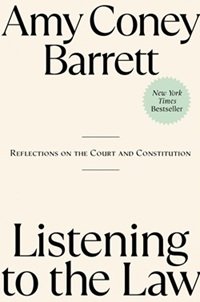
There is something quietly radical about Amy Coney Barrett’s Listening to the Law, although many readers—both admirers and critics—may fail to notice it. Published after one of the most polarising judicial confirmations in modern American history, the book might easily be dismissed as an accessible defence of originalism or an attempt to explain a controversial judicial philosophy to a sceptical public. That would be a serious misreading. Barrett’s most provocative argument is not that originalism is correct, nor that textualism produces superior constitutional outcomes. It is something considerably more unsettling. She asks citizens to trust judges only insofar as judges refuse to trust themselves. At a moment when constitutional courts across the democratic world are increasingly expected to solve political crises, Barrett advances what many will regard as an almost heretical proposition: the best judge is often the one who deliberately declines to pursue what she believes is justice.
The intellectual gamble at the heart of the book appears in one deceptively simple distinction. “Making judgments about what the law requires isn’t always the same thing as deciding what is just” (p. 28). Most constitutional writing attempts to reconcile law and justice, presenting legal reasoning as the pathway through which moral truth ultimately emerges. Barrett does precisely the opposite. She insists upon separating them. Her willingness to acknowledge voting to uphold a death sentence that she personally found “distasteful to cast” because “it was the right thing for me to do” (p. 28) is not merely an autobiographical confession. It is the organising principle of the entire book. Whether one agrees with her conclusion is almost beside the point. Barrett invites readers into an uneasy constitutional universe in which fidelity to law may require judges to produce outcomes they themselves consider morally troubling. Few contemporary judges are willing to defend judicial restraint with such disarming candour.
This is also where the book becomes genuinely controversial. Barrett rejects the increasingly popular expectation that judges should function as moral guardians correcting the failures of democratic politics. She dismisses what she calls the “Solomon” conception of judging, insisting instead that “a judge must abide by the rules set by the American people” embodied in constitutional and legislative texts (pp. 23–24). It is an argument that runs sharply against the prevailing tendency to celebrate courts as engines of social progress. Barrett’s claim is not that judges lack moral convictions. Rather, she argues that those convictions become constitutionally dangerous the moment they replace enacted law. “If I decide a case based on my judgment about what the law should be,” she writes with unusual bluntness, “I’m cheating” (p. 28). The word is eye-catching. Barrett does not describe judicial activism as mistaken or misguided; she describes it as a form of dishonesty.
The book’s greatest strength lies in its refusal to romanticise judges, including the author herself. Barrett openly acknowledges that “biases… surely do” influence judicial decision-making (p. 34), yet resists the fashionable conclusion that judges therefore become little more than politicians in robes. Instead she offers a quieter defence of institutional integrity, arguing that most judges sincerely “try to do their best by the law” (p. 34). Critics may regard this confidence as optimistic, even naïve, particularly in an era of increasingly ideological constitutional litigation. Yet Barrett’s argument deserves more serious engagement than it often receives. She is not claiming that judges always succeed in suppressing personal preferences. She is arguing that the aspiration to do so remains indispensable. Abandoning that aspiration would mean abandoning the distinction between courts and legislatures altogether.
Perhaps the most intellectually sophisticated aspect of Listening to the Law is Barrett’s discussion of originalism, which is notably more restrained than either its advocates or opponents often suggest. She explicitly rejects the caricature that originalism provides mechanical answers to modern constitutional disputes. “I’m not an originalist because I think that history yields easy answers,” she writes, “I’m an originalist because I think that it’s the right way to think about law” (p. 207). That sentence deserves closer attention than it usually receives. Barrett is making an argument about constitutional authority rather than historical certainty. Originalism, in her account, is not a guarantee of correct outcomes but a discipline intended to limit judicial discretion. Whether readers accept that discipline is another matter, but Barrett deserves credit for presenting originalism as a constitutional ethic rather than an infallible methodology.
Her defence of textualism follows a similarly democratic logic. Barrett repeatedly argues that legislation should be interpreted according to the words enacted rather than speculative inquiries into legislative intent. “The text is the common denominator” (p. 214), she observes, because legislative language reflects compromises that no individual legislator may fully endorse. Equally persuasive is her warning that judges who rewrite statutes to better serve legislative purposes risk undoing “the very compromises that made the passage of legislation possible” (p. 217). This is among the book’s most convincing contributions because it reframes textualism as respect for democratic bargaining rather than semantic literalism. Barrett’s concern is not linguistic purity but institutional legitimacy.
Yet the book also exposes the limitations of Barrett’s constitutional philosophy, often unintentionally. Her insistence that new constitutional rights generally belong to legislatures rather than courts (pp. 187–191) raises profound questions about the historical role of judicial protection for vulnerable minorities. Constitutional history repeatedly demonstrates that legislatures have often proved unwilling to recognise rights until courts compelled them to do so. Barrett herself acknowledges that the Constitution’s “gravest flaw” was its accommodation of slavery and that freedom required civil war and constitutional amendment to become universal (p. 159). That admission creates an unresolved tension within the book. If democratic institutions were capable of sustaining slavery for generations, why should contemporary readers possess unqualified confidence that democratic majorities alone will adequately protect contested liberties? Barrett never entirely resolves this dilemma, and it remains the strongest challenge to her constitutional vision.
Another remarkable feature of the book is its defence of intellectual disagreement as a constitutional virtue rather than a democratic pathology. Barrett’s observation that “an echo chamber repeats mistakes as readily as truths” (p. 38) carries significance well beyond judicial deliberations. Her insistence that “different judges with different viewpoints improve decision-making” (p. 39) reflects a broader philosophy of constitutional pluralism. Particularly memorable is her advice that public disagreements should end like “John Adams and Thomas Jefferson,” not “Alexander Hamilton and Aaron Burr” (p. 48). In an age increasingly defined by ideological tribalism, Barrett’s emphasis upon collegiality appears almost counter-cultural. She reminds readers that constitutional government depends not merely upon institutional rules but upon habits of intellectual humility and civic restraint.

The most surprising quality of Listening to the Law is its tone. Readers expecting a triumphalist defence of conservative jurisprudence will instead encounter an argument permeated by self-imposed limits. Barrett repeatedly warns against judicial overconfidence, popular acclaim and institutional pride. “The judge who always likes the results he reaches is a bad judge” (p. 29), she quotes Justice Scalia approvingly. Even criticism, she suggests, performs a constitutional function because “adulation fuels pride” (p. 34). Such passages reveal a jurist more concerned with constraining judicial authority than expanding it. Whether this restraint consistently survives the realities of constitutional adjudication is open to legitimate debate, but the aspiration itself distinguishes Barrett from both progressive and conservative visions that treat courts as instruments for achieving preferred political outcomes.
The book forces readers to confront an increasingly neglected question. What happens to constitutional democracy when judges become more interested in reaching the right answer than in asking whether they possess the constitutional authority to reach it? Even readers who reject Barrett’s conclusions will struggle to dismiss that question. In an era in which courts are routinely asked to resolve political controversies that legislatures cannot, Listening to the Law serves both as an explanation of one judicial philosophy and as a challenge to every competing one. Whether history will ultimately vindicate Barrett’s commitment to constitutional restraint remains uncertain. That her arguments continue to provoke serious debate is evidence enough that they cannot simply be ignored.