A major Chinese historical film portraying the Qing dynasty’s conquest of Taiwan has been indefinitely delayed without official explanation, despite extensive state backing and expectations that it would become one of the country’s biggest patriotic releases of the summer.
The Battle of Penghu, released internationally under the title The Belief, had been scheduled to open in cinemas across China on 25 July. However, the film disappeared from cinema listings before its release. While major ticketing platforms continue to list it as “coming soon”, neither its producers nor Chinese regulators have announced a new release date or explained the postponement.
According to China’s National Film Administration database, the production received approval to begin filming in 2021. However, it has not been granted the exhibition licence required for theatrical release, despite its close alignment with official narratives promoted by the Chinese government.
Directed by Hong Kong filmmaker Soi Cheang and produced with a budget of 500 million yuan (approximately €60 million), the film recounts the 1683 naval campaign through which the Qing dynasty established control over Taiwan. Emperor Kangxi ordered Admiral Shi Lang to attack Penghu, an archipelago between mainland China and Taiwan. The victory led to the surrender of the Zheng forces, who remained loyal to the fallen Ming dynasty, allowing the Qing Empire to incorporate Taiwan into its territory.
The film’s officially approved synopsis describes the campaign as an operation to prevent the Zheng forces’ “brazen attempt at independence”, language closely mirroring Beijing’s present-day characterisation of Taiwan’s democratically elected government and President Lai Ching-te, whom Chinese authorities regard as promoting separatism.
The project received substantial institutional backing from the outset. Among its co-producers is the Propaganda Department of the Communist Party in Fujian Province, which lies directly across the Taiwan Strait from the island. Promotional material features Emperor Kangxi instructing Shi Lang to “advance on Penghu, take Taiwan and restore the empire’s integrity”, before concluding with the declaration that “Taiwan’s reunification is unstoppable”.
Chinese state media had promoted the production as a patriotic epic symbolising national unity. State broadcaster CCTV released its first trailer on 25 October 2025, coinciding with the 80th anniversary of what China describes as Taiwan’s “recovery” following Japanese colonial rule.
Despite this official endorsement, some observers believe regulators may have reconsidered the film’s release because of its international implications. Fan Shih-ping, a professor of East Asian Studies at National Taiwan Normal University, described the production as carrying “an enormous political burden” and being entirely focused on reunification. However, he suggested that portraying the Qing campaign as a historical precedent could reinforce international perceptions that any future Chinese military action against Taiwan would likewise constitute an invasion.
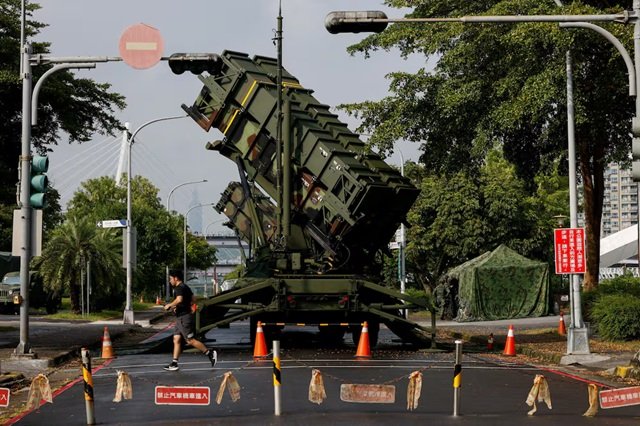
The postponement comes amid heightened tensions across the Taiwan Strait. Since Lai Ching-te of the Democratic Progressive Party assumed office in 2024, Beijing has intensified diplomatic and military pressure, suspended official contacts with his administration, increased military aircraft and naval operations near Taiwan, and conducted exercises simulating blockades and attacks on ports and strategic infrastructure. This summer, China’s Coast Guard added further pressure by carrying out what it described as a law enforcement patrol near Taiwan’s coastline.
Historian Wang Fei-hsien of Indiana University told Nikkei Asia that Chinese regulators may also fear the film could generate “unnecessary diplomatic friction” or encourage “misinterpretations”. Although Beijing continues to advocate what it describes as “peaceful reunification”, it has repeatedly stated that it does not rule out the use of force to achieve what it considers a historic mission.
Domestic reaction to the film’s trailer has added another layer of complexity. Some nationalist groups active on Chinese social media criticised the production’s portrayal of Shi Lang as a national hero. These groups argue that the Manchu-led Qing dynasty conquered the Han Chinese Ming dynasty and therefore represented foreign invaders rather than legitimate rulers. From this perspective, the Zheng government represented the final legitimate Ming authority, making Shi Lang a collaborator rather than a unifying figure.
The controversy has revived interest in the so-called “Vision of 1644”, an interpretation circulating on Chinese online platforms that views the fall of the Ming dynasty as the conquest of Han civilisation by an external power. Supporters contend that Manchu rule ultimately contributed to China’s weakness in the face of Western powers during the nineteenth century. Following the trailer’s release, some users criticised the film’s cast on social media and called for a boycott.
The debate poses a broader challenge to official historical narratives. The Chinese government presents the People’s Republic as a unified state comprising 56 recognised ethnic groups and portrays Chinese history as a continuous civilisation jointly built by all of them. This interpretation also underpins Beijing’s sovereignty claims over regions such as Inner Mongolia, Xinjiang and Tibet, whose incorporation into the Chinese empire largely occurred during Qing rule. Recasting the Manchus as foreign conquerors could therefore undermine the historical narrative supporting China’s territorial claims.
Chinese authorities have already responded publicly to similar historical interpretations. In late 2025, a platform linked to the National Ethnic Affairs Commission described Emperor Kangxi’s campaign in Penghu as “inevitable” after peaceful reunification efforts had failed. The Zhejiang Provincial Propaganda Department also published a rebuttal of the “Vision of 1644”, later republished by CCTV, rejecting Han-centred historical interpretations and defending the Qing dynasty’s contribution to China’s territorial development. A separate article in the China Social Sciences Daily, citing researchers from the Chinese Academy of Social Sciences, argued that such interpretations threatened ethnic cohesion, national identity and territorial integrity while providing arguments for separatist movements.
For now, The Battle of Penghu remains without a release date, leaving one of China’s most ambitious patriotic productions in limbo as political sensitivities, historical debate and cross-strait tensions converge.