by Our Correspondent in Colombo
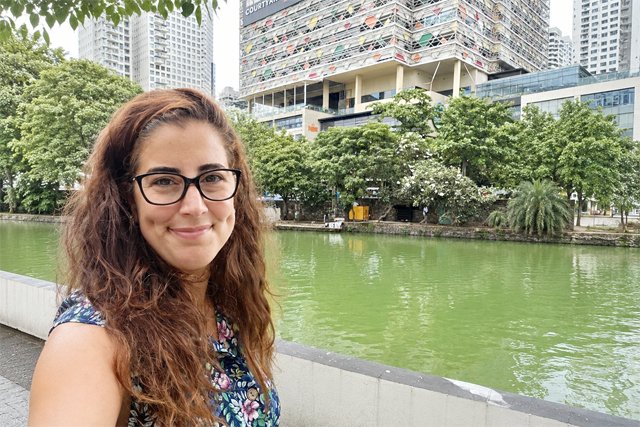
Dr. Lauren Dagan Amoss has spent much of her academic and professional career examining India from outside South Asia, studying the country’s foreign policy, security calculations and evolving relationships with major powers. A political scientist, lecturer and researcher at Bar-Ilan University in Israel, her work has focused particularly on India’s relationship with Israel, strategic autonomy, multi-alignment and the wider strategic dynamics of the Indo-Pacific. Her doctoral research examined the evolution of India’s foreign policy towards Israel, while her more recent work has widened the lens to India’s balancing among major powers and the strategic significance of the blue economy. Her work has increasingly placed India not simply within the familiar framework of great-power rivalry, but at the centre of an international system in which strategic autonomy, economic interests, security partnerships and regional calculations intersect.
This is the second time we have spoken with Dr. Dagan Amoss. The earlier conversation focused on India–Israel relations and the strategic thinking behind Narendra Modi’s engagement with Israel. This time, the discussion turns towards the Indian Ocean, Sri Lanka and the meaning of strategic autonomy in a region where geography, security, connectivity and competing interests increasingly converge.
This was Dr. Dagan Amoss’s first visit to Sri Lanka, where she came to attend a conference. We also had a brief conversation with her shortly before her departure. That initial exchange has now been followed by a more extensive discussion examining India’s multi-alignment, the continuing evolution of India–Israel relations, Sri Lanka’s strategic agency, the responsibilities that come with its Indian Ocean location, the choices available to smaller states and what the wider world may still be getting wrong about the region.
India’s foreign policy is often described through the language of strategic competition, with partnerships, rivalries, alliances and spheres of influence shaping much of the discussion. But Dr. Lauren Dagan Amoss approaches the question from a different starting point. For her, the central issue is not whether India aligns itself with one power or another, but whether it retains the freedom to make its own choices. That distinction, she argues, is essential to understanding India’s changing engagement with the world.
Asked whether multi-alignment itself can eventually become a form of alignment, Amoss frames the issue around strategic autonomy rather than labels. “Multi-alignment is not simply about avoiding alignment,” she says. “It is about preserving strategic autonomy and maintaining the freedom of copyright with different partners of different issues.” The phrase was spoken in the course of an interview, but the underlying argument is clear. India can work with different powers without necessarily surrendering the freedom to make independent decisions.
There are, she acknowledges, circumstances in which India may move considerably closer to one group of countries on a particular issue. The Indo-Pacific is one example. India works closely with the United States, Japan and Australia, but such cooperation does not automatically mean that New Delhi has abandoned strategic autonomy or entered a conventional alliance structure.
For Amoss, the decisive test is whether India retains the capacity to disagree with those partners. “Multi-alignment becomes more alignment only when a country loses the ability to say no to its partners,” she says. “As long as India retains independence, decision-making, and the ability to cooperate without different actors according to its own interests, I will still call it multi-alignment.” The question, therefore, is not simply how many partnerships India maintains, but whether those partnerships ultimately restrict its freedom of action.
That distinction also informs her assessment of India’s relationship with Israel, a subject central to her research and to our earlier conversation. One assumption about the relationship that she considers simply wrong is that India–Israel ties are primarily about defence and security. Defence cooperation remains important and has historically been one of the strongest pillars of the relationship, she says, but it no longer captures the breadth of the partnership.
“Today, the relationship is much broader,” Amoss says, pointing to cooperation in agriculture, water management, technology, cyber, quantum, trade and other areas. She therefore prefers to describe India–Israel ties as “a strategic partnership” rather than simply a defence relationship.
At the same time, she does not regard the partnership as a finished project. “I don’t think the relationship has reached its full potential yet,” she says. Among the areas in which cooperation could be expanded are technology, connectivity, research, education, innovation and people-to-people relations. The relationship, in her assessment, is “still developing”.
Her understanding of India’s relationship with Sri Lanka begins with something more permanent than diplomacy — geography. Colombo, she says, understands that India is not simply another external power entering Sri Lanka’s strategic environment. “Geography, history, economy, and security make India a permanent factor in Sri Lanka’s strategic environment.”
But recognising India’s regional importance does not mean treating Sri Lanka as a passive participant. One of the points Amoss repeatedly returns to is Sri Lanka’s own strategic agency. “Sri Lanka is not simply responding to India, China, and the U.S. or any other power,” she says. The country has its own domestic constraints, economic priorities and foreign-policy interests.
For New Delhi, that means understanding the relationship in terms that go beyond influence and response. “The relationship between India and Sri Lanka has a complicated history and that cannot be ignored,” she says. But precisely because India is the major regional power, she argues, it carries “a special responsibility to develop a clearly more consistent and more flexible strategy for Sri Lanka”.
That observation leads naturally into the question of the sea around Sri Lanka and the concept of the blue economy. Amoss is cautious in discussing the issue because, as she acknowledges, she is still learning about Sri Lanka. Her first visit has given her an initial impression rather than anything resembling a final assessment.
Her impression is that Sri Lanka understands the importance of its location in the Indian Ocean. But location, she argues, creates obligations alongside opportunities. “Geography creates opportunities and responsibilities for the same time.” Sri Lanka must navigate the interests of India, China, the United States and other actors while simultaneously managing its own economic and domestic challenges. From what she has observed, she says, “Sri Lanka is learning how to manage this position quite carefully.”
The blue economy, in her understanding, therefore cannot be reduced to ports and commerce. “The blue economy is not only about port trade and economic opportunities,” she says. It also encompasses maritime security, stability, environmental protection, fisheries, connectivity and regional stability. Sri Lanka’s geographical position gives it “significant strategic weight”, but that weight also creates considerable responsibility for the development of the Indian Ocean.
Her first experience of Sri Lanka has altered some of her own perceptions as well. She had wanted to visit for a long time, and the conference that brought her to the country provided the opportunity. But one week, she now feels, was hardly enough. “My biggest mistake was that probably coming for only one week, because now I realize how much more there is to see and learn.”
What surprised her most was “the combination of diversity and complexity”. The physical beauty of the country was evident, but it was the people who particularly caught her attention. She found them “incredibly warm, polite, and welcoming”. She was also interested in the diversity of Sri Lankan society and in the different communities, religions and identities that exist within what she described as a relatively small country. “Coming from Israel, this is something I neutrally pay attention to,” she says.
Yet Amoss is careful about the limits of a first visit. “One visit does not make anyone an expert on the country,” she says. Instead, the experience has encouraged her to learn more, academically as well as personally. “I generally hope my second visit will happen.”
Her argument about smaller states in the Indian Ocean follows the same principle that underpins her understanding of Indian multi-alignment. Independence depends upon retaining choices. When great powers compete, smaller countries should cooperate with them, she argues, but should avoid becoming completely dependent upon any single power.
Her first red line, she says, should be “severity”, before explaining the principle in terms of diversification. Economic partnerships, security partnerships, infrastructure, investment and diplomatic relationships all need to be diversified. “Dependence on a single major power cannot eventually reduce strategic freedom,” she says.
But the responsibility does not rest entirely with smaller states. Great powers, she argues, must also recognise that smaller countries have choices. “They cannot assume that influence is automatic. They have to remain attractive partners.”
For smaller Indian Ocean states, therefore, neutrality is not necessarily the objective. Instead, Amoss argues for “maintaining maximum strategic room for maneuver while protecting sovereignty and regional interests”. The phrase echoes her earlier definition of Indian multi-alignment and its emphasis on preserving freedom of choice.
It is perhaps in her final answer, however, that Amoss’s wider understanding of the Indian Ocean becomes clearest. Asked what the world may be getting completely wrong about the region over the next decade, she identifies what she sees as a persistent failure, particularly in the West, to appreciate the importance and many-layered character of the Indian Ocean.
Too often, she argues, the region is reduced to individual themes such as China, American security, shipping routes or great-power competition. “But the Indian Ocean is much more than that.” It connects South Asia, the Middle East, East Africa and Southeast Asia, and is becoming increasingly important for energy trade, supply chains, digital connectivity and security.
The greater danger, she suggests, is trying to understand the region from a distance. “You cannot understand this region from distance,” she says. A single visit to a port or a single story about China cannot explain the strategic dynamics of the region. “Every country has its own history, domestic politics, sensitivities, and interests.”
Her final point brings the discussion back to the central theme running through all seven answers. India’s relationship with the world cannot be reduced to alliance structures. India–Israel ties cannot be reduced to defence. Sri Lanka cannot be reduced to an object of competition between larger powers. And the Indian Ocean cannot be reduced to a map on which great powers mark their strategic interests.
“If I identify one mistake,” Amoss says, “it is that we will still tend to treat the Indian Ocean as a strategic space in the map rather than as a complex political region that requires much deeper knowledge.”
For someone whose research has long examined the interaction between India, Israel and the wider strategic order, her first encounter with Sri Lanka has added another dimension to that understanding. The Indian Ocean, in her telling, is not simply where great powers meet. It is where countries with different histories, interests, vulnerabilities and ambitions attempt to preserve their choices. Understanding that region, she suggests, requires looking beyond the strategic map and paying closer attention to the countries and societies that give it meaning.