by Our Correspondent in Colombo
As Cardinal Malcolm Ranjith rejects the death penalty while continuing to demand answers over the Easter Sunday attacks, a more fundamental question is becoming increasingly difficult to avoid: has the search for justice become entangled with an unproven theory of a hidden mastermind, even as the courts establish specific and legally defined forms of responsibility?
For seven years, Sri Lanka has lived with the unresolved trauma of the Easter Sunday attacks. More than 250 people were killed when suicide bombers struck churches and hotels on 21 April 2019, leaving grieving families with questions that have never entirely disappeared. Who planned the attacks? Who facilitated them? Who knew? Who failed to act? And was the massacre solely the work of the extremist network that carried it out, or was there a wider conspiracy?
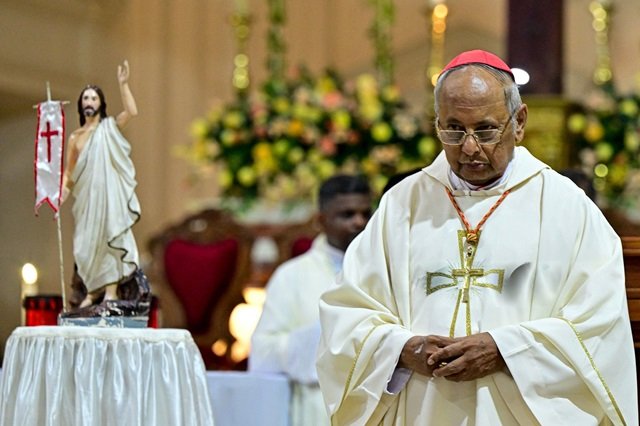
The Catholic Church, led by Archbishop of Colombo Malcolm Cardinal Ranjith, now 78 and approaching his 79th birthday in November, has made the search for answers about the attacks one of its most persistent public campaigns. That demand for justice is legitimate. But the more the Church invokes the possibility of a hidden mastermind, the more important it becomes to distinguish what has been established in court from what remains an allegation.
That distinction is particularly important in relation to Nilantha Jayawardena, the former Director of Sri Lanka’s State Intelligence Service.
Jayawardena has repeatedly been portrayed in public discourse as a central figure in the alleged security failure surrounding Easter Sunday. But the legal record does not establish that he was a mastermind of the attacks, nor that he participated in the terrorist conspiracy.
The Supreme Court’s January 2023 fundamental-rights judgment found senior officials, including Jayawardena, responsible for violations of the fundamental rights of victims in connection with failures before the attacks and ordered compensation. That was a serious judicial finding. But it is not the same as a finding that Jayawardena planned, facilitated or deliberately enabled the bombings.
The distinction has become even more important following the Colombo Permanent High Court Trial-at-Bar judgment of 31 July 2026, when former IGP Pujith Jayasundara and former Defence Secretary Hemasiri Fernando were convicted and sentenced to death in connection with their criminal negligence and failure to act on intelligence warnings concerning the impending Easter Sunday attacks. The judgment therefore established a specific form of responsibility: senior officials were held criminally liable for failing to respond adequately to intelligence warnings.
That judgment should not be converted into something it did not say. It does not establish a hidden mastermind. Nor does it establish that an intelligence officer deliberately joined the conspiracy.
This is where the public debate surrounding Jayawardena requires greater precision.
There is a profound difference between an intelligence failure, a failure to act on intelligence, criminal negligence, deliberate facilitation and participation in a terrorist conspiracy. Each carries a different evidentiary and legal burden. Conflating them may satisfy political narratives, but it does not advance a judicial determination of guilt.
Cardinal Ranjith has repeatedly raised the possibility of a political conspiracy and argued that the individuals identified as perpetrators do not represent the entire story. He has demanded that the alleged masterminds and all those associated with the attacks be identified. Those questions can and should be investigated. But a question is not a finding, a suspicion is not a conviction, and the repeated use of the word “mastermind” cannot substitute for evidence.
That makes the recent courtroom developments particularly significant.
If there is evidence of a mastermind beyond those already identified and prosecuted, where is it?
If there is evidence of a wider conspiracy, where is the evidence?
If there is evidence that an intelligence officer deliberately assisted the attackers, why has that evidence not been established before a competent court?
These are not questions designed to protect anyone. They are the minimum questions required by the principle of justice that the Church itself says it supports.
The same principle applies to the death penalty.
On 10 August, Cardinal Ranjith stated that the Catholic Church does not endorse capital punishment. Referring to paragraph 2267 of the Catechism of the Catholic Church, he said that capital punishment was inadmissible because it violated human dignity. At the same time, he reaffirmed the Church’s solidarity with the victims and its determination to identify the masterminds and all those associated with the attacks through the laws of the country.
That position is clear: justice, not revenge.
But consistency demands that the same principle apply to public accusations. If the Church believes that guilt must be determined through the established judiciary, then no intelligence officer should be publicly transformed into a mastermind without evidence establishing that claim.
This is also why the reported call by Catholic priest Father Rohan Silva for Jayawardena to be hanged raises an uneasy question for the Church hierarchy. For more than a year, the Church has remained largely silent as its Easter Sunday campaign increasingly echoed punitive and politically charged demands, yet Cardinal Ranjith now appears to have awakened from that deep slumber with a firm reaffirmation of Catholic teaching on capital punishment, almost as though a stronger voice from the Vatican, conveyed through its diplomatic presence in Colombo, had reminded the hierarchy that the Church’s principles must take precedence over political narratives.
When Father Rohan Silva publicly advocated the death penalty, Cardinal Ranjith did not directly rebuke him, with the Church instead relying on a third-party clarification that the remarks were his personal views. Yet Father Rohan continued to publicly identify himself as a Catholic priest, with no apparent disciplinary action. If the Church now insists that capital punishment violates human dignity, where was that principle when its own priest was publicly calling for an accused man to be hanged?
The answer should not depend on whether the accused is popular, unpopular, powerful or politically convenient.
The victims of Easter Sunday deserve the truth. They deserve to know who planned the attacks, who assisted the perpetrators, whether anyone deliberately facilitated them and whether any official knowingly failed to prevent them. But they also deserve a process in which established facts are separated from political theories.
At the same time, the victims themselves must be protected from those who may have exploited their anguish for ulterior motives, whether to gain political influence or financial benefit. The Church, too, must answer legitimate questions about transparency: years after the tragedy, it has yet to publicly disclose audited accounts detailing the funds received in the name of the Easter Sunday victims, leaving continuing questions over financial accountability and how those contributions have been handled.
Sri Lanka has already spent seven years navigating competing narratives about Easter Sunday. The courts have now established criminal responsibility in specific cases. That judicial process should be allowed to proceed without being overtaken by claims that remain unproven.
The Catholic Church has every right to demand answers. Cardinal Ranjith has every right to challenge governments and insist that investigations continue. But religious authority cannot replace evidence, just as political pressure cannot replace the courtroom.
If there is evidence of a mastermind, produce it.
If there is evidence of a conspiracy, establish it.
If there is evidence that an intelligence officer deliberately assisted the attackers, prosecute the case.
But where the courts establish negligence, dereliction of duty or failure to act on intelligence, that is what must be stated.
The Easter Sunday tragedy is too grave to be reduced to competing political narratives. The victims deserve justice, but justice cannot be built on an allegation simply because it has been repeated for years.
Cardinal Ranjith’s rejection of the death penalty is therefore only one test of consistency. The other is whether the campaign for accountability is prepared to subject every allegation — including the allegation of a hidden mastermind — to the same standard of evidence that it demands from everyone else.