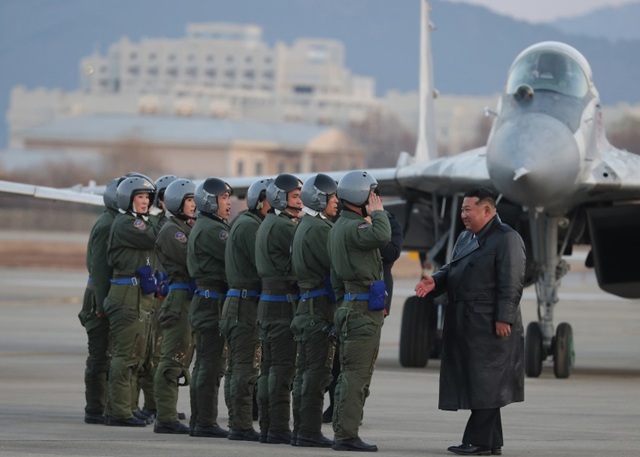
North Korea may be preparing to send another large contingent of troops to support Russia in its war against Ukraine, raising concerns not only about the immediate battlefield consequences but also about the longer-term military benefits Pyongyang is gaining from the conflict.
The assessment comes from Joseph S. Bermudez Jr., a North Korea military and intelligence specialist at the Center for Strategic & International Studies in Washington, D.C., in an interview with Der Spiegel. Bermudez, 72, has studied North Korea’s military, intelligence services and ballistic missile programme for decades and specialises in analysing satellite imagery to identify developments inside the country.
North Korea previously deployed an estimated 15,000 soldiers from the end of 2024 to fight alongside Russian forces. Ukrainian President Volodymyr Zelenskyy has now said that as many as 50,000 North Korean soldiers could be deployed against Ukraine. Bermudez believes that figure may represent the total number of North Korean military personnel in Russia rather than the number expected to fight directly at the front. Of those, he estimates that perhaps 30,000 could occupy combat positions, with others serving in support roles such as engineering, road and bridge construction and the maintenance of ammunition depots.
The potential deployment comes alongside reports that a North Korean missile unit has been moved to western Russia. According to Ukrainian services, the unit is equipped with 120 ballistic missiles, while North Korean missiles are believed to have been used in recent attacks against Kyiv.
Bermudez said Russian forces can now effectively operate North Korea’s KN-23 and KN-24 ballistic missiles with their own personnel. Some North Korean engineers and technicians were likely involved initially, but Russian units now appear capable of using the missiles routinely. Their reported use against Kyiv, he said, indicates that Russian forces understand how to operate them effectively.
The continued presence of North Korean personnel in the missile programme nevertheless serves a wider purpose for Pyongyang. According to Bermudez, Kim Jong Un wants the unit in Russia because its involvement deepens Russia’s dependence on North Korea. Kim also regards participation in the war as important to his own ambitions as a global political figure.
The arrangement is not without compensation. The precise terms are not publicly known, but Bermudez said they must be substantial. Economic assistance is one element, while the exchange of military technology and supplies, including oil, are also possibilities.
For Pyongyang, however, battlefield information may be among the most valuable returns. The performance of North Korean weapons in actual combat provides information that cannot easily be obtained through exercises or observation.
That experience has already had an effect on weapons production. Bermudez said some North Korean ammunition initially supplied to Russia was of poor quality and failed. Military personnel returning information to North Korea changed that situation. Kim has subsequently visited ammunition factories, creating direct pressure to improve production standards.
The result, Bermudez said, has been clear: “the quality of the weapons has risen.”
The battlefield itself is becoming a training ground for the North Korean military. Before its involvement in the Ukraine war, North Korea had only limited experience of modern warfare, gained largely through military observers in different countries. Its personnel can now learn directly from a high-intensity conflict involving extensive electronic warfare and widespread drone use.
That experience extends well beyond sophisticated weapons. North Korean soldiers are learning how small drones operate and how disruptive they can be on the battlefield. They are also gaining experience in practical military questions, including whether protective clothing performs adequately in difficult conditions, how ammunition is kept dry and how wounded personnel are evacuated.
The first deployment came at a significant cost. British intelligence estimated in early 2025 that approximately 4,000 of the 11,000 North Korean troops deployed at the time had been killed or wounded, representing about 36 per cent. Many of those troops were reportedly drawn from North Korea’s special forces and were considered among its best personnel.
Yet the losses did not necessarily make the deployment a failure from Pyongyang’s perspective. According to Bermudez, North Korean forces suffered severe casualties but learned rapidly from the experience. Officers who returned to North Korea are likely to have helped train those preparing for a new deployment.
“We must assume that the North Koreans will fight more effectively this time,” Bermudez said.
Where those forces would be deployed remains uncertain. Some could return to the Kursk region, where North Korean troops previously operated along the front near the Ukrainian border. Others could be sent further south towards the Donbas. North Korean forces would presumably favour concentrated deployments, while Russian commanders could distribute them according to battlefield requirements.
The consequences could extend well beyond Ukraine. The soldiers returning to North Korea will take their experience of modern warfare with them, potentially improving the wider Korean People’s Army.
“The quality of the North Korean army, the fifth-largest army in the world, is improving, which makes it more dangerous,” Bermudez said. The speed at which those improvements spread throughout the military remains uncertain, but he expects North Korea’s capabilities in missiles, cruise missiles, drones and electronic warfare to improve.
South Korea and the United States are aware of the development, Bermudez said, but adapting quickly to those changes remains difficult.
The deepening military relationship between North Korea and Russia also has implications for China. Beijing previously had considerable leverage over Pyongyang as North Korea’s principal supplier of petroleum products, military technology and food. A stronger Russian role reduces that dependence and potentially weakens China’s ability to exert pressure on Kim Jong Un.
China is watching the changes closely, particularly whether Kim becomes more aggressive, although Bermudez does not believe the relationship between Moscow and Pyongyang has yet reached a level that would cause Beijing serious concern.
Inside North Korea, the war carries another set of consequences. The regime initially concealed both the deployment of its troops and their losses. But wounded soldiers eventually returned home, making secrecy increasingly difficult to maintain. Kim responded by publicly recognising the sacrifices and establishing a monument in Pyongyang to North Korean soldiers killed in Ukraine.
Families of fallen soldiers are also likely to receive compensation, including survivors’ pensions, according to Bermudez. The regime has therefore attempted to control the political consequences of casualties by incorporating them into a narrative of national sacrifice.
North Korean propaganda presents the war in different terms. State media portray the soldiers as courageous internationalists supporting Russia, describing their participation as repayment for the assistance once provided by the Soviet Union while simultaneously creating a debt that Russia owes North Korea. The campaign also frames the conflict as part of a wider struggle against what North Korea calls US imperialism.
The Ukrainian population itself appears largely absent from that calculation. Bermudez argues that Kim’s decision reflects a strategic opportunity as much as ideology: participation can generate money, military experience and international influence.
The consequences, therefore, extend beyond the battlefield in Ukraine. Russia is gaining manpower and access to North Korean military capabilities, while North Korea is gaining something more difficult to obtain through conventional training: experience of modern war under real combat conditions.
That exchange could leave a lasting mark. The first deployment exposed North Korean troops to heavy losses, but it also exposed them to the realities of drones, electronic warfare, logistics and modern battlefield coordination. If a second deployment follows, those lessons are likely to be carried into a force that has already demonstrated an ability to learn from its failures.
For the Korean Peninsula, that may ultimately be the most consequential outcome of North Korea’s involvement in the Ukraine war. The conflict is not only providing Pyongyang with military returns in the present; it is giving its soldiers and weapons systems experience that could improve the capabilities of North Korea’s armed forces for years to come.