


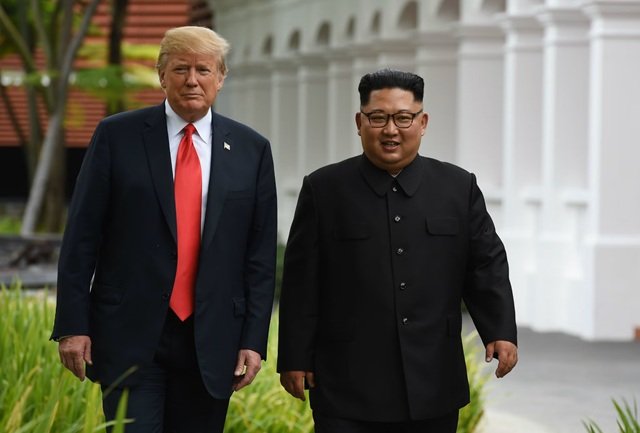
US President Donald Trump has ordered the Pentagon to “substantially reduce” an annual round of joint military exercises with South Korea, arguing that the drills are costly and send an inappropriate and hostile signal to North Korea. The decision came just hours before the exercises were due to begin, placing renewed attention on Trump’s longstanding effort to limit or end large-scale military manoeuvres with Seoul and his stated desire to maintain a close relationship with North Korean leader Kim Jong Un.
Writing on Truth Social on Sunday, Trump said he was “not happy” that the United States had agreed to conduct such exercises in the past. He described the drills as sending a “totally inappropriate and hostile” signal to a country that, during his presidency, he said had been “unthreatening and respectful”. Because it was too late to cancel the exercises altogether, Trump said he had instructed Defence Secretary Pete Hegseth, whom he refers to as “War Secretary”, to reduce them substantially.
The annual Ulchi Freedom Shield exercises began on Monday as scheduled and are due to continue until August 27. About 18,000 South Korean military personnel are participating. The exercises are intended to strengthen the two countries’ defensive capabilities and prepare them for a possible defence against North Korea. Officials said last week that this year’s training was expected to include operations designed to counter drones, disrupt GPS signals and respond to cyberattacks, reflecting the changing capabilities attributed to North Korea.
South Korea’s Joint Chiefs of Staff confirmed to Reuters that the exercises began as scheduled but declined to comment on Trump’s remarks. The country’s presidential office and its defence and foreign ministries did not immediately respond, with Monday being a public holiday in Seoul. A Pentagon spokesperson referred questions about the next steps for the exercises to the White House, which did not immediately respond to a request for further information.
Trump’s latest intervention also links the military exercises to a broader pattern in his dealings with Seoul and Pyongyang. He has repeatedly sought to curtail exercises with South Korea, describing them during his first term as provocative and costly. He has also clashed with Seoul over the cost of stationing 28,500 US troops in South Korea and their role in securing the wider region.
His latest statement came shortly after he publicly emphasised his relationship with Kim. On Saturday, Trump shared a photograph of himself alongside the North Korean leader and highlighted what he described as their “very good relationship”. Trump has repeatedly sought contact with Kim, meeting him several times during his first term. Their 2019 summit in Hanoi ended after a diplomatic dispute, with Kim leaving early. During Trump’s second term, when he travelled to Asia in the autumn of 2025, he again expressed interest in meeting Kim, although another meeting has not taken place.
The relationship between the two leaders has shifted dramatically over the years. Trump once mocked Kim as “little rocket man” and threatened North Korea with “fire and fury”, while Kim responded by saying he would “tame the mentally deranged U.S. dotard with fire”. Yet the confrontation was followed by three summits, and Trump later declared that the two leaders had “fell in love” after exchanging letters. Those diplomatic efforts did not result in changes to North Korea’s nuclear weapons or ballistic missile development.
Trump’s latest decision comes as Washington continues to maintain its stated objective of the complete denuclearisation of North Korea. The largely isolated country remains subject to extensive United Nations sanctions because of its nuclear programme, as well as additional US sanctions. United Nations Security Council resolutions also generally prohibit North Korea from launching ballistic missiles.
Despite those restrictions, North Korea has conducted several missile tests recently. Experts have interpreted the launches as demonstrations of power and expressions of opposition to the annual US-South Korean military exercises. Pyongyang routinely denounces the drills as preparations for an invasion. On Wednesday, North Korea fired a ballistic missile from its eastern coast towards the Sea of Japan, according to South Korean and Japanese militaries, six days after a similar short-range ballistic missile launch on August 6.
Trump also referred to another source of tension with Seoul: South Korea’s position on US-Israeli actions involving Iran. In his Truth Social post, he said that he had recently asked South Korean President Lee Jae-myung whether Seoul would join US efforts in the “Denuclearization of the Islamic Republic of Iran”, adding that the response had been, “No thanks!”
It remains unclear how the Ulchi Freedom Shield exercises will be reduced. In recent years, the drills have already moved away from live-fire exercises towards computer-simulated missile and cyberattacks. The uncertainty surrounding Trump’s instruction therefore comes at a time when the nature of the exercises is itself changing to address emerging military capabilities.
US military officials have said North Korean troops who have fought alongside Russia in its invasion of Ukraine have gained battlefield experience, including in the use of unmanned systems, electronic warfare and cyber operations. Ukraine said last week that North Korean-made missiles were used in a Russian ballistic missile attack on a steel plant in Zaporizhzhia that killed seven workers and forced a halt to production. Russia’s Zircon hypersonic missiles were also used in the attack.
The military implications were further highlighted last week by Lieutenant General Joseph Jarrard, a high-ranking US Northern Command official, who warned that North Korea had successfully tested intercontinental ballistic missiles with “enough boost to deliver a nuclear payload anywhere in North America”. Such developments, he said, complicate efforts to defend the US homeland.
For Jenny Town, head of the Stimson Center think tank’s 38 North programme, Trump’s decision may form part of a broader effort to create a diplomatic opening with Pyongyang. She said Trump had consistently sought such an opportunity since returning to office, while adding that the “haphazard nature” of the move was unlikely to make much of an impression in Pyongyang.
The decision therefore places two elements of US policy in close proximity: the military alliance with South Korea and Trump’s pursuit of a relationship with North Korea’s leader. While Washington continues to declare its commitment to North Korea’s denuclearisation, Trump is simultaneously seeking to reduce exercises that Pyongyang has long regarded as hostile. The immediate effect on this year’s drills remains unclear, but the order marks another significant turn in the long and unpredictable relationship between Trump, Kim and the Korean peninsula.










