



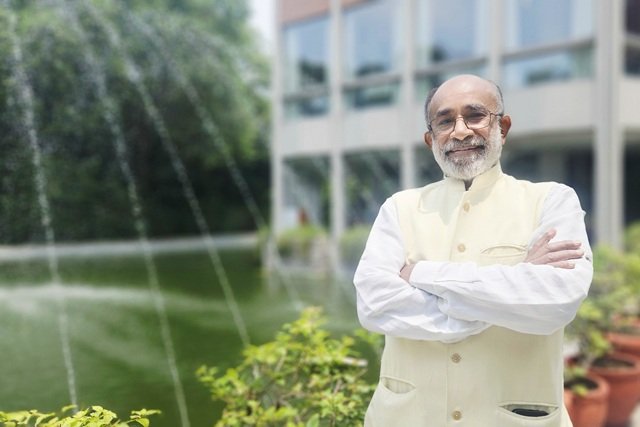
“My fight was against the mafia, not against the citizen, and I am a libertarian. At the same time, I would say I am absolutely left.” K. J. Alphons, former Union Minister, said when I recently sat down with him in New Delhi for an extended conversation about power, bureaucracy, politics and the future of India. He speaks with little interest in the cautious language that usually surrounds Indian public life. His answers are direct, often provocative and sometimes deliberately uncompromising. A former Indian Administrative Service officer who went on to become a Kerala legislator, BJP politician, Rajya Sabha member and Union minister, Alphons discusses bureaucracy, Narendra Modi, Kerala, political ideology, economic development, education, technology and India’s future with the confidence of a man who believes that India’s fundamental problem is not a shortage of ideas but the failure to turn them into results. Yet beneath the force of his assertions lies a more complicated political philosophy, one that combines libertarian economics with an insistence that the state must protect the poor, admiration for strong leadership with a belief that India must remain democratic, and an almost relentless faith in individual determination with a deep frustration at the institutions he once served.
Alphons Kannanthanam, a former Indian Administrative Service officer, served in the Kerala cadre for 27 years before leaving the service and entering electoral politics. He became District Collector of Kottayam and later Commissioner of the Delhi Development Authority, where he acquired the reputation of the “Demolition Man” for his campaign against illegal construction and encroachment. He subsequently entered the Kerala Legislative Assembly as an independent candidate supported by the Left Democratic Front. In 2011, he left that political arrangement and joined the Bharatiya Janata Party, a decision he says was made principally because he believed Narendra Modi possessed the determination and administrative record required to lead India. He later became a Rajya Sabha member and Union Minister for Tourism and Electronics and Information Technology. His career has therefore crossed institutional and ideological boundaries that are not easily reconciled within the conventional categories of Indian politics.
Dream like an elephant, not like an ant
Yet the origins of his worldview lie much further back, in a Kerala that he says has largely disappeared. His father was a schoolteacher who had fought in the Second World War, including at the Battle of Kohima, where the Allied forces repulsed the Japanese advance from Burma. His father had entered the British Army with a distinctly Indian calculation. He believed that if Indians helped defeat the Japanese and Germans, Britain would reward that loyalty by granting India independence. The experience left him disillusioned. Churchill’s hostility to Indian independence convinced him that the expectation had been misplaced, and he left the army after the war and returned to teaching. The story became part of the moral inheritance of the family. His father was not wealthy. The family had five acres of land and eventually eleven children, including two adopted from an orphanage. Yet Alphons remembers a household in which poverty was not understood merely as an economic condition belonging to other people. His parents built a house for a poor family every year. Food and provisions were available to neighbours who needed them. His father, despite being a schoolteacher, became a point of contact for villagers dealing with the government, writing petitions, taking them to officials and often paying the costs himself.
The most revealing lesson his father gave his children was not about academic achievement. It was about labour. Before school in the morning, the children were made to work in the fields. In the evening, they worked again before they were allowed to play. His father’s phrase was that they had to know “the smell of the earth”. It was not simply an agricultural instruction. It was a philosophy of citizenship and human dignity. You should understand how food is produced, what labour means and what it means to earn your bread. Alphons sees that ethic as characteristic of an older Kerala in which even wealthy families worked alongside their employees. He recalls that his own family ate with workers, including people from Scheduled Castes, because his grandfather insisted that they were entitled to sit at the same table and eat the same food. The principle, as he understood it through the Christian ethic of his upbringing, was simple. “We are all one.”
That memory is central to his explanation of Kerala’s achievements. He has no difficulty acknowledging the extraordinary social progress of the state. He points to education, healthcare, equality and social indicators as achievements that many parts of India have struggled to reproduce. But he sharply separates those achievements from what he sees as the contemporary work ethic of Kerala. “It’s completely gone,” he says when asked whether the old spirit of enterprise remains. His criticism is deliberately blunt. The children of the generation that accumulated wealth, he argues, inherited the results without inheriting the discipline. In his telling, the old culture of work has been replaced by a culture in which people can afford to avoid work. He recalls seeing queues outside bars from ten in the morning and argues that Kerala has become a “talk shop”. “We talk a lot. But nothing else much happens.”
This is not nostalgia for poverty. Alphons is careful to say that his own family did not feel poor. They had enough to eat, land to cultivate and a supportive community. His ambition, therefore, was not born simply from deprivation. It came from an internal conviction that he could do more. That conviction was tested early. He scored only 42 per cent in his school board examinations and remembers that his headmaster believed he would fail. Instead of accepting the judgement, he decided that neither the headmaster nor anybody else had the authority to determine whether he was intelligent or talented. “It’s not somebody else who will decide whether I’m intelligent,” he says. That moment appears to have established one of the most persistent characteristics of his personality. Failure is acceptable. Submission to somebody else’s definition of your limits is not.
He approached his deficiencies in the same manner in which he later approached administration. English was weak, so he taught himself. He learnt words from a dictionary, worked through 25 pages a day, constructed sentences to understand how words functioned in context and practised speaking by addressing a wall. He listened to BBC speaking lessons and imitated them because he wanted an English that could be understood internationally. When he decided to become a debater, he practised again. His first public attempt was catastrophic. The audience shouted. Then came paper. Then books. Finally, shoes. By the time he finished speaking, he says, there were approximately 250 shoes on the stage. He did not stop. The humiliation became fuel rather than a verdict. He eventually became a national debating champion and won major college prizes. His explanation is characteristic. “When you get beaten, you stand up and you decide, no, I’m not going to get beaten up once again.”
The same mentality shaped his entry into the IAS. He did not want the service because of the prestige of the red beacon, the official car or the status associated with being an administrator. He wanted power because he believed power was necessary to change people’s lives. “I want to bring happiness on the face of people,” he says. In his calculation, the IAS was the most powerful job in India through which he could pursue that objective. His preparation for the civil service examination was consequently less romantic than methodical. He had nine months. He planned every day before opening a book. Six months would be devoted to study and three to revision. He would study for eight hours rather than pretending that 15 hours of exhausted reading constituted discipline. Every subject was divided into precise blocks. Every chapter had its place. His notes became progressively shorter, eventually fitting on a library catalogue card. He would read, reduce the material to numbered points, memorise it and then reproduce the structure in the examination. The result was that the candidate who had once scored 42 per cent topped the written examination.
From this he draws a lesson that extends beyond examinations. Ambition without organisation is useless, and hard work without intelligence is not enough. His formulation is almost deliberately theatrical. “Dream like an elephant, not like an ant.” But he immediately qualifies the slogan. Dreams become reality through “hard work” and “systematic work”. There is, he insists, “no point working like a donkey”. The distinction matters because his philosophy of public administration is built on the same premise. Effort must produce measurable results.
His contempt for bureaucratic complacency is consequently personal. At the Lal Bahadur Shastri National Academy of Administration in Mussoorie, he says, many newly selected officers begin behaving as if they have become gods. The selection process is so difficult, and the number of successful candidates so small, that the service itself can encourage a sense of superiority. His conclusion is brutal. “IAS has become an extremely arrogant service.” His objection is not merely to individual arrogance but to the culture created when authority becomes detached from accountability. Passing an examination, he argues, does not confer the right to look down upon citizens. Power has a purpose. It must be used to bring dignity and happiness to the people over whom the state exercises authority.
That principle explains his description of his 27 years in the IAS as “completely unconventional” and “completely out of the box”. He says he did not regard rules as sacred when rules prevented citizens from receiving legitimate assistance. He would break rules for people, he says, but never for his own financial or personal benefit. His office was open. People did not require appointments. He answered calls. He wanted citizens to believe that an officer was there to listen and act rather than to hide behind procedure.
His record as an elected representative followed the same model. As an MLA, he rejected what he regarded as the conventional political culture of attending marriages and funerals and maintaining personal relationships for electoral purposes. His job, he believed, was development. In his constituency, village meetings would be organised in which residents were asked to identify their priorities and then reduce them to three concrete demands. He would turn those demands into projects and pursue the necessary funding. He claims that he brought approximately ₹350 crore into the constituency over five years, more than any other MLA had obtained and more than the Chief Minister had secured during the comparable period. More important to him than the figure was execution. Bridges, he says, were completed within 100 days. A 100,000-square-foot mini civil station that had been assigned a four-year construction period was completed in 427 days. Countdown boards were erected publicly, with the number of days remaining until completion. On the day the counter reached zero, the project was inaugurated.
“I don’t believe in slow incremental growth. I think we need to come with a bang.”
The physical building itself is an expression of his approach. He designed the concept of the civil station with the assistance of an architect whom others in the Public Works Department regarded as brilliant but eccentric. Alphons’s instinct was not to exclude the difficult person but to give him responsibility. The two engineers responsible for execution were women. It is a small detail, but it fits his wider belief that competence matters more than convention. The question for him is not whether an individual fits an established bureaucratic mould. It is whether that individual can deliver.
His subsequent move from Left-backed independent politics to the BJP is therefore best understood through his own description rather than through the standard narrative of ideological conversion. He says the decision was made in 2011 because he wanted a strong Prime Minister. He had watched Narendra Modi as Chief Minister of Gujarat and concluded that Modi had the determination to get things done. “The only reason why I joined the BJP was because of Narendra Modi,” he says. “It’s got nothing ideological.” He wanted someone who would “set things right”, eliminate corruption, put food on the table, provide education and create employment. He rejected an offer from the Left’s leadership to remain within its political structure and potentially receive a ministerial position in Kerala. His answer, as he recounts it, was that the decision was about national interest rather than personal advancement.
This is where his political identity becomes difficult to classify. He calls himself a libertarian, a capitalist and, simultaneously, “absolutely left”. His libertarianism means that people with money should be allowed to create wealth and jobs without bureaucratic obstruction. He wants less red tape, more enterprise and a state that does not prevent investment. Yet he rejects the proposition that the market alone can protect the vulnerable. “Poor cannot take care of themselves,” he says. “The government should take care.” He sees no contradiction. Wealth creation and social protection are not opposing principles in his conception of the state. The entrepreneur should be free to create wealth, while government must ensure that those without the means to protect themselves are not abandoned.
His relationship with communism is similarly complicated. He does not claim to have been a Communist. He was an independent MLA supported by the Left. But he credits the communist movement with helping transform Kerala’s social structure by insisting upon equality, dignity and the right to a decent life. He does not reject its contribution simply because he rejects communism as his own political ideology. His politics are therefore less doctrinal than functional. He appears to judge systems according to whether they work.
That same criterion explains his continuing admiration for Modi. Alphons’s description of the Prime Minister is intensely personal. He says that when he meets Modi, the Prime Minister gives him complete attention, without phones, officials or distractions. He describes him as warm, extremely sharp and capable of understanding complicated problems quickly. Modi makes his own notes, Alphons says, and takes decisions quickly. What impresses him is not primarily ideological affinity but administrative capacity. “I don’t like people who just issue manifestos and speeches. I want somebody who will deliver actually on the ground.”
His defence of Modi is therefore built around delivery. He believes critics of the Prime Minister sometimes refuse to acknowledge what he regards as demonstrable achievements in housing, sanitation, LPG connections, financial inclusion, direct transfers, healthcare, roads, airports, defence production and digital payments. He is particularly enthusiastic about UPI, describing it as among the best digital payment systems in the world and pointing to its penetration among ordinary vendors. His book Accelerating India: 7 Years of Modi Government was intended to document what he regarded as physical achievements of the Modi government across 24 sectors rather than merely repeat political claims.
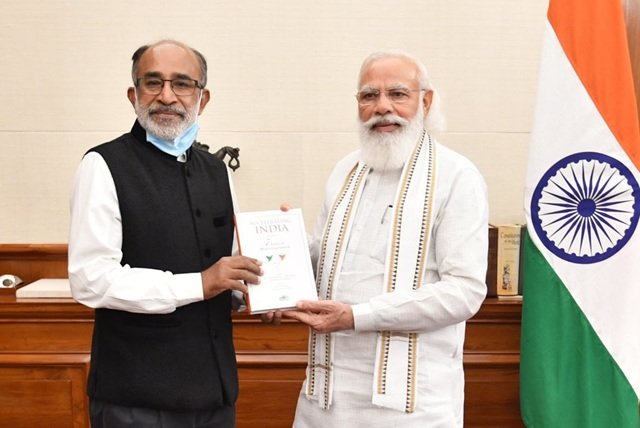
Yet Alphons’s account is not simply a catalogue of praise. When asked what Modi’s strongest supporters fail to see, he identifies complacency. A successful leader can create a political structure in which people assume that success will continue automatically. The Prime Minister may connect effectively with citizens, but the party organisation must do the same at village level. His criticism is revealing because it applies his own doctrine of administration to his political party. Winning an election does not remove the obligation to remain present among citizens.
His assessment of India’s future is equally mixed. He sees strong macroeconomic fundamentals and substantial infrastructure development, but he does not pretend that the country’s problems have disappeared. Industrial investment remains inadequate. Job creation is insufficient. Artificial intelligence could displace workers even in sectors in which India has traditionally enjoyed an advantage. Around half the population remains dependent upon agriculture, while fragmented landholdings create substantial underemployment. His argument is that India must move millions of people from agriculture into industry, something China accomplished through prolonged industrialisation. He is blunt about the scale of the challenge. India has too many people relative to the opportunities its economic structure currently creates, even though population growth has already fallen below replacement level.
The problem of education is equally deep. Alphons was involved in the drafting process for the New Education Policy and argues that India’s challenge is not simply a shortage of schools but a structural problem in how children are taught. Too many schools have single rooms and single teachers. Parents and teachers remain excessively invested in rote learning and examination rankings. His question is deliberately uncomfortable. How many parents genuinely want a child who can think, innovate and discover knowledge rather than merely achieve a high examination score? Government can build infrastructure and train teachers, but it cannot transform the educational culture without changing the expectations of parents and teachers themselves.
His concerns about child nutrition fit into the same pattern. He accepts that the government is providing food to hundreds of millions of people, but he refuses to equate food distribution with nutritional security. Children may be eating enough calories while failing to receive sufficiently nutritious diets. In his view, some of the problem lies in poverty, but much of it also lies in food habits. This is an important qualification to his broader defence of government delivery. The state cannot solve every social problem simply by spending more money.
His comments about the global economy are similarly cautious. India may be growing at roughly seven per cent, he says, and its reserves, inflation and consumption indicators may look healthy, but the external environment is extraordinarily unstable. Heavy dependence on imported fuel leaves India vulnerable to global price movements. The multilateral trading order has weakened. He describes the World Trade Organisation system as having crumbled after decades of negotiation and says the established international order has lost much of its authority. His assessment is not that India has solved its vulnerabilities, but that it has navigated an unpredictable world relatively well so far.
His views on Kerala’s BJP future reveal another tension. He acknowledges that the party remains an outsider in the state. He cites a rise in its parliamentary vote share from 5.6 per cent when he joined in 2011 to around 18 per cent in the parliamentary election he refers to, while noting that its Assembly performance remains below the level necessary to form a government. He rejects gradualism. “I don’t believe in this slow incremental growth. I think we need to come with a bang.” Yet he also recognises the strength of Kerala’s established political division between the Left Democratic Front and the United Democratic Front. The BJP, he argues, has to persuade voters that its record deserves consideration rather than simply waiting for the established system to collapse.
His view of democracy after Modi is less anxious than that of many political observers. He believes circumstances produce leaders and that the BJP has people at different levels and age groups who could eventually assume leadership. But he makes an important concession. Finding another politician with Modi’s determination and electoral appeal will not be easy. He does not predict what India will look like in 2050. He simply insists that India should remain a democracy and that it can become a developed country by 2047 if the machinery of government becomes dramatically more efficient.
And here he arrives at the target that has perhaps remained constant throughout his entire career. “Bureaucrats. My tribe.” That is his answer when asked what could prevent India from becoming a global power by 2047. He places politicians second and bureaucracy first. His criticism is not that bureaucrats are inherently incapable. It is that the system rewards the wrong behaviour. Officers write files, protect themselves, avoid responsibility and remain inaccessible to ordinary citizens. In his view, this mentality must be destroyed. “You are not here to write files. You are there to bring happiness.”
His own examples are intended as proof that a different administrative culture is possible. As District Collector, he says, he visited primary health centres regularly. When an elderly woman complained that she had repeatedly travelled to see him and demanded to know why he could not come to her village because “government has given you a car”, he changed the system. The resulting mass-contact programme took thousands of government officials into villages, gathered thousands of petitions and systematically addressed them. He says the programme was repeated across every village and that its political consequences were still visible 15 years later when he returned to contest an election as an independent without spending money.
The same combination of toughness and accessibility defined his relationship with officials. He claims to have told village officers that if they took even one rupee from a citizen, he would “kill” them. He used the language deliberately because he wanted the threat to be unmistakable. If he ordered an officer to complete something by five o’clock, he expected the call at five, not five minutes later. Yet he insists that those same employees adored him. His explanation is that discipline becomes legitimate when employees know that the person imposing it is acting for a larger purpose and is willing to impose the same standards on himself.
His DDA experience takes that philosophy to a more extreme level. He describes inheriting an enormous public land estate, much of it encroached upon, and discovering that powerful political figures were among the beneficiaries. He says he had no political support and was the first South Indian commissioner in the position, without strong Hindi skills. He nevertheless decided that the land would be protected. The campaign, according to his account, resulted in the demolition of 14,310 large illegal structures. He says he lived under extraordinary personal security threats, carrying a gun for five years, while his wife and children travelled under police protection. His wife was attacked and left for dead, he says, but survived.
There is no attempt in his account to portray this as a conventional exercise in compromise. His philosophy is unapologetically coercive when he believes the objective is legitimate. Yet he insists that strength must be targeted. “My fight was against the mafia, not against the citizen.” This distinction is perhaps the most important qualification to his advocacy of strong state action. A powerful state can protect citizens or intimidate them. For Alphons, the legitimacy of coercion depends upon identifying the right target and maintaining respect for the ordinary person.
That belief also explains why he rejects the suggestion that he was a dictator. His answer is that citizens liked him precisely because they experienced the administration as responsive rather than oppressive. He claims that a Times of India survey gave him 89.6 per cent support. Whether every element of this recollection withstands independent scrutiny is a separate question, but his underlying argument is unmistakable. Authority itself is not the problem. Authority without purpose, accountability and empathy is the problem.
The same philosophy informs his response to artificial intelligence. He rejects the idea that technology should govern in place of human beings. Politicians and administrators should use technology aggressively but retain responsibility for decisions. He points to his own experience as Commissioner for Entrance Examinations in Kerala, where he says a process that previously took three months was reduced to seven days using existing people, computers and machinery. The lesson, again, is not that machines automatically improve government. It is that leaders must know how to use them. He sees enormous potential for AI and drones in healthcare, education, road construction and infrastructure monitoring, particularly in a country whose sheer geographical scale makes conventional administrative supervision difficult.
“We all, elderly people, we all think that the young generation is useless. They know nothing. All that they’re doing is watching videos. But actually, no, they’re very smart. We need to listen to them.”
His most sympathetic comments are reserved for young people. He rejects the familiar complaint that Gen Z is distracted, politically apathetic or intellectually shallow. Older generations, he says, tend to assume that young people are useless because they spend so much time watching videos. He sees something else. They have access to knowledge that earlier generations never possessed. Their demands are not unreasonable. They want dignity, education, employment, skills, entrepreneurship, innovation and respect. The danger, in his view, is that a generation already frustrated by insufficient jobs and inadequate educational opportunities can become alienated when its grievances are dismissed.
He accepts that external political forces can exploit that alienation. He says there are extreme voices among young protesters and political movements, but also voices of moderation and maturity. The answer is not to dismiss the generation but to understand its basic message. “This country belongs to them.” That sentence perhaps contains the most democratic instinct in the entire interview. Older politicians, bureaucrats and administrators are already established. Their responsibility is not to preserve their own comfort but to create the conditions in which the next generation can build its future.
There is a striking consistency between this position and the story of the 80-year-old woman who forced him to rethink his administration. In both cases, the person with institutional power has to listen to the person without it. The citizen does not exist to make the administrator’s life convenient. The administrator exists to serve the citizen. The young person is not an obstacle to the political establishment. The young person is the reason the political establishment exists.
That may also explain why Alphons’s political philosophy refuses to settle comfortably into either the left or the right. He advocates capitalism but insists upon state protection for the poor. He praises a strong political leader but insists that democracy must endure. He admires administrative power but condemns bureaucratic arrogance. He supports technology but rejects surrendering human responsibility to machines. He praises government delivery but admits that government cannot solve every social problem. He is an admirer of Modi but warns against complacency within the BJP. He is proud of being a bureaucrat while identifying bureaucrats as the principal obstacle to India’s development.
There is a harder edge to all of this. Alphons has immense faith in personal will. He believes that a determined individual can overcome weak institutions, resistant officials, political pressure, humiliation and even physical danger. His career is presented as evidence. But the very force that makes his philosophy attractive also creates its central question. Can a modern democracy depend on unusually determined individuals to compensate for institutions that do not function properly? Or does the success of exceptional administrators risk concealing the deeper institutional weaknesses that require reform?
Alphons’s answer appears to be that exceptional leadership is necessary because systems do not change by themselves. He does not seem particularly interested in waiting for consensus. His instinct is to decide, organise, execute and measure. He wants countdown boards rather than promises, completed bridges rather than announcements, functioning offices rather than files, and citizens who can see the state working rather than hear politicians describe what it intends to do.
That is eventually the thread running through his story from the fields of Kottayam to the corridors of the Union government. His father’s lesson was to know “the smell of the earth”. His own lesson is that public power has meaning only when it touches the lives of ordinary people. The boy who was told he would fail refused to accept the verdict. The civil servant who entered a notoriously hierarchical institution refused to behave like a god. The collector who was challenged by an elderly woman went to the villages. The DDA commissioner who confronted powerful encroachers accepted extraordinary personal risks. The MLA turned residents’ demands into projects. The minister rejected routine files so that he could concentrate on creative work. The politician who crossed from the Left to the BJP says he did so not because he discovered a new ideology but because he believed one particular leader could deliver.
Whether one agrees with Alphons’s political conclusions is another matter. His account is openly partisan in places, particularly in its assessment of Modi and the BJP. Some of his numerical and historical claims would require independent verification before publication as established fact. But the interview is valuable precisely because he does not present himself as neutral. He presents a theory of government drawn from his own life, and he states it without apology.
For him, the test of politics is delivery. The test of bureaucracy is whether citizens receive justice. The test of power is whether it produces dignity rather than humiliation. The test of education is whether children learn to think rather than merely memorise. The test of technology is whether it helps the state reach people. The test of political leadership is whether promises become physical outcomes. And the test of democracy, in the end, is whether those who govern remember whom they are supposed to serve.
His most uncompromising demand is therefore also his simplest. “Deliver.” For Alphons Kannanthanam, that is not a slogan. It is the standard by which he wants his entire career to be judged.











Good afternoon, respected Nilantha bhai.
This compelling interview with K. J. Alphons is a bracing meditation on governance, leadership, and India’s unfinished developmental journey.
Its central proposition—that bureaucratic arrogance, inertia, and weak accountability can suffocate national ambition—is both provocative and profoundly relevant.
Alphons speaks from an unusually rich vantage point: administrator, reformer, politician, and minister. His insistence that governments must deliver rather than merely declare gives the conversation exceptional practical force.
Particularly striking is his conviction that public authority exists to serve citizens, not intimidate them. Despite its partisan undertones, the interview transcends political allegiance, offering a powerful reminder: India’s 2047 dream will ultimately depend upon accountable institutions, courageous leadership, administrative efficiency, and a relentless culture of results.
—Anwar A. Khan—
Witness to the conflagration that forged a nation in 1971,
Voice of an indomitable tempest that refused silence,
Born amid the inferno and tempered by truth,
Bearer of the Eternal Flame—
(From: Dhaka, Bangladesh).