


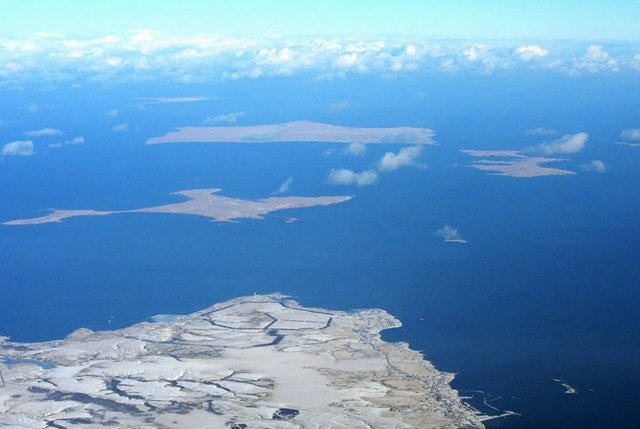
Russia’s decision to summon the Japanese ambassador has brought a 150-year-old territorial dispute back into sharp focus, underscoring the strategic importance of the Kuril Islands and the increasingly difficult relationship between Moscow and Tokyo.
The latest confrontation followed Vladimir Putin’s visit to Etorofu, one of the four islands claimed by both countries, marking the first time the Russian president had travelled there. Japan’s prime minister, Sanae Takaichi, described the visit as “completely unacceptable” and summoned the Russian ambassador in Tokyo. Russia responded in kind. Foreign minister Sergei Lavrov accused Tokyo of crossing the “line of decency” and summoned the Japanese ambassador, who did not immediately comply but later spent 20 minutes inside Russia’s foreign ministry building.
The dispute centres on an archipelago of 56 volcanic islands stretching off the coast of Hokkaido. The Kurils form a natural barrier between the Sea of Okhotsk and the wider Pacific Ocean, giving them significance well beyond the question of sovereignty.
The islands have been contested for generations. Russia and Japan initially divided the Kurils in 1855. Twenty years later, the islands were handed over to Japan in exchange for Sakhalin. The Soviet Union seized the Kurils in August 1945 and expelled the Japanese population.
Today, Russia controls the entire chain, but Japan disputes Moscow’s ownership of four islands closest to its territory. Tokyo describes their seizure as “illegal”, while Moscow maintains that its sovereignty over them is legitimate.
The unresolved dispute has had consequences far beyond the islands themselves. Competing claims over what Japan calls the Northern Territories have been a central reason why Tokyo and Moscow never concluded a formal peace treaty after restoring diplomatic relations following the Second World War.
Putin’s recent visit therefore carried particular significance. His trip to Etorofu was a break with recent practice: the last Russian leader to visit one of the disputed islands was Dmitry Medvedev in 2015. Putin sampled fish roe and spoke with local residents, placing himself directly on territory whose status remains contested by Japan.
For Moscow, the islands are not simply a historical inheritance. They are an important military position in Russia’s Pacific strategy.
The Kurils provide a crucial point of embarkment for Russia’s Pacific Fleet and act as a natural barrier between the Sea of Okhotsk and the Pacific Ocean. The Sea of Okhotsk itself is used by Moscow as a bastion for its second-strike nuclear deterrent, giving the island chain a strategic role in Russia’s wider military posture.
The islands also have substantial economic value. Their surrounding waters contain some of the most productive fishing grounds in the world, while the islands themselves are associated with valuable underground mineral reserves.
Russia has increasingly reinforced its position around the Kurils in recent years. In July 2022, an updated Russian maritime doctrine specifically stated that the islands would be protected “by all means”. Two months later, Moscow revoked an agreement that had allowed former Japanese residents to visit the islands without a visa. In October 2022, Ukraine officially recognised Japan’s claim to the southernmost islands.
The deterioration in relations between Moscow and Tokyo has taken place against the wider backdrop of Russia’s full-scale invasion of Ukraine. Japan has imposed sanctions on Russia and listed the country as a “source of primary threats”, adding another layer to a relationship already burdened by the unresolved territorial dispute.
The timing of Putin’s visit has also raised the question of whether Moscow is looking beyond its immediate dispute with Tokyo.
Russia and China have increasingly found common ground in opposition to Japanese policies. Beijing cancelled tourist flights to Japan and imposed export restrictions after Takaichi suggested last year that Japan could become involved in a conflict over Taiwan. China, Russia and North Korea are all unhappy with Tokyo’s plans to increase military spending and strengthen its security relationship with the United States.
Against that backdrop, Putin’s appearance on Etorofu can be viewed within a broader regional context. The visit reaffirmed Russia’s claim to the Kurils while coming at a moment when Japan is strengthening its military posture, particularly in the southwest near Taiwan.
Japan’s defence ministry said this month that the country faced its most “severe” security environment in 80 years. Tokyo has notably strengthened its defences in areas closer to Taiwan, reflecting the growing importance of the region to Japanese security planning.
The Kurils, however, point in the opposite direction.
For decades, Japan’s security concerns have increasingly focused on the waters and islands to its southwest. Russia’s renewed emphasis on the disputed northern territories is a reminder that Tokyo faces strategic pressure from more than one direction.
That may be one of the messages behind Putin’s visit. The islands remain a source of historical grievance, military advantage and economic value for Moscow. At the same time, their location gives Russia a means of reminding Japan that its northern approaches remain strategically significant.
The confrontation over Etorofu therefore extends beyond a dispute over four islands. It reflects the unresolved consequences of the Second World War, the continuing importance of territorial sovereignty in East Asian politics and the changing security relationships among Russia, Japan, China and the United States.
For Tokyo, the message is increasingly difficult to ignore: while Japan looks south-west towards Taiwan and the wider Pacific, Moscow is making sure that the north-east remains firmly within the strategic equation.









