


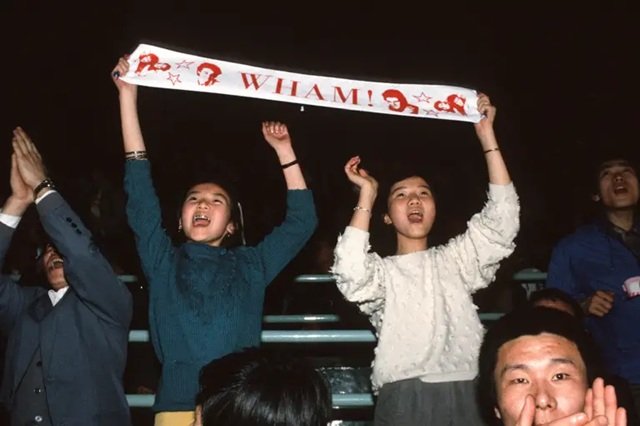
An analysis of communism delivered by a naked pop star while receiving a massage may sound like an unlikely scene from a music documentary. Yet it captures something essential about Wham!’s extraordinary 1985 journey to China: a collision between global pop culture and a political system cautiously opening itself to the West.
The episode is at the centre of Wham! 10 Days in China, a new BBC Two documentary due to air after a limited cinema run. The film, directed by Mike Christie, draws on previously unused footage from If You Were There, an unreleased tour film made by acclaimed Free Cinema pioneer Lindsay Anderson. Wham! rejected Anderson’s film months after returning to Britain. A revised version, Wham! In China: Foreign Skies, approved by the band in 1986, was screened only once, at their final concert together.
Four decades later, Christie returns to Anderson’s long-lost footage, combining it with present-day interviews and material that brings the remarkable tour back into focus.
At its centre is George Michael, then only 21, whose presence remains striking throughout the footage. Speaking to American cinematographer Paul Goldsmith while receiving a massage, Michael reflected on how his understanding of China had changed after arriving there.
“We have a different view of communism than when we first arrived,” he said. “It seems that just their whole way of life is actually quite oppressive, in an unrealistic kind of way.” He also questioned the government’s attitude towards the band, saying they appeared to have been invited as a gesture while officials were “trying to ignore the fact we were here”.
Wham!’s arrival coincided with a significant period in China’s development. In April 1985, the country was six years into Gaige Kaifang, Deng Xiaoping’s programme of reform intended to transform China into a socialist market economy. The government had introduced the one-child policy while also establishing special economic zones, granting greater autonomy to local economies and encouraging international investment.
Into this changing environment came veteran pop manager Simon Napier-Bell, who had previously worked with the Yardbirds and Marc Bolan and co-written You Don’t Have to Say You Love Me with Vicki Wickham for Dusty Springfield. After seeing Wham! on Top of the Pops, he recognised their potential and later became central to arranging their Chinese performances.
As Wham!’s co-manager, Napier-Bell travelled to China “many, many” times over 18 months in an effort to secure two concerts, in Beijing and Guangzhou. He met ministers and translators whom he assumed were secret police. His strategy was deliberately bold. He told Chinese officials that allowing a subversive youth act from overseas would demonstrate confidence in opening the country.
Yet Napier-Bell had another objective: America. He wanted the China tour to accelerate Wham!’s exposure in the United States, a process that might otherwise have required several years of touring. By then, however, George Michael was dealing with vocal polyps and did not particularly want the demanding venture.
Wham! had already begun making their mark in America. Wake Me Up Before You Go-Go, released in November 1984, and Careless Whisper, released in February 1985 as a Wham! track, had both reached No 1. The Chinese tour subsequently helped propel their international profile further, including through appearances on mainstream American television such as CBS Morning News.
By the end of 1985, Careless Whisper and Wake Me Up Before You Go-Go were the first and third bestselling singles in the United States, separated only by Madonna’s Like a Virgin.
But the significance of the China concerts went beyond record sales.
The Observer UK, whose reporting is the source of this account, highlights how an international group of journalists helped draw attention to Wham!’s visit. Among them was Mark Brayne, then the BBC’s China correspondent. For him, the timing was crucial. “There was a hunger in China for connection with the west,” he says in the film. “Wham!’s timing was exquisite.”
Brayne’s report for Today after the first concert, held at the Beijing Workers’ Gymnasium, captured the unusual political circumstances surrounding the event. A government representative explained the official welcome by saying: “Any performance which is healthy and vigorous, we will receive them this year.”
Michael himself came to believe that Wham! had been selected precisely because they were considered a safe form of Western entertainment. He recalled his surprise that audiences did not know how to clap along and suggested that dancing was restricted, with police repeatedly making people sit down.
“Because we represent showbusiness more than rock’n’roll,” he explained. “Rock’n’roll, obviously, as far as the Chinese would see it, breeds decadence… We were the safest option.”
Brayne, who describes Michael as “incredibly impressive, intelligent, with a very wise head on very young shoulders”, does not believe the concerts changed China. Rather, he sees them as a reflection of the changes already taking place.
That distinction became more striking four years later. Brayne returned to Tiananmen Square, where Wham! had staged photographs during their visit. He left only a week before the massacre. For him, that marked “the end of fantasy” about what China might become and the beginning of a more brutal reality.
Yet the legacy of the concerts survived in another form.
Chinese musicians who attended the performances describe them as transformative. Cheng Fangyuan recorded Chinese-language versions of Wham! songs, which were given away with the duo’s cassettes at the concerts. She recalls the visit as “a historical event… like opening a window”.
Andrew Ridgeley, now 63, has similarly reflected on the unexpected influence of the band’s music. He says he feels “immensely privileged” that the records endured and inspired people to pursue lives in music.
The documentary also revives tensions surrounding Anderson, whose leftwing politics became a particular target for Ridgeley. Ridgeley argues that whatever “socialist utopia” Anderson had imagined, he did not find it in China, while Anderson’s letters made clear, in Ridgeley’s view, that financial considerations were also involved.
The most enduring image, however, may belong to Michael himself. At the second concert, in Guangzhou, he delivered Careless Whisper before an audience witnessing something that had been almost unimaginable only a short time earlier: British pop culture performing inside communist China.
The young singer would soon embark on a global solo career, but in China he had already participated in a moment that crossed the boundaries between music, commerce and geopolitics.
After the concert, Michael offered a remarkably modest assessment of what had happened: “It’s nice to make a bit of history, because pop is, you know, let’s face it, a very transient business. It’s rare that you can do anything of any importance at all.”
Four decades later, the footage suggests that Wham! did indeed make history—but perhaps not by changing China. Instead, they briefly revealed a country caught between openness and control, and showed how, for a moment, a pop concert could become an unlikely window into a society undergoing profound change.










