


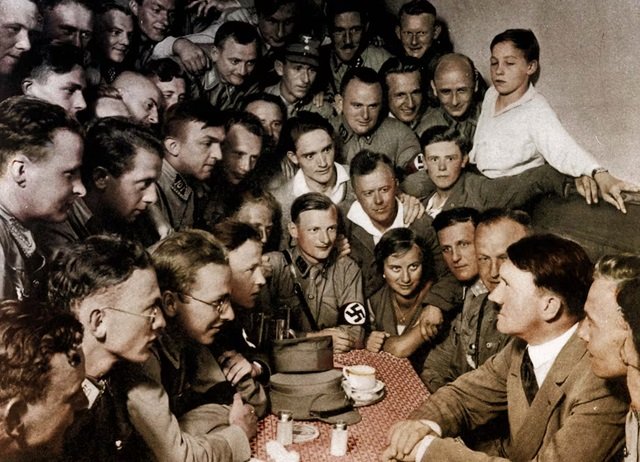
At least 57 former members of the Nazi Party sat in the seventh German Bundestag in 1976. Among them were early Nazi supporters, politicians who had joined as teenagers and figures who would go on to occupy senior positions in the Federal Republic. Their political affiliations spanned the SPD, CDU/CSU and FDP.
Had they formed a parliamentary group of their own, former Hitler supporters would have constituted the third-largest faction in the Bundestag, behind the SPD and CDU/CSU.
Most of them, however, knew little about one another’s pasts. The complete list was known to Daniel P. Simon, director of the Berlin Document Center, or BDC, an American-run archive in West Berlin. In a safe at the centre were the Nazi Party membership cards of the politicians — and those of many other prominent figures in postwar Germany.
The archive, which housed the NSDAP membership records from 1945 until its transfer to German control in 1994, became the centre of a decades-long dispute between Germany and the United States. The question was not merely who owned the documents. It was what their publication could reveal about the political establishment of the Federal Republic.
The records in Simon’s safe included the membership cards of one German chancellor, Kurt Georg Kiesinger; two federal presidents, Karl Carstens and Walter Scheel; two Bundestag presidents, Carstens and Richard Stücklen; and 17 ministers who had served in governments between Konrad Adenauer and Helmut Kohl. The collection also contained records concerning state secretaries, prosecutors and a president of the Federal Archives.
The German government knew about the existence of the safe by July 1976. A Bonn diplomat visiting the BDC was told by Simon that politically sensitive files involving prominent figures in the political life of the Federal Republic were being kept under special restriction.
The BDC itself was an extraordinary repository. It contained around 12 million NSDAP membership cards alongside personnel records from the SS and SA and documents concerning millions of Germans who had moved from territories occupied by the Soviet Union or Germany. In total, the archive contained around 400 tonnes of paper from the Nazi era.
The material had first come into American possession near the end of the Second World War. In April 1945, SS men removed records from the NSDAP headquarters in Munich and ordered a paper-mill owner to destroy them. He ignored the order and handed the material to the US Army.
The victorious Allied powers subsequently gathered the documentary remains of the Nazi regime in several document centres. The first trainload of NSDAP membership cards and related material arrived in Berlin in December 1945. Under American legal reasoning, the collection was considered war booty and therefore US property.
The documents became important evidence for the Nuremberg war-crimes trials, denazification and security checks on German personnel working for the occupying powers. But as the Federal Republic became established, the American view of the archive changed more slowly than Germany itself.
By the 1950s, Washington had returned large quantities of German records. The BDC was different. American policy called for retaining documents that could potentially threaten the democratic political order of the Federal Republic. With more than 22 million names represented in the wider BDC holdings, the Americans feared that revelations about the extent of former Nazi involvement in the construction of West Germany could damage the stability of the Bonn republic.
The issue was also international. During the Cold War, the Soviet Union and the other Western Allied powers watched closely how West Germany dealt with its Nazi inheritance. The East German government repeatedly publicised the Nazi past of prominent West German politicians in an effort to portray the Federal Republic as fundamentally compromised.
The American decision to retain the BDC became increasingly difficult for Bonn to accept. Successive German governments requested its return. By 1966, German authorities were sending tens of thousands of enquiries to the centre concerning security checks, Nazi crimes and citizenship questions.
In 1967, President Lyndon B. Johnson decided that the United States should finally seek to resolve the issue, partly because maintaining the archive was costly. Washington proposed transferring the records but imposed two significant conditions: the United States would retain permanent access, and it would film documents likely to have future political significance for Germany or the United States.
The negotiations soon stalled.
For German officials, accepting such conditions would mean surrendering control over records concerning millions of Germans. For the Americans, unrestricted transfer created concerns about what might happen to politically sensitive material once it came under German control.
The question became even more complicated in the 1970s. Chancellor Willy Brandt had no personal Nazi past, having fled Germany in 1933 and supported the Allies from Scandinavian exile. Yet several members of his cabinet had belonged to the NSDAP. Interior Minister Hans-Dietrich Genscher had joined the party at the age of 17 in 1944. He later made the BDC his personal responsibility while also seeking restrictions on access to records concerning former party members.
By 1973, negotiations had effectively ended. The Americans did not want to surrender the BDC at any price, while the Germans were unwilling to accept every American condition.
The issue returned under Chancellor Helmut Schmidt. In 1978, SPD politician Karl-Heinz Hansen accused the government of protecting former Nazis who might be embarrassed if certain documents became public. Schmidt considered the accusation insulting but nevertheless supported the return of the BDC.
Behind the dispute was a larger concern: Germany’s international reputation. Schmidt feared that renewed international attention to the Nazi past could become a handicap for German foreign policy. His government wanted the archive transferred, but also wanted strong protection for the personal rights of those documented in it.
The Americans had their own reasons for delaying. US investigators were pursuing suspected Nazi war criminals who had entered the United States after the war using false identities. The Office of Special Investigations needed original documents for legal proceedings and feared losing access if the archive came under German control.
By the 1980s, the dispute had become increasingly difficult to separate from the broader politics of Germany’s Nazi past. German officials feared that unrestricted access to the records could trigger a media campaign examining the biographies of political, economic and intellectual leaders across the Federal Republic.
A German diplomatic assessment warned that such scrutiny could create the impression of continuity between the Nazi regime and the Federal Republic.
The political environment eventually changed. The Berlin Wall fell in 1989, and German reunification followed. A BDC under American control in a sovereign, reunited Germany with Berlin as its capital became increasingly difficult to justify.
In 1993, Germany and the United States finally signed an agreement providing for the transfer of the BDC on 1 July 1994. The Americans would retain access to their microfilms, while the original documents would pass to the Bundesarchiv.
The transfer took place quietly.
On the eve of the handover, the BDC’s successor to Simon emptied the safe. The Americans had inserted beige cards, known as placeholders, into the main NSDAP membership files to indicate which records had been removed and stored separately. Those cards were removed before the archive was handed to Germany, meaning that the original collection would not itself reveal which politicians’ membership records had once been locked away.
But the American microfilm copies preserved evidence of the missing files.
The records could therefore eventually be reconstructed. According to the reconstruction described by Der Spiegel, more than 70 prominent figures can be identified as having had files stored in the safe. Some cases remain uncertain, including that of Genscher, whose card was reportedly seen in the safe by witnesses even though the corresponding placeholder is missing.
By the late 1990s, the last Bundestag members with NSDAP backgrounds were leaving parliament. Genscher was among them. His Nazi Party membership card had by then become public. He maintained that he had been registered as a member without his knowledge, a claim also made by other prominent former party members.
Historians, according to the reconstruction, regarded such explanations as a defensive claim.
The story of the BDC was therefore never simply about an archive. It was about who controlled the evidence of Germany’s political past, who had the right to see it, and how long a democratic state could postpone confronting the biographies of those who helped build it.
For almost half a century, the most politically sensitive cards were not destroyed, but neither were they freely accessible. They remained in a safe, separated from the archive they belonged to.
The eventual release of the records did not rewrite the history of postwar Germany. It made parts of that history harder to hide.









