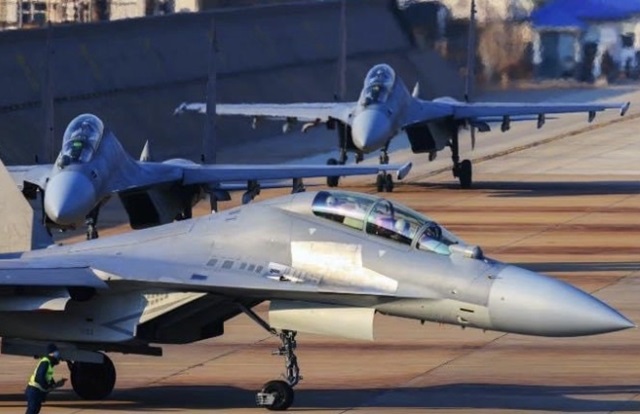
A fleet of Chinese J-16 fighters has arrived in Egypt for the Eagles of Civilisation 2026 exercise, marking the aircraft’s first-ever deployment to Africa and providing a significant test of the People’s Liberation Army Air Force’s ability to operate far from its home bases.
The aircraft and the aviators participating in the exercise arrived at an Egyptian airbase on Friday morning after travelling 6,000km (3,700 miles) in a journey that lasted nine hours and required the fighters to refuel in mid-air, according to the People’s Liberation Army. Chinese service personnel involved in the exercise had begun preparations for the drills, which the PLA has previously said would conclude early next month.
The deployment places one of China’s principal multi-role fighter aircraft in an unfamiliar operating environment thousands of kilometres from the country’s shores. The J-16, a twin-seat aircraft nicknamed the Hidden Dragon, regularly patrols along China’s east coast and around potential flashpoints including the South China Sea and Taiwan Strait.
Its arrival in Egypt extends that operational experience into a very different geographical setting.
The J-16 has previously participated in overseas military exercises, including drills with Russia and Pakistan. Its deployment to Egypt, however, represents a first for the aircraft in an exercise with the Egyptian air force and its first appearance in a joint military exercise on African soil.
The development also builds on a previous stage of Chinese-Egyptian military cooperation. During the inaugural joint exercise with Egypt last year, China deployed J-10C fighters, lighter, single-engine multi-role aircraft. The decision to send the larger and more capable J-16 this year places a different Chinese aircraft and a broader set of operational capabilities at the centre of the exercise.
The Chinese defence ministry said the 2026 exercise would focus on air combat tactics and air superiority operations, among other elements. It said the drills were intended to deepen trust and cooperation between the two militaries and contribute to regional peace and stability.
For the Chinese air force, however, the exercise also provides an opportunity to develop capabilities that cannot be fully tested through training conducted exclusively within China.
Song Zhongping, a Chinese military commentator and former PLA instructor, said the deployment reflected Beijing’s effort to train its air force in unfamiliar locations and under unfamiliar conditions. He argued that different types of aircraft across China’s air force units needed opportunities to operate abroad in order to strengthen combat training and readiness.
“The different aircraft types across China’s air force units all need to go abroad, to go out and take a look, in order to strengthen their combat training and readiness capabilities,” he said.
“There need to be as many exercises like this as possible in order to increase our capability to operate in unfamiliar airspace, in different types of airspace. Going up against different opponents can also greatly improve our own capabilities.”
The journey itself represented an important part of that training. Song described the flight to Egypt as the J-16’s longest-range deployment to date and said it would have been a “major test” of the pilots’ tactical and technical skills as well as the aircraft’s technical performance.
The 6,000km journey, completed in nine hours with mid-air refuelling, demonstrates the logistical demands involved when Chinese combat aircraft operate far beyond their normal patrol areas. The deployment requires not only the aircraft and pilots to travel the distance but also the supporting personnel and infrastructure necessary to conduct an overseas exercise.
Such experience is becoming increasingly important as China seeks to develop the ability of its armed forces to operate beyond the immediate areas surrounding the country.
Song suggested that exercises of this kind were likely to become more frequent as the Chinese air force sought to improve its ability to conduct coordinated combat operations. He linked that requirement to the expansion of China’s overseas interests and the need to ensure that military forces can operate effectively in distant environments.
“China is a major global power in terms of development, and we also need to rely on cooperation with other countries to support our own development,” he said.
The J-16 deployment consequently carries significance beyond the exercise itself. Its arrival in Egypt illustrates the growing emphasis Beijing places on giving its military units experience outside familiar operating environments, while also strengthening practical cooperation with foreign armed forces.
The exercise provides Chinese pilots with exposure to different airspace and operational conditions, while giving the two militaries an opportunity to train together in air combat tactics and air superiority operations.
For Beijing, the ability to conduct such operations is increasingly linked to the broader question of how China protects its interests beyond its borders.
Song argued that developing the global power-projection capabilities of the Chinese navy and air force was therefore “critically important”.
“We can’t rely only on diplomatic capability. We also need hard power, including military capability, to safeguard our overseas interests.”
That emphasis places the Egyptian deployment within a broader effort to develop China’s ability to project military power at greater distances. Yet the exercise itself remains framed by Beijing as a training and cooperation activity, with the Chinese defence ministry stressing trust, military cooperation, regional peace and stability.
For the J-16, the immediate challenge is operational: flying farther than it has previously done for an overseas exercise, operating in unfamiliar airspace and training alongside another air force. For China’s military, however, the experience offers something more enduring — practical knowledge of how its combat aircraft, pilots and support personnel perform when operating thousands of kilometres from home.
The Eagles of Civilisation 2026 exercise therefore represents both a bilateral military engagement with Egypt and another test of the Chinese air force’s ability to function beyond its traditional operating environment. As the J-16 makes its African debut, the aircraft is not merely travelling farther; it is becoming part of Beijing’s continuing effort to build the operational experience required for a military with increasingly global interests.