by Eric
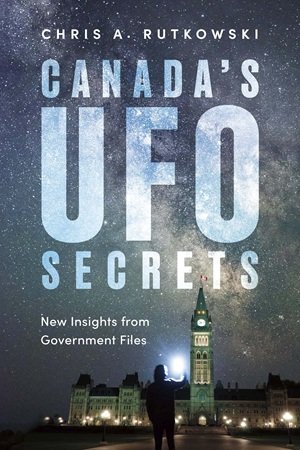
Chris A. Rutkowski’s Canada’s UFO Secrets: Disclosing Government Files on What Is Happening in Our Skies is most interesting when it stops behaving like a UFO book. Its real subject is not whether extraterrestrials are visiting Earth, but what happens to evidence when governments, militaries, scientists, journalists, politicians and civilian investigators encounter phenomena they cannot immediately explain. That distinction matters. Rutkowski is a veteran UFO researcher, but he does not ultimately offer the reader the familiar consolation of a hidden alien civilisation waiting to be exposed. Instead, he presents something more uncomfortable: a history of institutional uncertainty, bureaucratic inconsistency, imperfect investigations and the persistent human desire to turn unexplained observations into either conspiracies or certainties. The book’s great strength is therefore also its central tension. It repeatedly dismantles the mythology of government secrecy while simultaneously demonstrating why that mythology has been so difficult to kill.
Rutkowski announces his position almost provocatively at the beginning: “Canada has been dealing with UFOs too” and, “if anything, the Canadian government has been remarkably transparent about UFOs in the Great White North” (p. 6). This is an important thesis because it challenges one of the foundational assumptions of UFO culture: that governments possess definitive knowledge and deliberately conceal it. Yet the evidence Rutkowski himself assembles produces a considerably messier picture. On one page, the Department of National Defence is credited with having “disclosed” thousands of pages of UFO-related material since 1947 (p. 63); elsewhere, Rutkowski records that DND eventually stopped supplying him with reports because of “institutional reluctance” and complaints from other UFO enthusiasts (p. 132). The contradiction is not necessarily evidence of a conspiracy. It is evidence of an institution that has never possessed a coherent policy towards UFO reports. That is a subtler and, arguably, more significant finding.
The book becomes particularly compelling when it reconstructs the history of Canadian official interest. Rutkowski shows that UFOs were not always treated as the cultural joke they later became. In 1966, Lester Pearson ordered ministers to provide him with reports on what had been done about UFO sightings, after noting “the interest being shown in Parliament and the press” (pp. 38–39). Earlier, Parliament had heard questions about flying objects, including a 1940 report concerning “unidentified aircraft” over the St Lawrence River (p. 30). One report was sufficiently serious to generate a message marked “Secret” after an unidentified aircraft reportedly dropped two flares near Vancouver (p. 30). Such episodes undermine the simplistic claim that governments have always dismissed UFOs as nonsense. They also reveal the more mundane reason officials cared: an unidentified aircraft is potentially a security problem whether it comes from another planet, another country, or nowhere more exotic than a misidentified conventional object.
This distinction between “unidentified” and “extraterrestrial” is the intellectual foundation on which the book is strongest. Rutkowski repeatedly demonstrates that an unexplained observation is not synonymous with an unexplained object. His account of one investigation records the DND conclusion that apparently strange objects “resembled jet aircraft in every respect except for the ‘parachute-like’ shape” and that the anomaly was “an illusion caused by the unfamiliarity of the observer with the swept-back wing of the Sabre” (p. 37). This is precisely the kind of explanation that UFO mythology tends to resist because it is psychologically unsatisfying. Yet it is also the essence of empirical inquiry: an extraordinary interpretation should not be preferred merely because the original observation was extraordinary to the witness.
The treatment of the Falcon Lake case demonstrates the book’s more sophisticated side. Stefan Michalak’s encounter remains one of Canada’s most famous UFO stories, but Rutkowski refuses to transform its persistence into proof. The University of Colorado investigators eventually classified it as “Case 22” and considered it likely a hoax (p. 50), while Canadian military investigators had publicly acknowledged that they could not explain what happened (pp. 57–58). Here Rutkowski exposes an important epistemological problem: an official failure to explain an event is frequently remembered as evidence that officials know something extraordinary. But “we do not know” and “we know it was extraterrestrial” are radically different propositions. The book’s most valuable contribution is its insistence that the gap between those statements must not be filled by imagination.
Yet Rutkowski is not an uncomplicated sceptic. His criticism of official institutions can be sharp, particularly when bureaucratic secrecy becomes self-defeating. He recalls a government official stating that “the government does not have much to conceal on a subject like this” (p. 59), a remark Rutkowski dismisses as “naivete”. The author is right to recognise the problem. Even where there is no extraterrestrial secret, unnecessary secrecy generates suspicion. His later observation that officials should release information precisely to avoid “creating an impression that DND is hiding or concealing something” (p. 136) is arguably one of the book’s most important political arguments. Transparency is not merely an ethical virtue here; it is a counter-conspiracy mechanism.
But the author’s own position introduces another complication. He gradually becomes what he calls “Canada’s UFO guy” (p. 15), later describing himself as the Canadian government’s “point man on UFOs” (p. 103). He becomes a repository for reports after the government effectively leaves the “UFO business” in 1995, and in 1999 reaches an agreement to act as a public liaison for sightings (p. 117). This is fascinating but also raises questions about epistemic authority. What happens when a government that no longer wants to collect UFO reports effectively channels them towards one prominent civilian researcher? Rutkowski recognises the irony but does not fully interrogate its consequences. The very arrangement that facilitates transparency can also centralise a field of inquiry around an individual whose professional identity is inseparable from the subject being investigated.
That problem becomes particularly acute when Rutkowski recounts writing to researchers and responding to information requests “since I was representing Her Majesty the Queen” (p. 119). The line is amusing, but it captures an important institutional ambiguity. Is Rutkowski an independent investigator, an intermediary, an archivist, a public servant by proxy, or a representative of a government information system? His unusual position gave him access and credibility, but it also complicates the conventional distinction between official and civilian knowledge. The book would have benefited from more sustained methodological reflection on this relationship.
Its treatment of politicians is similarly revealing. William Dean Howe argued that UFOs were “past the point of being funny” and that there was “too much unexplained evidence to ignore” (pp. 43–45). That formulation remains surprisingly defensible, provided “unexplained” is not quietly transformed into “extraterrestrial”. Rutkowski’s account of politicians repeatedly shows that democratic institutions can perform a useful function simply by demanding answers. But political attention can also inflate the significance of ambiguous evidence. The history of UFOs therefore becomes partly a history of how uncertainty is politically managed.
The discussion of Wilbert Smith and Project Magnet is perhaps the clearest example of Rutkowski refusing to indulge his own subject. Smith claimed that flying saucers “didn’t originate on the earth” and that the subject was classified “two points higher even than the H-bomb” (p. 70). Rutkowski does not merely repeat this sensational claim; he subjects it to sceptical scrutiny. He notes that Smith’s experiments produced no useful results and that government support ended in 1954 (p. 70). More damagingly, documents indicate that Smith himself wrote that “the results to date have hardly been spectacular” (p. 73). This is exactly how responsible UFO history should work: extraordinary claims are preserved, but they are not granted extraordinary evidential status simply because they are intriguing.
The 2023 balloon and UAP episodes shift the argument into contemporary geopolitics. The book shows how quickly “UFO” can become a national-security category once unidentified objects enter controlled airspace. NORAD’s statement that it numbers objects not immediately identified is especially revealing: “most objects are found to be innocuous” (p. 159). Yet the subsequent shooting down of airborne objects illustrates the danger of institutional overreaction. Rutkowski notes that Sidewinder missiles can cost more than $500,000 and calls their use against objects that posed no obvious threat “overkill” (p. 153). The episode demonstrates that the UFO question is no longer merely about believers versus sceptics. It concerns surveillance, threat assessment, military escalation and the extraordinary costs of making decisions under uncertainty.
The book ultimately points towards a more intellectually defensible ufology. Rutkowski admires the Galileo Project’s commitment to “experimental ufology” based on technological observation and testable data (p. 188). Its rejection of retrospective speculation and anecdotal claims is crucial. As the project puts it, researchers should “follow evidence from its sensors wherever it leads, and share the data openly with the public” (p. 190). Rutkowski’s own conclusion is similarly disciplined: most sightings involve conventional phenomena, while a tiny fraction remain unexplained because “we need more information or context” (p. 192). This is a much less glamorous conclusion than alien visitation, but it is scientifically stronger.
And yet Rutkowski cannot quite resist leaving the door ajar. “Maybe — just maybe — they are visiting us” (pp. 194–195), he writes. The sentence is intellectually modest but rhetorically powerful. It ensures that the book does not close the mystery altogether. That is perhaps its greatest virtue and its greatest weakness. The author wants readers to reject both governmental absolutism and UFO absolutism, but he also understands that mystery is what keeps the subject alive.
The most important sentence comes near the end: “A robust answer to Fermi’s old question ‘where is everybody?’ will originate from scientists, not from politicians or journalists” (p. 191). That is ultimately the standard by which Canada’s UFO Secrets should be judged. It is not a book that proves extraterrestrial visitation, nor is it a conventional debunking exercise. Its deeper argument is that uncertainty deserves investigation without mythology. Governments should disclose what they know, researchers should distinguish evidence from anecdote, and scientists should be willing to investigate anomalies without surrendering methodological discipline. In that sense, Rutkowski’s most controversial revelation is also his least sensational one: the real secret of UFOs may be that there is far less hidden knowledge than believers imagine, but considerably more uncertainty than governments, journalists and the public have been willing to admit.