The EU Initiative
The announcement in September 2026 that Canada has been invited to become the European Union’s first “associate member” is remarkable not merely for its political symbolism, but because it raises a fundamental question of international institutional law: can an international organization create a form of relationship which its constituent treaties do not expressly recognize? The answer is more nuanced than a simple assertion that “associate membership” does not exist in European Union law. It does not exist as a membership status comparable to full membership. Yet EU law contains sufficient treaty architecture to support an exceptionally deep relationship with a third State. The significance of the Canadian proposal therefore lies less in inventing a new species of membership than in constructing, through treaty-making, an unprecedented form of institutional association.
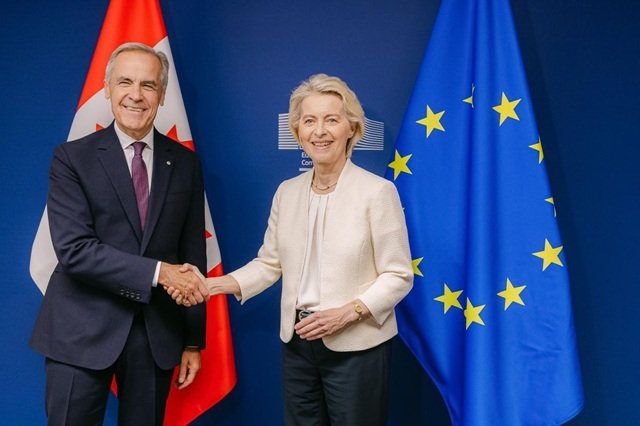
In her 16 September 2026 State of the Union address, European Commission President Ursula von der Leyen invited Prime Minister Mark Carney to work toward making Canada “the first associate member of the EU.” She simultaneously proposed moving beyond the Canada-European Union Comprehensive Economic and Trade Agreement, or CETA, toward an “Alliance for the Future” embracing intelligent manufacturing, technology, defence-industrial integration, the Arctic, energy, critical minerals, batteries, artificial intelligence, quantum technologies, cybersecurity and economic security. Prime Minister Carney responded by emphasizing strategic autonomy, critical minerals, defence-industrial capacity, AI and computing, energy security, space, payments, digital trade and greater movement of people.
Canada is not, however, becoming an EU Member State. Article 49 of the Treaty on European Union provides for accession by a European State respecting the Union’s values. Canada does not fall within that geographical conception. The more interesting question is whether the EU can construct an intermediate relationship conferring some functional advantages of participation without conferring the constitutional status of membership. Here the answer is potentially affirmative.
The Treaty Conundrum
The apparent paradox is that neither the Lisbon Treaty nor the Treaty on European Union or TFEU establishes a category called “associate member.” The treaties essentially distinguish between Member States and third countries, while providing mechanisms through which the latter may develop extensive relationships with the Union.
The crucial provision is Article 217 TFEU, which permits the Union to conclude agreements with third countries or international organizations establishing “an association involving reciprocal rights and obligations, common action and special procedure.” This is the legal doorway through which the Canadian proposal could pass.
The distinction between membership and association is fundamental. Membership is a constitutional status within the organization; association is a treaty-based relationship between the organization and an external State. Article 217 does not authorize the EU to create “associate members” as a new constitutional class. It permits the establishment of association with third countries.
Consequently, “associate membership” may be understood as political terminology describing an exceptionally deep association agreement rather than a new category of EU membership. Canada would remain a sovereign third State. It would not acquire representation equivalent to Member States in the Council, a European Commissioner, or automatic EU citizenship. It could, however, negotiate participation in selected programmes, agencies, markets and institutional processes.
Article 218 TFEU supplies the procedural machinery. Association agreements require Council action, including unanimity, and the consent of the European Parliament, while the precise Canadian ratification requirements would depend upon the substance of the agreement and Canada’s constitutional arrangements. The experience of CETA demonstrates that an ambitious agreement touching areas of Member State competence can become institutionally complex.
CETA: The Foundation Rather Than the Casualty
It would be premature to assume that associate membership would replace CETA. CETA is an existing treaty and the political announcement does not terminate it. Indeed, CETA provides an economic foundation upon which a much deeper relationship could be constructed. EU-Canada trade in goods reached €81.5 billion in 2025, compared with €46.3 billion in 2016, while bilateral services trade reached €49 billion. The European Commission has reported substantial increases in both categories since provisional application of CETA.
The language of an “Alliance for the Future” suggests evolution rather than legal extinction. CETA itself contains mechanisms through which the parties may amend the Agreement, while its institutional structure permits the Joint Committee to adopt binding decisions subject to the requisite internal procedures.
The more probable legal consequence is therefore transformation rather than disappearance. CETA could remain the economic foundation while an overarching EU-Canada Association Agreement establishes a broader architecture. Alternatively, CETA could be substantially amended, or a new treaty could incorporate its commitments while adding chapters on digital commerce, financial services, mobility, defense supply chains, critical minerals, technology, energy and regulatory cooperation.
The emerging relationship would thus represent not the abandonment of CETA but its possible metamorphosis into one component of a much larger institutional structure. Existing cooperation in digital trade, industrial policy, raw materials, economic security, energy and Horizon Europe suggests that the proposed association is developing from an established institutional ecosystem rather than being created ex nihilo.
The Four Freedoms and the Difficult Question of People
One of the most difficult questions concerns the four freedoms of the European internal market. The internal market is constructed around the movement of goods, persons, services and capital, and the possibility of selecting these freedoms à la carte presents a constitutional difficulty.
Canada might negotiate greater opportunities for its citizens to work, study or reside in Europe, accompanied by reciprocal opportunities for European citizens in Canada. But such arrangements need not amount to EU free movement in its constitutional sense. They could be reciprocal, sector-specific, time-limited or subject to quotas.
This distinction is critical. EU citizenship embodies a constitutional relationship with the Union. Canada cannot acquire that relationship without becoming part of the EU constitutional order. The Canadian model would therefore not necessarily reproduce either Norway’s participation through the European Economic Area or Switzerland’s network of bilateral agreements. It could constitute something different: a bespoke association designed for a non-European strategic partner.
Canada could consequently become a constitutional laboratory for the EU, testing whether deep economic and institutional integration can be achieved without formal membership.
The North American Consequence
The implications for Canada’s relationship with the United States may be profound. The United States remains Canada’s overwhelmingly important economic neighbour, and North American manufacturing is deeply integrated. Automobiles, aerospace, energy, agriculture, pharmaceuticals, financial services and advanced manufacturing frequently cross the border several times during production.
Yet diversification toward Europe could broaden Canada’s economic options. Diversification should not be confused with decoupling. Canada cannot reproduce European networks overnight or simply substitute European markets for the highly integrated North American economy. It could, however, reduce the degree to which its economic choices are concentrated upon a single external market.
Privileged access to European capital, technology, defense procurement, critical-mineral markets and digital networks could gradually alter the bargaining structure between Canada and the United States. Canada could possess a second major economic and strategic pole without abandoning the first.
Critical minerals provide an obvious field for such cooperation. Canada possesses resources important to European industrial policy, while Europe possesses capital, technology and downstream markets. Lithium, nickel, cobalt, rare earths and battery materials could become components of integrated transatlantic supply chains.
The Arctic adds a further dimension. Canada is not merely another European trading partner; it is an Arctic State. A deeper EU-Canada relationship could therefore give European Arctic policy a more structured partnership with a sovereign State possessing its own territorial, maritime and strategic interests.
Sovereignty and the Paradox of Voluntary Limitation
The deeper philosophical question is whether associate membership would diminish Canadian sovereignty. The answer depends upon what sovereignty means in contemporary international law.
Sovereignty is not synonymous with isolation. States routinely limit aspects of their freedom of action through treaties. The essential question is whether such limitations are voluntary, reciprocal, legally structured and constitutionally authorized. Sovereign States possess the capacity to bind themselves through international law.
Canada would therefore not necessarily surrender sovereignty by entering a deep relationship with Europe. Rather, it would exercise sovereignty by deciding to undertake particular international obligations. But the extent of those obligations would be politically consequential. Regulatory alignment, European supervisory functions and mobility rights could necessarily constrain Canadian policy autonomy in particular fields.
That is not in itself a defect. It is the inevitable consequence of meaningful international cooperation. The constitutional imperative is transparency: Canadians must understand the nature and extent of the commitments before those commitments are assumed.
The Institutional Problem: Who Decides?
The greatest difficulty may ultimately be institutional rather than economic. If Canada participates in European programmes and is affected by EU regulations, who decides? If Canadian enterprises gain access to European markets but must comply with rules over which Canadian legislators have no formal control, what constitutes adequate democratic accountability?
The same question arises in defense procurement. Who determines Canada’s contribution, strategic objectives and response when Canadian foreign policy diverges from that of the EU?
These questions expose the essential distinction between participation and membership. The Canadian arrangement would require carefully constructed mechanisms of committees, councils, consultation, arbitration and institutional dialogue. A Canada-EU Council, parliamentary dialogue, sectoral committees, dispute-resolution mechanisms and regulatory consultation could form part of the architecture. Canada might receive observer or participation rights in selected EU institutions without voting rights.
The danger would be the creation of obligations without representation. Associate membership, therefore, is not principally a question of market access. It is a question of constitutional design.
Defense and Strategic Autonomy
The security dimension may ultimately prove more significant than CETA. Canada already possesses a Security and Defense Partnership with the EU covering maritime security, cyber issues, hybrid threats, space security, military mobility and defense cooperation.
Canada’s participation in SAFE represents a further development. It demonstrates that the EU increasingly regards Canada not simply as a commercial partner but as a strategic partner capable of contributing to European security.
For Canada, deeper association could provide access to European defense supply chains. For Europe, Canada offers industrial capacity, natural resources, technological expertise, Arctic geography and NATO interoperability.
For the United States, however, the development may carry a different political significance. European strategic autonomy is sometimes considered in Washington through the prism of NATO and American leadership. Yet closer Canada-EU defense cooperation need not undermine NATO. Canada could increasingly possess three overlapping strategic identities: North American, Atlantic/NATO and European-associated.
The more sophisticated Canadian approach would not necessarily require choosing among these identities, but integrating them within a broader foreign-policy architecture.
The WTO Dimension
CETA operates within the WTO framework, and a deeper association cannot simply disregard WTO disciplines. Preferential treatment must remain consistent with the applicable rules governing free-trade areas and customs arrangements.
This becomes increasingly important if Canada receives access to portions of the EU internal market approaching that enjoyed by European Economic Area States. The closer the relationship approaches an internal-market arrangement, the greater the legal complexity.
The association must therefore be constructed with precision rather than aspiration. Political terminology cannot displace the disciplines of international economic law.
The Precedent for Australia and New Zealand
The Canadian initiative could eventually have consequences beyond Canada. If the EU develops a successful model of deep association with a non-European strategic partner, countries such as Australia and New Zealand may seek comparable arrangements.
This raises an institutional question. Would “associate membership” become a general legal category or remain a collection of bespoke arrangements? A general category could require a more elaborate legal architecture, while bespoke agreements would preserve flexibility but potentially raise questions of unequal treatment.
The latter approach may presently be more legally prudent. International institutional law has frequently developed through differentiated arrangements rather than rigid constitutional categories.
My Take
The phrase “associate membership” should therefore be approached with both intellectual curiosity and legal caution. The EU has not amended its treaties to create a new category of membership for Canada. Article 49 remains concerned with accession by European States, while Article 217 provides the more plausible legal foundation for a profound association with a non-European third country.
The genius, and perhaps the danger, of the proposal lies precisely in this distinction. International law evolves through the interaction of treaty text, State practice and institutional necessity. The absence of the words “associate membership” from the Lisbon Treaty does not necessarily prevent the EU from constructing a relationship bearing that political description. What matters is whether the substantive arrangement rests upon valid treaty-making authority, follows the appropriate EU procedures and is implemented consistently with Canadian constitutional requirements.
The vocabulary must not, however, obscure the legal reality. Canada would remain sovereign. Sovereignty is not an antique relic which disappears whenever States cooperate, nor is it an absolute licence to disregard international obligations. It is the legal capacity of a State to determine its internal and external affairs, including the capacity voluntarily to assume obligations through international law.
The proposed relationship may therefore be understood as an exercise in cooperative sovereignty. Canada would not preserve sovereignty by refusing to cooperate with Europe, nor would it necessarily surrender sovereignty by cooperating deeply with Europe. The decisive question is whether Canada knowingly and democratically chooses the obligations accompanying that cooperation.
There is nevertheless a constitutional line that must not be crossed unnoticed. If Canada were to accept extensive European regulation without meaningful participation in the processes producing those rules, if democratic accountability were displaced by executive agreements, or if “associate membership” became a euphemism for obligations without representation, the legitimacy of the project would become problematic.
The answer is not necessarily to reject integration but to make integration accountable.
The relationship should therefore be constructed incrementally: CETA as its economic foundation; digital trade as a further layer; critical minerals, energy and technology as strategic components; defense and Arctic cooperation as security pillars; and mobility and institutional participation as carefully negotiated constitutional dimensions.
Nor should the United States necessarily regard the project as anti-American. Canada need not choose between North America and Europe. It can remain geographically North American, strategically Atlantic, institutionally associated with Europe and constitutionally sovereign.
That would not represent abandonment of the United States. It would represent diversification.
The deeper significance of Canada’s prospective relationship with Europe may consequently lie beyond the immediate economic benefits. It may signal the emergence of a form of international organization in which the old binary distinction between member and non-member gives way to graduated forms of participation. Such an evolution would be consistent with the dynamic character of international law, provided that sovereignty remains respected and obligations are clear, reciprocal and democratically authorized.
The phrase “associate member” may therefore be legally imperfect but politically illuminating. Ultimately, the treaty will matter more than the label.
The fundamental question is not whether Canada becomes sufficiently European to be admitted into Europe. It is whether Canada and Europe can demonstrate that sovereignty in the twenty-first century is not measured by the capacity to stand alone, but by the capacity of sovereign peoples to decide, freely and lawfully, with whom they will cooperate, for what purposes and under what rules.
Sovereignty is the starting point of international order; cooperation is its necessary instrument. The challenge for Canada is to ensure that, in reaching for a closer Europe, it does not surrender the democratic agency that gives sovereignty its meaning.