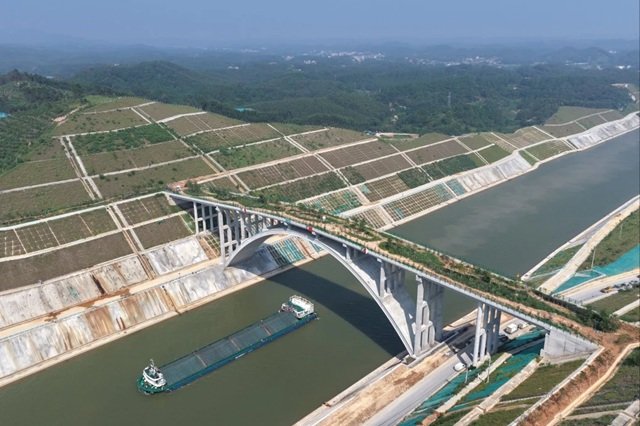
China is preparing to open the Pinglu Canal, a 72.7 billion yuan (US$10.8 billion) waterway designed to accelerate trade between the country’s inland manufacturing regions and Southeast Asia, with its first command vessel delivered as authorities move towards the project’s expected opening later this month.
Named Pinglu 001, the first command and management vessel was delivered on Monday and is expected to enter service soon. A fleet of such vessels will patrol the 134km (83-mile) canal, overseeing navigation and responding to emergencies as China prepares to put one of its most significant new transport links into operation.
The canal connects Nanning, the capital of the Guangxi Zhuang autonomous region, with the Gulf of Tonkin, also known as the Beibu Gulf, between China and Vietnam. Its opening is expected to coincide with the 23rd China-Asean Expo, scheduled to take place in Nanning from September 17 to 21.
The delivery of the command vessel represents one of the final steps towards the opening of the megaproject, which has been years in development. Beijing sees the canal as a strategic infrastructure project that could accelerate freight movements and reduce transport costs with the Association of Southeast Asian Nations (Asean), China’s largest trading partner.
Although only 134km long, the canal is expected to have an impact far beyond its physical size. Designed to accommodate vessels weighing up to 5,000 tonnes, Pinglu is China’s first river-to-sea canal and is expected to shorten the route between inland Guangxi and the ocean by 560km (348 miles).
The waterway will connect an extensive network of rivers and tributaries to the sea, providing landlocked parts of southern and southwestern China, including Yunnan, Guizhou and Sichuan provinces, with faster access to Asean and global shipping routes.
That connection could create a major new logistics artery for commodities and manufactured goods including textiles, timber, plastics, electronics and steel. The canal is also being developed at a time when Vietnam remains a popular destination for Chinese manufacturers shifting production.
The scale of regional trade has strengthened the case for improved transport links. China-Asean trade rose 24.7 per cent to US$744.4 billion in the first seven months of the year, according to Chinese customs data. Bilateral trade between China and Vietnam increased 33.7 per cent to US$215.1 billion over the same period.
Trade with Southeast Asia also helped China withstand a renewed trade war with the United States in 2025. Beijing is now seeking to accelerate export diversification while giving fresh economic momentum to inland regions close to Asean, with Pinglu forming a critical part of that strategy.
The authorities’ decision to begin testing a fleet of command vessels before the canal opens suggests they expect substantial traffic from the outset.
“Trialling a fleet of command ships prior to the canal’s opening is an indication that authorities expect the waterway to instantly carry a lot of shipping following its opening, especially for goods to and from Vietnam,” said Qu Ke, a transport analyst at CCB International in Hong Kong.
Qu said water transport is cheaper than moving goods by land or rail, while the canal’s 5,000-tonne capacity and efficiency could be enhanced through intermodal logistics and new technology.
He said goods and sub-assemblies from factories across China’s western and southwestern interior could first be transported to Nanning, a major city with strong transport connections, before being loaded on vessels travelling down the Pinglu to Vietnam, potentially reducing both costs and transit times.
The canal’s first shipping route, however, is expected to run to the island province of Hainan, according to state media reports. Located just across the Gulf of Tonkin, Hainan is now China’s largest free-trade area by size, while both Hainan and Guangxi are positioning themselves at the forefront of China’s deeper economic integration with Asean.