The fragile ceasefire and current status quo of the war between the United States and Iran were tested over the weekend as the U.S. military launched its first strikes in over a month, while Iran responded with missile strikes against U.S. bases in Jordan. The renewed exchange has brought the Strait of Hormuz back to the centre of a confrontation that has already lasted more than six months, rattled the global economy and destabilised large parts of the Middle East.
According to The Soufan Center, U.S. forces struck targets on Larak Island, a six-mile-long island that serves as an important logistical hub and military and shipping control point for Iranian forces near the Strait of Hormuz. The strikes, according to U.S. Central Command (CENTCOM), targeted Iranian rocket launchers that were attempting to disperse sea mines in the Strait.
Iran responded by firing a barrage of missiles at U.S. bases in Jordan. Jordanian authorities claimed to have intercepted eight missiles. CENTCOM spokesman Capt. Tim Hawkins said: “Last week, CENTCOM completed cleaning sea mines from the strait’s international shipping routes,” adding: “[w]e simply will not allow Iran to emplace more mines.”
The confrontation over the Strait is not simply another exchange of fire between the two countries. The waterway has become the central focus of a struggle for leverage, with its security directly connected to civilian maritime traffic, commercial shipping and global commerce. The U.S. attack on the Iranian rocket launchers was described as an effort to protect civilian mariners, facilitate commercial shipping and restore commercial activity through the Strait.
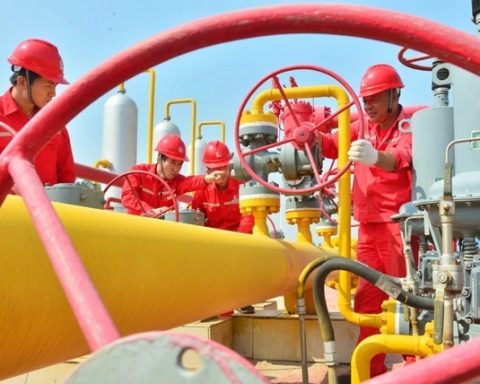
Approximately one-fifth of the world’s energy supplies transit through the waterway, making Iran’s ability to threaten or disrupt shipping a critical element of the wider conflict. Washington is reportedly considering a more extended military campaign aimed at Iranian radar, air defence and anti-ship capabilities along the Strait — capabilities Iran is currently believed to be rebuilding.
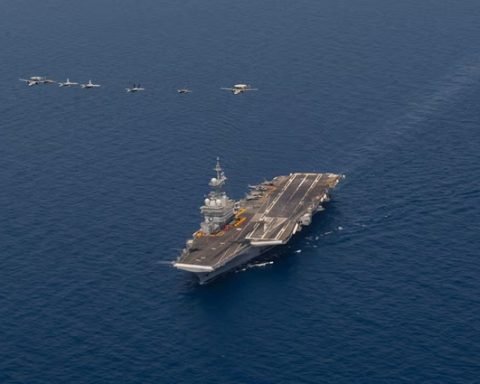
The risks to U.S. forces operating around the waterway have already become evident. In a recent incident, Iran fired an anti-aircraft missile at an F-35 fighter jet providing cover to ships transiting the Strait. A more sustained American campaign against Iranian assets would therefore seek to loosen Tehran’s grip on a narrow waterway whose significance extends far beyond the immediate battlefield.
President Donald Trump has vowed to respond to Iran’s attacks. Speaking to Fox News, he said: “We’re going to hit them hard. There will be a response.” He subsequently issued a lengthy statement on Truth Social in which he declared: “Iran is officially a Failed Nation. IT IS DEAD!” Trump also claimed that Iran had “no Navy”, “no Air Force” and “no currency”, while accusing its leadership of being “in total disarray and incapable of properly representing the country”.
The President also posted an AI-generated video depicting U.S. forces attacking Kharg Island. In an interview yesterday, Trump ruled out using a nuclear weapon against Iran, calling a reporter’s question about its use “stupid” and arguing that there was no need for such a weapon against an adversary that had been “totally defeated militarily”.
Yet the prospect of a further major American military response is complicated by pressures within the U.S. military itself. The Soufan Center noted that some experts remain less sanguine about an expanded campaign, particularly because of munitions shortfalls that have affected the United States since the early weeks of the war.
Several high-ranking U.S. military leaders have warned Secretary of Defense Pete Hegseth that continuing large-scale military operations against Iran is becoming unsustainable. They have also warned that the conflict risks opening the U.S. military to other vulnerabilities, including reducing its ability to confront other U.S. adversaries.
U.S. military readiness and interoperability have been negatively affected by the continuing conflict. Senior leaders have sounded the alarm and have even taken a “non-concur” position with the Secretary of Defense — meaning they will execute the orders given but disagree with them from a strategic perspective.
At the same time, Washington is applying growing economic pressure on Tehran. A reinvigorated U.S. naval blockade of Iranian ports and new sanctions have further strained Iran’s economy. The Trump administration appears confident that Iran’s deteriorating economic conditions will eventually become a weakness its rulers cannot effectively withstand.
Inflation is approaching 70 per cent, while the International Monetary Fund has forecast that Iran’s economy will contract by more than five per cent this year. The cost of basic goods and services has risen sharply, and unemployment has soared. It remains unclear how Tehran will respond to what Treasury Secretary Scott Bessent announced last week as Washington’s “Economic D-Day”, or Operation Economic Outcast.
But Iran retains instruments capable of imposing costs beyond its own territory. During the first six months of the war, the Islamic Revolutionary Guard Corps has threatened commercial shipping in the Strait, attacked U.S. military bases in the region and sought to hold Gulf Arab states hostage by attacking their energy infrastructure.
The Military Times recently reported that Iran has inflicted approximately $400 million worth of damage to U.S. Naval Support Activity in Manama, Bahrain. Iran’s military pressure is also supported by its proxy forces, including Lebanese Hezbollah, Iraqi Shia militias and the Houthis in Yemen, who have threatened ships near the Bab el-Mandeb and the broader Red Sea region.
IRGC leadership described the latest U.S. strikes as “a strategic and fatal error by the Trump administration” and warned that they would be met with “severe repercussions”.
For Iran, geography remains a powerful constraint on Washington’s ability to secure the Strait. Iran analyst Danny Citrinowicz has argued that “the fundamental problem is geography”. Even with a smaller footprint, Iran has recognised that an asymmetric approach can disrupt commercial traffic through a narrow waterway.
The Soufan Center’s assessment points to a conflict in which neither side appears ready to concede the leverage it believes it possesses. From the earliest days of the war, it has been evident that the Trump administration failed to prepare for the high likelihood that Iran would attempt to shut down the Strait.
Now, with both countries locked in a mutually hurting stalemate, the central question is no longer simply which side can inflict greater damage. It is which side can withstand pressure for longer.
Washington faces the strain of sustained military operations, depleted munitions, reduced readiness and the risk of vulnerabilities elsewhere. Tehran faces severe economic pressure, military strikes and a continuing struggle to maintain its ability to threaten shipping and regional U.S. interests.
Yet neither side appears to believe that it has exhausted its leverage. That mutual conviction leaves the conflict caught between military escalation and economic pressure, with no clear off-ramps available.
For the United States and Iran, the fragile status quo has therefore become a contest of endurance. For the wider world, the Strait of Hormuz remains the point at which that contest can carry consequences far beyond the countries fighting it. With both Washington and Tehran believing they possess the leverage to prevail, continued conflict remains the most likely scenario — and there is no immediate end in sight.