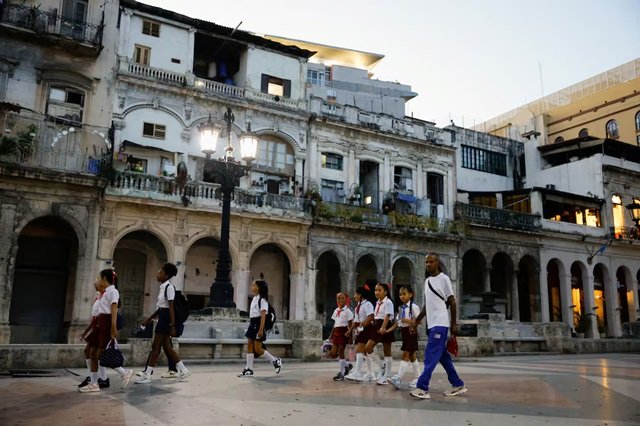
More than six decades after Fidel Castro declared education one of the central pillars of the Cuban Revolution, the country’s schools have opened for a new academic year under conditions the Government itself describes as “very difficult” and marked by “tremendous difficulties”.
When Castro addressed children on 14 September 1959, less than a year after the Revolution, he asked whether the Revolution had already been made and told them that studying was the first duty of a good revolutionary. His Government subsequently expanded access to education, reduced illiteracy to 3.9%, trained large numbers of teachers and extended schooling into rural areas. Castro presented these achievements alongside the health system as evidence of the Revolution’s social transformation.
More than half a century later, however, the start of the new school year has exposed severe strains in that system. Families face shortages of teachers, school materials, uniforms, food, water and electricity, while some mothers are considering keeping their children at home.
In Havana, a mother known as China said her nine-year-old son was due to begin his fourth grade after more than 30 hours without electricity at their home in the municipality of Regla. She said she did not want to wake him because he was exhausted. The family was also facing shortages of bread and difficulty keeping food and water cool. School uniforms were expensive, with blouses and shirts costing between 1,000 and 2,000 Cuban pesos and skirts and shorts between 2,000 and 4,000 pesos.
The difficulties extend into the classroom itself. Education Minister Naima Trujillo said the Government had struggled to meet the demand for uniforms for almost 1.4 million students. Electricity shortages have affected workshops, while fuel shortages have disrupted the movement of fabric around the country and limited the ability to import materials.
Teacher shortages have added another burden. Trujillo reported a deficit of 21,000 teachers, leaving only 73% of teaching positions covered. Havana has had to relocate around 3,000 teachers from the eastern part of the country, while provinces including Camagüey and Holguín are also facing substantial shortages. Low salaries of about 12 dollars a month and a lack of transport have contributed to teachers leaving the profession.
Even one of the Revolution’s flagship educational institutions has been affected. At the Vladimir Ilyich Lenin Vocational Pre-University Institute of Exact Sciences in Havana, a school designed to train elite students, the new term was delayed by a week because of a lack of water. Parents have also reported a shortage of 400 mattresses, while students were asked to bring rechargeable lamps because the school faces power cuts lasting 20 or 22 hours, like elsewhere in the country.
For families, meeting even basic educational costs has become increasingly difficult. Jessika, whose son is entering 12th grade at the Lenin institute, said she had begun selling croquettes, empanadas and handicrafts to meet household expenses. She paid 15,600 pesos, more than 22 dollars, for her son’s school trainers and still needed to buy toiletries, socks, underwear and food.
The pressures come against a broader economic crisis. A recent study by the Cuban Observatory of Human Rights estimated extreme poverty at 94% of the population. It found that 68% of respondents earned less than 20,000 Cuban pesos, around 30 dollars, a month, while eight in 10 Cubans said they had skipped breakfast, lunch or dinner because of a lack of money or food.
The electricity crisis has become particularly acute, with Cuba experiencing at least seven total collapses of the National Electric System this year. The Government has blamed the wider economic pressure partly on Washington’s measures, while the Communist Party has described the return to school as “another act of heroism”. President Miguel Díaz-Canel said the new academic year began despite what he called an American plan of suffocation.
Yet the consequences are increasingly being absorbed by families. Sociologist Elaine Acosta González said the effects of the crisis on mental health were “incalculable”, affecting children, adolescents and those caring for them, particularly women. She described intense daily stress, depression and growing difficulties for students in meeting academic demands.
As the State struggles to provide school materials and basic services, a parallel market has emerged. Imported educational supplies are being sold at prices many families cannot afford, while businesses offer to reprint textbooks that schools often cannot provide. Some parents have resorted to sending children to school in ordinary clothes because uniforms are unavailable, while others are accepting that their children may not attend.
The transformation of Cuba’s education system is therefore increasingly visible not only in schools but in the burden placed on families. A project once presented as a universal guarantee of education is now confronting shortages that are forcing parents to provide more of the food, clothing and basic resources required for their children to study.