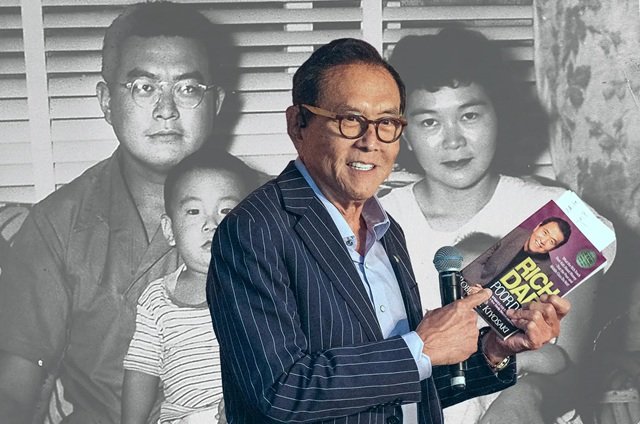
For generations of aspiring investors, Robert Kiyosaki’s name has been closely associated with a simple but provocative proposition: debt can be a tool for building wealth. His 1997 bestseller, Rich Dad, Poor Dad, encouraged readers to distinguish between assets and liabilities and to consider borrowing money to acquire investments capable of generating cash flow.
Now, the 79-year-old Japanese-American author’s own use of debt has placed that philosophy under an unusually intense spotlight.
In a series of podcast interviews over the summer, Kiyosaki claimed that he owed US$1.2 billion. The figure immediately attracted attention in China, where Rich Dad, Poor Dad was also a huge hit and became an introduction to personal finance for many readers.
But the reaction was shaped by more than fascination with the scale of the number. China’s property market has suffered a deep downturn in recent years, with steep falls in housing prices leaving huge numbers of investors in negative equity over the past five years. For some Chinese property investors, Kiyosaki’s comments therefore touched a particularly sensitive nerve.
On the Chinese social media platform RedNote, users said they had bought flats after reading Rich Dad, Poor Dad, only to suffer losses during the property downturn. Some expressed regret at having followed the investment philosophy associated with the book. Others, however, recalled reading it when they were younger and credited it with encouraging them to invest in stocks and funds.
The reaction ranged from admiration to scepticism and, in some cases, schadenfreude. Some users questioned how an ordinary person could ever obtain US$1.2 billion in loans, particularly where much of the borrowing was connected to property investment.
The apparent contradiction between a personal finance educator and such an extraordinary level of debt became a central part of the debate. But the figure requires qualification.
Kiyosaki’s ex-wife and long-term business partner Kim Kiyosaki clarified in an interview with Vanity Fair in late August that the US$1.2 billion figure covered borrowings related to investments in roughly 1,500 flats. Those investments were shared with partners rather than representing personal liabilities.
Vanity Fair estimated that Kiyosaki’s personal debt was more likely to amount to roughly US$30 million to US$60 million. Even so, the liabilities remain substantial, and their scale has intensified scrutiny of the investment principles that made him famous.
For Yan Yuejin, vice-president of the E-house China Research and Development Institute, there is less contradiction than might initially appear.
“There does appear to be a stark contrast when a personal finance educator carries massive debt. However, this is precisely the real-world application of the logic in his book,” Yan said.
At the centre of Kiyosaki’s philosophy is the distinction between assets and liabilities and the argument that borrowing can be used to acquire assets that generate cash flow. In this interpretation, debt itself is not necessarily evidence of financial failure. What matters is what the borrowing is financing and whether the underlying assets can support the obligations.
Kiyosaki’s liabilities, Yan explained, were essentially project-level debt arising from property investments. Such an approach is common among large-scale US property investors, who can refinance against asset appreciation to roll over and expand investments while using limited liability companies to insulate themselves from personal risks.
That distinction is particularly important when considering the story behind Rich Dad, Poor Dad. The book contrasts two father figures: Kiyosaki’s biological father, a well-educated teacher with a stable public-sector job who nevertheless struggles financially, and the “Rich Dad”, portrayed as his childhood friend’s father, a less-educated but financially savvy entrepreneur who built wealth through investments.
The book spent six years on The New York Times bestseller list after its release in 1997. Its success in China helped make Kiyosaki a familiar figure among readers seeking an alternative approach to personal finance.
Yet the property investment strategy described through his philosophy has become harder to replicate. Higher interest rates in the US have driven a notable rise in financing costs, while rent growth has cooled, Yan noted. Those pressures make highly leveraged property investments more difficult to sustain.
Kiyosaki also entered the property market early, in the 1970s, giving him a very low cost basis for his assets. His portfolio consists of rent-generating properties with relatively steady cash flow, according to Yan. Those conditions are difficult for later entrants to reproduce.
The durability of the model therefore depends heavily on asset valuations and the ability of cash flows to cover debt obligations. For now, Yan said, the strategy can remain viable provided there are no extreme market shocks.
Kiyosaki himself has acknowledged that his operating model — high-leverage, large-scale and long-term investing — is barely replicable for most people. He has repeatedly warned readers: “Don’t follow my example.”
That warning may be especially significant for readers who interpreted Rich Dad, Poor Dad as a blueprint rather than as an account of an unusually leveraged investment strategy.
“This represents him taking his own investment philosophy to its extreme. Average readers need to recognise the huge gap between underlying principles and real-world execution,” Yan said.
For Chinese investors reflecting on years of property losses, the debate over Kiyosaki’s debt is therefore about more than the size of one investor’s liabilities. It has revived a fundamental question at the heart of his bestselling philosophy: whether principles that may work at large scale, with established assets, substantial cash flow and sophisticated financing structures, can safely be translated into ordinary investors’ lives.