China has completed the maritime safety system for the approaches to the Pinglu Canal, officially releasing its nautical map and fully installing aids to navigation along the canal’s seaward stretch on Monday, according to China Central Television (CCTV).
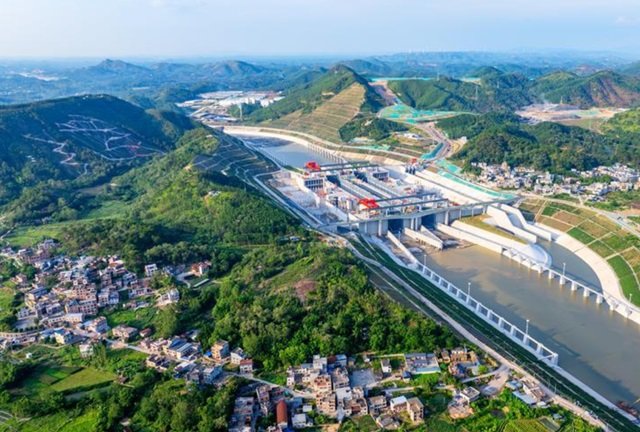
The move marks the completion of the canal’s maritime safety infrastructure, covering both channel marks and chart coverage, ahead of its planned opening to navigation in September this year. The 134.2-kilometre waterway is described as a “project of the century” and forms the backbone of China’s New International Land-Sea Trade Corridor, an initiative aimed at strengthening trade connectivity for the country’s southwestern inland regions.
The Pinglu Canal is also the first canal in China to have been planned at the national level since 1949, giving the project a prominent role in the country’s transport and trade infrastructure.
The newly released nautical map is an official Pinglu Canal chart published by the China Maritime Safety Administration (MSA). It covers the newly constructed 22-kilometre coastal section extending from the Qinjiang Bridge on the G75 Lanhai Expressway, past Longmen Bridge, to the junction with Qinzhou Port.
The chart connects seamlessly with existing Qinzhou Port charts, creating a continuous chart series for the Qinzhou harbour area in the Beibu Gulf, in South China’s Guangxi Zhuang Autonomous Region. The coverage is intended to provide navigational information for vessels using the canal’s connection with the coastal port system.
Alongside the chart release, the South China Sea Aids to Navigation Center under China’s Ministry of Transport completed the installation of 127 navigation marks along the canal’s coastal waters, according to CCTV.
The installations include lighted buoys, bridge navigation marks, beacons and pipeline marks. They are designed to provide ships with precise guidance, particularly when vessels pass beneath bridges along the canal.
The canal is designed to accommodate vessels of up to 5,000 metric tons and is scheduled to open to navigation in September, according to the Xinhua News Agency. Its operation is expected to provide a new maritime connection for China’s southwestern inland regions through Qinzhou Port and the Beibu Gulf.
The canal’s potential significance extends beyond China’s domestic transport network. Chea Munyrith, president of Cambodian Chinese Evolution Researchers Association, told the Global Times on Monday that the opening of the Pinglu Canal could create a significant new opportunity to strengthen ASEAN-China connectivity and economic cooperation.
By connecting inland regions more efficiently with the sea, the canal could complement existing land, rail, maritime and river transport networks, Munyrith said. Such integration could improve logistics efficiency, reduce transportation costs and facilitate the movement of goods between China and ASEAN markets.
Munyrith also said the canal could strengthen regional supply chain resilience and create new opportunities in trade, investment, logistics, manufacturing, agriculture and tourism. For ASEAN countries, he said, improved connectivity with China could provide greater access to one of the world’s largest markets and create more opportunities to participate in regional value chains.
The significance of the canal, he added, could become more pronounced over the longer term as its role within regional connectivity and economic cooperation develops.