In Sri Lankan society, the betel leaf is not merely a plant leaf, but a paramount cultural symbol intertwined with our rituals, customs, and hospitality. A sheaf of betel leaves holds a special place during the Sinhala and Tamil New Year, weddings, showing respect to elders, and various traditional ceremonies. However, what many who view betel as solely a domestic cultural symbol and practice do not know is that it is also an important export agricultural crop that brings a significant amount of foreign exchange into the country.
Under the bilateral Pakistan-Sri Lanka Free Trade Agreement (PSFTA), Pakistan is the primary market for betel, a traditional export crop of Sri Lanka. However, over the past few years, the betel export sector has faced a severe crisis due to tariff and regulatory barriers encountered by Sri Lankan exporters when entering the Pakistani market. An analysis of information obtained under the Right to Information (RTI) Act from the Department of Commerce and the Department of Export Agriculture clearly reveals the nature of this trade crisis, as well as the contradictions and lack of coordination between the relevant state institutions in addressing it.
Statistical Decline in Betel Exports and the Cultivation Area Contradiction
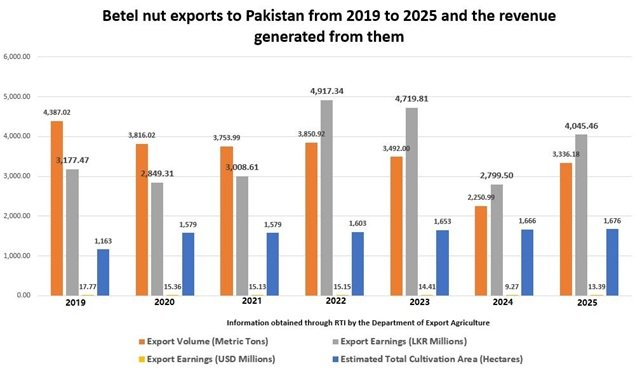
Below is the annual data table showing betel export volumes to Pakistan, earnings generated, and the estimated total betel cultivation area in Sri Lanka from 2019 to 2025, according to data provided by the Department of Export Agriculture:
| Year | Export Volume (Metric Tons) | Export Earnings (LKR Millions) | Export Earnings (USD Millions) | Estimated Total Cultivation Area (Hectares) |
| 2019 | 4,387.02 | 3,177.47 | 17.77 | 1,163 |
| 2020 | 3,816.02 | 2,849.31 | 15.36 | 1,579 |
| 2021 | 3,753.99 | 3,008.61 | 15.13 | 1,579 |
| 2022 | 3,850.92 | 4,917.34 | 15.15 | 1,603 |
| 2023 | 3,492.00 | 4,719.81 | 14.41 | 1,653 |
| 2024 | 2,250.99 | 2,799.50 | 9.27 | 1,666 |
| 2025 | 3,336.18 | 4,045.46 | 13.39 | 1,676 |
Examining the data above reveals that the export volume of 4,387.02 metric tons in 2019 dropped sharply to 2,250.99 metric tons by 2024. Similarly, revenue earned in 2019 of USD 17.77 million fell to a minimum of USD 9.27 million in 2024. Although 2025 showed a slight recovery with export volume reaching 3,336.18 metric tons and revenue rising to USD 13.39 million, it did not return to 2019 levels.
Despite cultivation land continuously expanding from 1,163 hectares to 1,676 hectares (a 44% increase) between 2019 and 2025, USD export revenue declined from USD 17.77 million to USD 13.39 million (a 24.6% drop). This highlights a clear contradiction between cultivation area and export earnings. Across the 7 years analyzed, the lowest export volume (2,250.99 MT) and lowest USD revenue (USD 9.27 million) were recorded in 2024. Furthermore, the relative increase in LKR revenue during 2022–2023 despite falling USD earnings was primarily driven by the depreciation of the Sri Lankan Rupee against the US Dollar.
Pakistan’s Regulatory Duty and the Exporters’ Crisis
According to information released by the Department of Commerce, feedback was sought from Sri Lankan exporters in the fourth quarter of 2025 in preparation for the 8th Session of the Pakistan-Sri Lanka Commerce Secretary Level Talks scheduled to be held in Sri Lanka on January 28, 2026. A Sri Lankan export company pointed out that Regulatory Duty (RD) imposed by Pakistan on betel leaves (classified under HS Code 1404.90.20) restricted market access, reduced export volumes, and negatively impacted the expected economic benefits of the PSFTA.
Subsequently, this issue was presented to the Pakistani delegation during the Commerce Secretary Level Talks on January 28, 2026, as well as at the 4th Meeting of the Joint Working Group on Trade, Investment, and Auto Sector held online on July 01, 2026. In response, the Pakistani side conveyed that their target is to gradually reduce the relevant duty and phase it out completely by 2030.
Communication Gap Between the Two State Institutions
Comparing the RTI information reveals a serious communication gap between the two state institutions. Despite exporters raising concerns with the Department of Commerce regarding market access loss caused by tariff barriers, the Department of Export Agriculture stated that its development or research divisions had conducted no studies on the impact of Pakistan’s tariffs and import restrictions on betel exports.
Furthermore, the department mentioned that no complaints had been received from farmers in the Kurunegala and Gampaha districts and that no loss of the Pakistani market had been reported to them. Even as betel export volumes continued to decline, the Department of Export Agriculture expanded betel cultivation land from 1,163 hectares in 2019 to 1,676 hectares by 2025 by offering free planting materials and investment subsidies. Expanding cultivation area without first resolving tariff issues in the export market risks pushing farmers into overproduction, leaving them exposed to a severe crisis.
Bilateral Talks and the Future of Trade Agreements
During the 13th Session of the Pakistan-Sri Lanka Joint Economic Commission and Commerce Secretary Level Talks held on January 28, 2026, discussions covered several areas including the PSFTA review, removal of para-tariffs, establishment of bilateral trade facilitation centers, and customs cooperation. Further information on this can be accessed on the official website of the Department of Commerce.
To safeguard Sri Lanka’s betel export sector, it is essential to establish proper coordination between the Department of Commerce and the Department of Export Agriculture, conduct field studies on exporters’ tariff barriers, and strengthen diplomatic engagement to secure the early removal of Pakistan’s regulatory duties under the PSFTA framework rather than delaying until 2030.