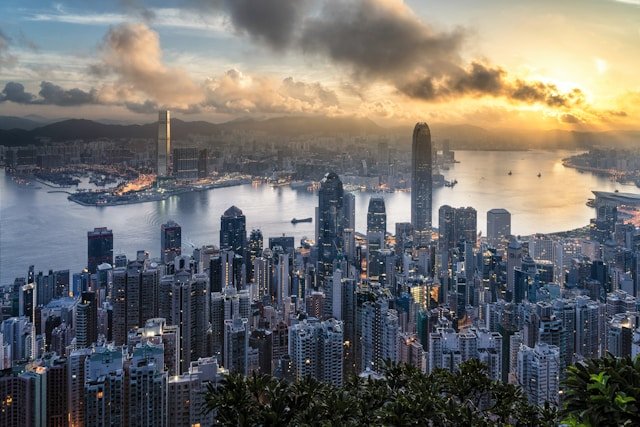
Hong Kong has unveiled its first five-year strategic blueprint, placing the financial sector at the centre of its economic strategy and describing finance as the city’s “pivotal and crowning strength”.
The plan, released on 16 September, has received early support from financial-sector leaders and economists, who see it as an attempt to provide greater policy continuity and coordinate initiatives that have previously been pursued separately.
But beneath the broad ambitions lies a more practical question: can Hong Kong turn policy direction into new products, deeper markets and sustained international demand?
Bonnie Chan, chief executive of Hong Kong Exchanges and Clearing (HKEX), said the blueprint and the city’s 2026 policy address established an ambitious framework for strengthening Hong Kong’s contribution to China’s economic development.
Candise Tang, senior director at H/Advisors, said the plan could provide greater continuity through the change of government expected in 2027, particularly because it contains specific targets and performance indicators.
Betty Wang, lead economist at Oxford Economics, said many of the measures formalise and coordinate policies that have already been discussed or introduced. In that sense, the blueprint also responds to concerns that policymaking has been too heavily focused on short-term priorities.
Its central financial strategy is broad rather than narrowly focused on equities.
HKEX’s Chan identified four directions: expanding Hong Kong’s offshore renminbi, fixed-income, currency and commodities ecosystem; deepening its secondary market; strengthening its fundraising platform for international issuers; and upgrading market infrastructure to accommodate future changes.
The renminbi is already a major part of that proposition.
Cindy Keung, an economist in OCBC’s macro research team, noted that Hong Kong handles about 75% of global renminbi clearing and has the world’s largest pool of offshore renminbi liquidity.
The five-year plan seeks to build further on that position. Measures include a half-rate tax concession for qualifying commodity-trading activities and preparations for renminbi-denominated, physically settled gold futures.
The argument is straightforward: Hong Kong’s proximity to mainland China and the rest of Asia gives it access to major sources of commodity demand, while its established renminbi infrastructure provides a link between Chinese markets and international investors.
“Aside from the tax advantages, Hong Kong’s key edges lie in proximity to Asian demand, a renminbi-denominated gold market and closer integration with the mainland’s commodity trading ecosystem,” Keung said.
The next challenge is market depth.
Byron Lam, an economist and market strategist at DBS Bank (Hong Kong), described Hong Kong as the central pillar of renminbi internationalisation, supported by roughly 1.1 trillion yuan (US$164 billion) in deposits and financing quotas.
But he said further progress would require broader institutional participation, deeper repo and collateral markets, more dim sum bond issuance and better hedging instruments.
For international investment managers, those details are not peripheral. They determine whether a market can accommodate large positions efficiently.
Kher Sheng Lee, co-head of Asia-Pacific at the Alternative Investment Management Association, said international managers would be more prepared to hold mainland exposure at scale when renminbi fixed-income markets have sufficient depth and effective hedging tools.
“Liquidity follows usable products,” he said, making product development and distribution across different asset classes an important test of the strategy.
The same principle applies to commodities.
Institutional investors require markets where assets can be traded, financed, stored and settled with legal certainty. Lee noted that Hong Kong’s emphasis on clearing, storage and insurance addresses those requirements in sequence.
Gold is already strengthening the city’s role as a gateway between mainland China and international markets.
According to Lam, gold imports into China through Hong Kong rose 92.4% year on year to 499 tonnes in August. Jamie Turnough, chief executive of Hong Kong-based precious-metals retailer Bullion Beasts, welcomed plans for a central gold-clearing system in early 2027 and expanded airport depository capacity.
He argued that Hong Kong’s advantages for investors seeking diversification include its proximity to major physical gold markets in Asia, expanding secure storage capacity, a forthcoming central clearing system, free movement of capital and a legal framework supporting allocated physical ownership.
The financial strategy extends beyond commodities.
Hong Kong also wants to deepen its secondary market and strengthen its ability to attract international companies seeking capital. The policy address included plans for HKEX to promote dual primary and secondary listings of overseas enterprises, including companies from South-east Asia and countries participating in China’s Belt and Road Initiative.
The exchange has already been developing those links.
In July, Johnson Chui, HKEX’s head of global issuer services, said the exchange wanted to position Hong Kong as a gateway to deeper international capital pools. He pointed to memorandums of understanding with regional exchanges, including those in Malaysia and Kazakhstan.
That strategy fits another priority: supporting mainland Chinese companies as they expand internationally.
Oxford Economics’ Wang said such expansion could create opportunities for Hong Kong institutions in cross-border financing, asset management and renminbi-related business. But the scale of those opportunities will also depend on how quickly mainland China’s financial system opens further.
Hong Kong’s wealth-management ambitions are similarly tied to its role as an intermediary between China and global capital.
Chi Man Kwan, group chief executive of Raffles Family Office, said families transferring wealth across generations would need access to multiple asset classes rather than a single investment category. He pointed to an estimated US$5.8 trillion in wealth expected to pass to the next generation in the Asia-Pacific region by 2030.
For Hong Kong, the objective is therefore not simply to attract more listings. It is to position the city as a “super connector” between mainland companies, international investors, wealth owners and financial markets.
That ambition inevitably brings Singapore into the discussion.
As geopolitical tensions reshape investment decisions, financial institutions and wealthy families continue to consider established Asian centres that offer regulatory stability, international connectivity and access to regional markets.
Hong Kong and Singapore occupy different positions within that competition.
Hong Kong’s strategy is increasingly centred on its connection to mainland China’s companies, capital and deal flow, as well as its offshore renminbi infrastructure. Singapore, meanwhile, continues to serve international families and businesses seeking a base from which to manage assets and operate across South-east Asia.
The competition may therefore be less about which city attracts the larger number of companies and more about which financial centre captures higher-value activities.
Neil Synnott, regional chief commercial officer for Asia-Pacific at IQ-EQ, said the next phase of competition among financial centres could revolve around the efficiency with which they connect capital, talent and innovation.
“If Hong Kong can execute effectively, its future strength may come not from being bigger than its peers, but from being more differentiated,” he said.
That qualification — execution — runs through the entire five-year strategy.
Creating financial products is one thing. Generating sufficient liquidity, attracting institutional participation and establishing international demand is another.
The same applies to infrastructure development. Hong Kong’s ambitions for commodities, technology and the Northern Metropolis require land, transport links, laboratories, data infrastructure and supporting services. Financial-sector expansion also requires a sufficient supply of international and domestic talent.
Wang cautioned that Hong Kong’s market-oriented economic system means implementation cannot be driven by government alone. Coordination among departments and the civil service, alongside participation by private-sector institutions, will be necessary to turn broad objectives into operational policies.
Lam identified similar risks, pointing to timely land and infrastructure development, cross-border regulatory coordination, talent retention and private-sector participation as important conditions for delivery.
The five-year blueprint consequently represents more than another set of economic targets. It is an attempt to define how Hong Kong fits into an increasingly fragmented global financial system.
Its strategy rests on several overlapping advantages: access to mainland Chinese companies and capital, an established offshore renminbi market, international financial institutions, a developed legal and financial infrastructure, and proximity to the fast-growing Asian economy.
But those advantages do not automatically produce deeper markets.
Hong Kong must persuade international investors to use its new products, convince mainland and overseas companies to raise capital through its markets, develop sufficient liquidity in emerging asset classes and maintain the talent required to operate an increasingly sophisticated financial centre.
The city’s first five-year plan has therefore set out a clear direction. Its more consequential phase begins after the announcement, when policy targets have to become functioning institutions, tradable products and sustained market activity.
As Lam put it, the blueprint provides a strategic road map. Its longer-term significance will be determined by measurable implementation.
For Hong Kong, the next five years will consequently be less about declaring a financial ambition than demonstrating that the city can convert its unique position between China and the global economy into new forms of financial activity — while remaining competitive with other Asian centres such as Singapore.