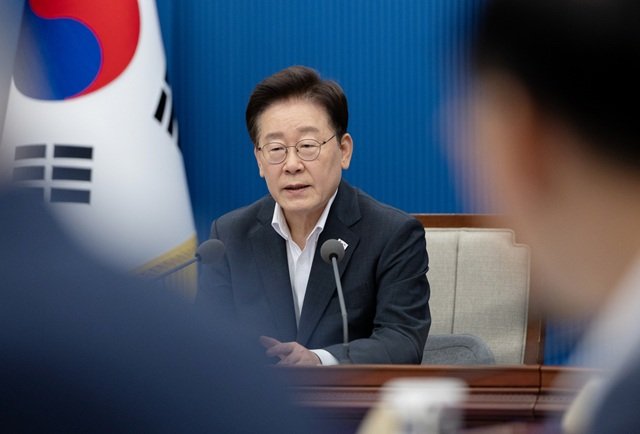
South Korean President Lee Jae Myung said on Friday that Seoul would not deploy military assets to the Middle East in a way that could draw the country into war, while acknowledging that the government was considering a greater role in protecting navigation and commercial interests in the region.
“There won’t be deployment that would involve or enter war. I can tell you that very clearly,” Lee said at a news conference. “We won’t deploy military assets in any form to that end.”
South Korea has maintained a naval presence off the coast of Somalia as part of an anti-piracy mission, while resisting calls from US President Donald Trump for Seoul to take a more active military role in supporting Washington during the war in Iran.
Lee nevertheless said South Korea needed to take limited measures to protect its commercial shipping, crude oil shipments and citizens. “It is also clear that we must do the minimum as other countries do to protect our commercial shipping and crude shipments, and also the safety of our people,” he said.
The South Korean government has been reviewing a possible military deployment to the Strait of Hormuz, although the proposal has proved unpopular domestically. The issue has also complicated relations with Washington, with Trump criticising Seoul for what he described as insufficient support for the Iran war.
The United States also scaled back major joint military drills with South Korea this summer, a move that unsettled the US ally. Seoul must therefore balance its security relationship with Washington against domestic opposition to becoming directly involved in the Middle East conflict.
Alongside the security debate, Lee said South Korea and the United States were nearing an agreement over Seoul’s investment commitments under their trade deal, although the commercial viability of the package remained the main sticking point.
South Korea committed last year to invest $350 billion in US manufacturing in return for Washington lowering tariffs on Korean imports to 15%. Lee said there were elements of the arrangement that Seoul found difficult to accept, but that negotiations were approaching an agreement. Seoul postponed a parliamentary briefing on the investment plans this week, with the briefing now expected to take place next week.
Lee also said a meeting between Trump and North Korean leader Kim Jong Un could take place in coming months, although several factors would need to align. He said Trump wanted talks and that Seoul was continuing coordination to make dialogue between Washington and Pyongyang possible. North Korean state media has so far remained largely silent on Trump’s repeated calls for such a meeting.
The South Korean president also ruled out seeking a second consecutive term, ending speculation over whether he and his Democratic Party, which holds a parliamentary majority, might seek constitutional changes allowing him to remain in office.
“Let me say this firmly. I have no intention of seeking a consecutive term whatsoever,” Lee said. The presidency is currently restricted to a single five-year term under the Constitution, with a sitting president specifically excluded from any amendment affecting the presidential term.
Lee also said he would pursue measures to reduce the concentration of government and economic activity in Seoul by designating Seoul as the economic capital and Sejong as the political capital. Many government agencies are already located in Sejong, about 120 km (75 miles) south of Seoul.