For decades, one of the foundations of American financial power was the relationship between oil and the US dollar. The oil shocks of the 1970s generated enormous current-account surpluses for petroleum exporters, many of whom accumulated dollar deposits and US securities. Western banks recycled part of those petrodollar surpluses into loans to developing countries, reinforcing the role of the dollar in global finance.
The influence of the petrodollar system remained substantial from the 1970s into the early 2010s, although its strength fluctuated with oil prices and changing patterns of global trade and finance.
From around 2014, however, several developments began weakening its relative importance. The US shale revolution reduced American dependence on imported oil, oil prices became less consistently elevated, Gulf states diversified their investments, and countries including China and Russia experimented with alternatives to dollar-based settlement. The growing use of local currencies by BRICS members has added another dimension to that trend.
Yet the dollar remains deeply embedded in international energy markets. The petrodollar, moreover, was never simply a matter of which currency appeared on an oil invoice. It connected a strategically important commodity with US financial markets, dollar liquidity and American security relationships with major Gulf producers.
Now another globally significant resource is becoming increasingly important: computing power.
Some analysts argue that artificial intelligence could create the foundations of an “AI dollar” — a system in which the US currency remains central not because it is required to purchase oil, but because companies and governments need dollars to access advanced chips, cloud computing, AI models, software and the capital required to build the infrastructure behind them.
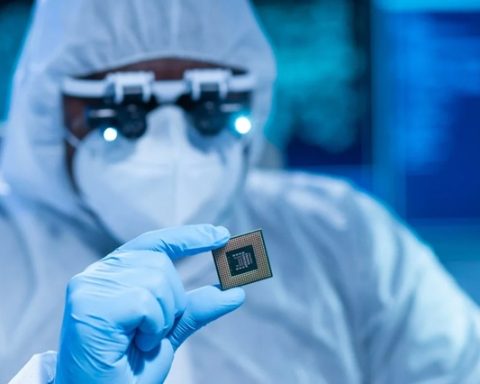
The United States currently occupies a powerful position across much of this technology chain. American companies lead major segments of advanced chip design, cloud computing, proprietary AI models and software, while US financial markets provide a substantial share of the equity, debt and venture capital supporting the sector.
That creates a potential feedback loop.
Foreign companies and governments could acquire dollars to purchase computing capacity, advanced semiconductors and AI services from American firms. Those companies would generate revenue abroad, while expectations of continued AI-driven growth could attract further international investment into US technology companies and private markets.
Dollar-backed stablecoins could reinforce the process. The Bank for International Settlements reported in 2026 that 99.4% of fiat-backed stablecoins by market value were pegged to the US dollar. It also noted that issuers generally hold reserves in dollar-denominated assets, including short-term public debt and bank claims.
If AI agents eventually conduct transactions autonomously using stablecoins, a further link could emerge between demand for AI services and demand for digital dollars. Companies using AI systems for international transactions could have an additional incentive to maintain dollar balances if computing services, contracts and automated payments are denominated in the currency.
That possibility has led some analysts to consider whether Washington could use access to advanced American chips as an economic instrument, encouraging international customers to settle AI-related trade in dollars.
But the analogy with oil has important limits.
Oil is a relatively homogeneous commodity with universal demand. AI is not. Artificial intelligence encompasses models, chips, cloud infrastructure, software and services that differ substantially in price, quality and function. Some AI models can also be downloaded and operated locally, reducing dependence on recurring purchases from a particular American provider.
The financial structure is different as well. Petrodollar surpluses were recycled heavily into bank deposits, loans and government securities. AI investment is much more concentrated in equities, venture capital and private assets. Those markets can generate enormous returns, but they are also considerably more sensitive to valuations and expectations.
An AI-dollar system would therefore be less a commodity-pricing arrangement than a technology-and-capital-market network.
That distinction matters because a significant challenge is emerging from China.
Chinese companies are developing open-weight AI models such as DeepSeek, Qwen and Kimi, potentially reducing dependence on American proprietary systems. Chinese semiconductor companies including Huawei and Cambricon are developing processors that could substitute for US-designed chips in some applications. Alibaba, Baidu and Tencent provide alternatives in cloud computing, while Chinese state-linked financial institutions can support infrastructure investment abroad.
China is also expanding payment infrastructure outside the traditional dollar-based system. Its Cross-Border Interbank Payment System, or CIPS, provides renminbi clearing and settlement for international transactions and is designed to reduce reliance on conventional correspondent-banking arrangements.
The more significant challenge would arise if these technologies were combined into a single ecosystem: Chinese AI models operating on Chinese-designed processors, hosted in Chinese-financed data centres, with cloud services paid for in renminbi through Chinese payment infrastructure.
Such a system could be particularly attractive to developing economies seeking lower costs, alternative suppliers or greater insulation from US sanctions.
China nevertheless faces substantial obstacles. Its most advanced semiconductor capabilities remain constrained by restrictions on access to leading-edge manufacturing equipment. Chinese cloud companies also lack the global reach and international trust enjoyed by the largest American platforms.
The financial obstacle may be even more important. The renminbi is not fully convertible, China’s capital controls restrict cross-border financial flows, and China does not possess a market for safe, liquid and internationally trusted government securities comparable in scale and depth to the US Treasury market.
That means China could potentially build a sizeable alternative AI ecosystem without immediately creating an alternative reserve-currency system.
The greatest vulnerability to an AI-dollar model, however, may lie within the United States itself.
American technological dominance does not automatically guarantee confidence in American public finances. Persistent federal deficits, a rapidly expanding national debt and rising interest costs have increased scrutiny of the country’s fiscal trajectory. All three major US credit-rating agencies have downgraded the country’s sovereign debt from their highest rating: S&P in 2011, Fitch in 2023 and Moody’s in 2025.
Long-term Treasury yields have also risen, although yields are influenced by multiple factors, including inflation expectations, monetary policy, economic growth and energy prices. Investors’ willingness to hold long-term US government debt therefore cannot be explained by fiscal concerns alone.
This creates a potentially important distinction between what might be called the “technology dollar” and the “sovereign dollar”.
International investors could remain confident in American technology companies while becoming less confident in the long-term purchasing power of the currency or the management of US public finances. Foreign investors could continue buying shares in companies such as Nvidia, Microsoft or Google while reducing their exposure to longer-term Treasury securities.
They could also hedge their currency exposure, meaning that the capital flowing into US technology markets would not necessarily translate into equivalent and lasting demand for dollars.
Central banks, meanwhile, could continue diversifying their reserves towards gold and other currencies if concerns about US fiscal policy, Federal Reserve independence or broader policy uncertainty increase.
This would produce an unusual form of dollar dependence: the world could remain heavily dependent on American technology without becoming equally dependent on American government debt.
AI investment could temporarily obscure that distinction. Strong international demand for US technology companies could help finance America’s external imbalances even if foreign demand for Treasuries weakens. But the quality of that support would be different.
Treasuries benefit from their role as highly liquid, widely accepted safe assets. Technology shares depend on expectations of future earnings. If projected AI profits fail to materialise or valuations fall sharply, international capital flows into the sector could weaken precisely when concerns about US debt were intensifying.
The result would be a more fragile foundation for dollar power.
The United States therefore possesses an unusual combination of advantages. It leads important parts of the semiconductor, cloud-computing and AI industries; its capital markets remain central to financing technological expansion; and the dollar dominates the rapidly expanding stablecoin market. The BIS has noted that the overwhelming dollar orientation of stablecoins could reinforce existing international currency hierarchies, although stablecoin use for real-economy payments remains much smaller than its headline transaction volumes suggest.
China, meanwhile, has the potential to fragment that network by combining alternative AI models, domestic semiconductor technology, cloud infrastructure, financing and renminbi-based payment systems. But technological gaps and the limited international role of the renminbi constrain how far that alternative can develop.
The emerging contest is therefore not simply between two currencies. It is increasingly a contest between technological ecosystems, financial markets and payment infrastructures.
The petrodollar was built around a strategic commodity and the financial recycling of its revenues. An AI dollar would be built around computing power, technological services and capital flows.
That could give the US another powerful source of international dollar demand. But technology cannot permanently substitute for confidence in the institutions behind a currency.
American technological leadership can attract capital and strengthen the dollar’s international role. It cannot, by itself, resolve fiscal pressures, guarantee stable purchasing power or replace confidence in the credibility of US economic institutions.
The future of the dollar may therefore depend on two different forms of American power: the ability to remain at the technological frontier and the ability to preserve confidence in the state that stands behind the currency.
An AI dollar could emerge as a powerful new pillar of US financial influence. Whether it becomes a durable one will depend on more than who builds the world’s most advanced AI.