Sweden’s centre-left opposition has emerged from the country’s parliamentary election with a narrow three-seat majority, bringing Prime Minister Ulf Kristersson’s four-year tenure to an end while opening a difficult round of negotiations over who will govern the country.
The final count gave the bloc backing Social Democratic leader Magdalena Andersson 176 of the Riksdag’s 349 seats, compared with 173 for the right-wing bloc led by Kristersson. The result was confirmed after the completion of the additional counting process on 17 September, although Sweden’s Electoral Authority distinguishes between the updated preliminary result and the formal final certification of the election.
Kristersson conceded defeat and announced his resignation after the result became clear. In a letter posted on social media, he asked to be formally dismissed as prime minister so that Parliament Speaker Andreas Norlén could begin consultations with party leaders over the formation of a new government.
“The Speaker of Parliament must now lead the next steps toward forming a new government,” Kristersson wrote, requesting that his dismissal take effect so the process could begin immediately.
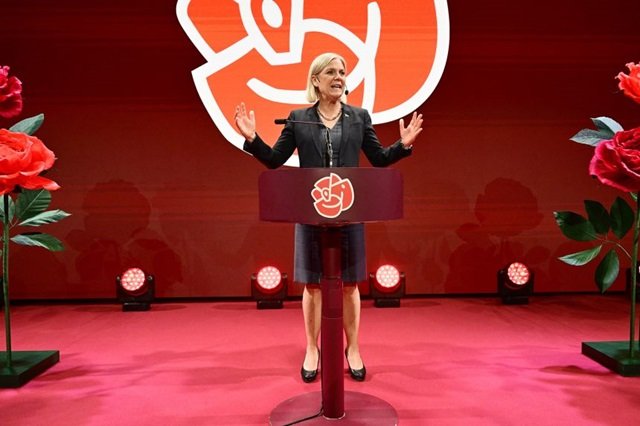
The transfer of power, however, is not yet straightforward. Andersson’s Social Democrats emerged as the largest party, winning around 28% of the vote and 99 seats, but their position within the broader centre-left bloc does not give them an automatic path to forming a government.
The Left Party, Centre Party, Social Democrats and Greens collectively hold the 176 seats. The parties share enough parliamentary ground to have produced a majority in the election, but significant differences remain over how that majority should be translated into a cabinet.
The most immediate dispute concerns the Left Party’s demand for ministerial representation and the Centre Party’s opposition to the Left Party taking cabinet positions. That disagreement leaves Andersson facing negotiations in which securing parliamentary support and constructing a coalition government are separate but interconnected challenges.
The difficulty is heightened by the fact that the election itself did not produce a dominant mandate for any individual party. The Social Democrats’ 28% made them the largest party, but it also represented their weakest national result in decades. The Moderates followed with approximately 19.8%, while the Sweden Democrats fell to around 17.5%, losing their position as the second-largest party in the Riksdag. The Sweden Democrats nevertheless remain a substantial parliamentary force, with 62 seats.
The final parliamentary balance was shaped by the counting of late-arriving advance votes and other ballots. Sweden’s Electoral Authority reported that the additional count transferred one seat from the Social Democrats to the Left Party, while leaving the overall bloc distribution unchanged at 176 to 173.
Turnout was high by international standards, with the Electoral Authority reporting preliminary participation of 84.8% of eligible voters.
For Andersson, the central political task now is to turn an electoral majority into an operational governing arrangement. The arithmetic is straightforward: the four centre-left parties collectively control more than half of the Riksdag. The political negotiations are considerably less so.
The Centre Party’s position is particularly important because its participation provides part of the parliamentary arithmetic needed for the bloc’s majority, while its opposition to giving the Left Party cabinet positions creates a direct obstacle to forming a conventional coalition government.
The process will therefore test whether the parties can maintain a common parliamentary position while preserving their separate political identities. Andersson must also establish how responsibilities would be divided within a cabinet and determine the policy compromises necessary to keep the four-party grouping together.
The right-wing bloc, meanwhile, has lost the parliamentary numbers it held before the election but remains an alternative route to government if the centre-left negotiations fail. Its parties — the Moderates, Sweden Democrats, Christian Democrats and Liberals — collectively hold 173 seats.
That arithmetic means the election has not produced an entirely settled political order. Instead, it has created a narrow parliamentary advantage for one bloc while leaving both sides with potential routes to influence the formation of the next government.
The result also marks a significant change in the parliamentary position of the Sweden Democrats. The party lost ground compared with the previous election and fell behind the Moderates, despite having played an important supporting role for Kristersson’s government since 2022. Its decline means that the political balance inside the right-wing bloc has changed even though the bloc remains only three seats short of its centre-left rivals.
The next phase will therefore be less about the counting of votes than the negotiation of power. Parliament’s procedures require consultations and votes before a new prime minister can take office, while the Speaker will play a central role in testing whether a proposed government can command sufficient parliamentary support.
Andersson has the largest bloc behind her, but that majority is dependent on parties with differing demands and priorities. Kristersson has resigned, but the right remains numerically close enough to remain part of the parliamentary equation.
Sweden’s election has consequently produced a clear parliamentary result but an unresolved political settlement. The centre-left has 176 seats. The right has 173. The decisive question is whether those numbers can be converted into a stable government — or whether disagreements within the winning bloc will reopen the contest over who governs Sweden.