A former Australian defence official’s decision to invoke an “aggressive Indonesia” while arguing for the strategic value of Aukus submarines has created an awkward moment for relations between Canberra and Jakarta. Michael Pezzullo, a former deputy secretary of strategy in Australia’s defence department, made the remarks on September 2 while giving evidence to the Aukus Public Inquiry, an independent, crowdfunded review of the trilateral defence pact.
Pezzullo was making the case that Aukus’ nuclear-powered submarines would give Australia its best route to undersea military dominance. In describing a hypothetical conflict, he presented Indonesia as an illustrative adversary and argued that Australian forces would seek to “rapidly destroy as much of the enemy’s fighting power as possible” without having to call on the United States or other allied forces.
The remarks were first published by media outlet News24 on September 5 and then edited and republished two days later by The Strategist, a journal run by the Australian Strategic Policy Institute, under the headline “Aukus has put Australia’s submarine effort back on track”. The institute, established by the Australian government in 2001, receives partial funding from the Department of Defence.
For Indonesia, the reference carried a weight beyond the hypothetical scenario itself. Abdul Rahman Yaacob, a research fellow at the Rabdan Security and Defence Institute in the United Arab Emirates, said Indonesian defence officials were “unhappy” and had raised the issue informally with their Australian counterparts in Jakarta on the same day the article was published.
“It is always good not to mention one’s potential adversary publicly when relations are good,” Rahman said. “That is clumsy diplomacy.”
The timing was particularly sensitive. Only seven months earlier, Australia and Indonesia had signed a landmark agreement committing the two countries to regular high-level consultations on regional and national security challenges and to expanded defence cooperation, including joint military training. The agreement came as the two countries sought to deepen a relationship that has repeatedly been shaped by mistrust as well as strategic necessity.
That history remains difficult to ignore. Rahman noted that Canberra had periodically viewed Indonesia as a threat, with Australian opinion polls in the early 2000s placing Indonesia “far outranking” other regional states as a perceived security threat. He linked that legacy to East Timor’s bitter struggle for independence from Indonesia and the Australian-led military intervention that followed.
Suspicion has also travelled in the opposite direction. In 2013, revelations leaked by former US National Security Agency contractor Edward Snowden showed that Australian intelligence had monitored the mobile phone of then president Susilo Bambang Yudhoyono. Jakarta responded by recalling its ambassador to Canberra and suspending bilateral cooperation for a time.
Yet the strategic relationship has since moved beyond some of those earlier confrontations. Gatra Priyandita, a senior analyst at the Australian Strategic Policy Institute, said Indonesia’s defence establishment was unlikely to regard the country as Aukus’ intended target despite Pezzullo’s remarks.
The two countries have a history of military confrontation, including during the “Konfrontasi”, president Sukarno’s 1963-66 armed campaign against the formation of Malaysia. Relations reached another low in 1999, when Australia led an international peacekeeping force into East Timor as the territory voted for independence, a move Jakarta viewed as an affront to its sovereignty.
But Gatra said the relationship had moved well beyond that period. Australia increasingly regarded a strong and stable Indonesia as important to its own security, while joint exercises, military training and personnel exchanges had created “a relationship built around cooperation rather than contingency planning against one another”.
“There are already serious efforts to build trust and confidence through regular training, personnel exchanges and combined exercises,” Gatra added.
For Jakarta, however, Aukus raises practical questions that extend beyond the identity of any hypothetical adversary. Gatra said Indonesia’s chief concern centred on the risks associated with nuclear-powered submarines themselves, including their potential impact on fisheries and the marine environment in the event of an accident.
Aukus, established by Australia, Britain and the US in 2021, is intended to equip Australia with two types of conventionally armed, nuclear-powered submarines: US-made Virginia-class boats and a newly developed Anglo-Australian class known as SSN Aukus.
Febry Triantama, an international relations lecturer at Paramadina University in Indonesia, said the programme also carried wider strategic implications for Jakarta because of its non-aligned, “free and active” foreign policy. He suggested that Australia might be using Aukus to discourage Indonesia “from siding with China” in any possible future conflict.
That possibility is particularly sensitive because Indonesia’s archipelagic sea lanes have strategic value. A hypothetical conflict between China and Aukus could place Indonesia at risk of being drawn into the confrontation or becoming a target of foreign military reconnaissance activities, Febry said.
The concern is not entirely abstract. Foreign underwater drones have been discovered in Indonesian waters. Most recently, in April, a fisherman found a 12-foot (3.7-metre) cylindrical drone in the Lombok Strait between Lombok and Bali bearing the logo of China Shipbuilding Industry Corporation.
“Indonesia’s seabed warfare capabilities must be maximised immediately,” Febry added.
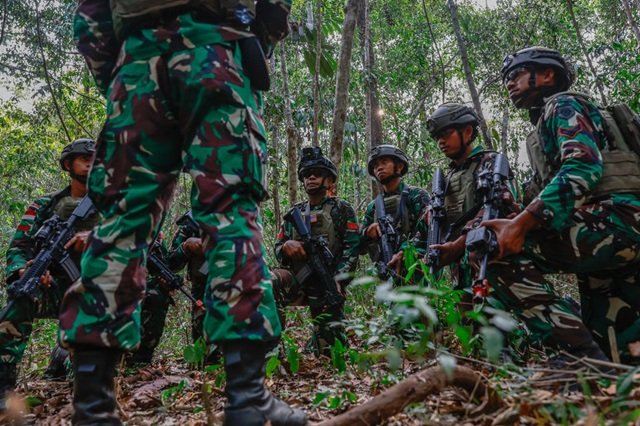
At the same time, Indonesia has continued to conduct joint military exercises with Australia and the United States. Indonesian soldiers took part in Super Garuda Shield 2026 in South Sumatra on September 7, alongside forces from Australia and the US, demonstrating the practical cooperation that now exists even as strategic suspicions remain.
Febry suggested that the February security pact could be reinforced through “Track 1.5 diplomacy” — informal dialogue involving officials and independent researchers — to address sensitive questions surrounding Aukus, maritime security and threat perceptions. Such discussions, he said, could “erode remaining suspicions and bridge the strategic understanding of both parties”.
Rahman recalled that when Aukus was first announced in 2021, Indonesia’s defence establishment “then perceived Australia’s defence engagement as superficial and insincere”. Canberra had since worked to change that perception.
The relationship has nevertheless continued to encounter moments of unease. Last year, reports that Russia was seeking access to an Indonesian airbase caused anxiety in Australia. Jakarta’s defence minister responded publicly that Russian military aircraft would not be permitted to operate from Indonesian territory. Indonesia has nevertheless continued joint drills with both Russia and China, alongside equipment-manufacturing plans and technology sharing.
For Canberra, that strategic independence remains part of the relationship it must navigate. “Canberra must understand that as part of Jakarta’s strategic culture,” Rahman said, adding: “Indonesia is always part of Canberra’s security calculus.”
The Pezzullo episode has therefore placed an unusually direct question at the centre of an already complicated relationship: how can Australia deepen military cooperation with Indonesia while publicly contemplating a scenario in which Indonesia itself becomes the enemy? The answer will depend not only on submarine capabilities or military planning, but on whether the confidence built through exercises, exchanges and high-level agreements can withstand the return of language that recalls an older era of strategic suspicion.