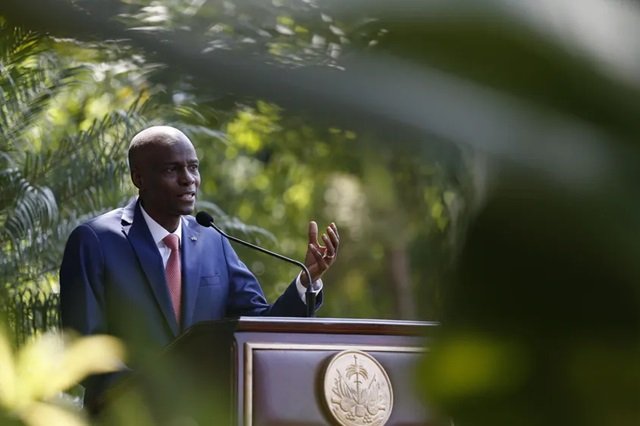
Five years after Haitian President Jovenel Moïse was assassinated, the investigation into one of the most consequential political murders in Haiti’s recent history has entered a new phase. Haiti has extradited 18 suspects to the United States, where they are expected to face proceedings in Florida as American authorities seek to establish who financed, supported, facilitated or directly participated in the plot.
According to US prosecutor Reding Quiñones, the suspects will face court proceedings in Florida. The FBI described the arrests and extraditions as evidence of the US determination to bring “all participants in this conspiracy” before the courts.
The transfer marks the end of a prolonged judicial process in Haiti and the beginning of another stage in the effort to establish responsibility for Moïse’s killing. Quiñones described the extraditions as a new and important phase in the investigation, while stressing that investigators were continuing to examine the wider network behind the assassination.
The central question is no longer simply who carried out the attack, but who enabled it. Investigators are examining who financed the operation, who provided support, who made the assassination possible and who directly participated in it. That broader inquiry places the 18 suspects within a much larger investigation into the organisation behind the killing.
Moïse was killed on 7 July 2021 at his residence in Port-au-Prince by a group composed of militarily trained Colombians. His security detail did not intervene. In the aftermath, Haitian police arrested around 40 suspects, including approximately 20 Colombian mercenaries.
According to Quiñones, 30 people have so far been charged in connection with the assassination. The extradition of 18 suspects to the United States therefore represents a significant development in a case that has already crossed national boundaries, involving Haitian political figures, Colombian former soldiers and a private security company based in Florida.
The American proceedings have already produced convictions. In May, four men were convicted in a federal court in Miami, among other charges, of conspiracy to murder or kidnap Moïse. They were linked to a private security company based in Florida.
Five other men were sentenced to life imprisonment by the US justice system. Among them were two former Colombian soldiers and a former Haitian senator. The convictions have established a series of criminal cases in the United States, while the latest extraditions indicate that American authorities are continuing to pursue additional suspects.
The investigation is unfolding against the backdrop of a country whose political and security crises have deepened since Moïse’s death. Haiti has for years suffered from political instability, economic hardship and widespread violence. The assassination of the president further destabilised a country already marked by severe poverty and criminality.
The deterioration has been particularly severe in relation to armed criminal groups. Powerful gangs have carried out killings, kidnappings and rapes, while forcing children to fight for them. The scale of the violence has compounded the political uncertainty that followed Moïse’s assassination.
Food insecurity has added another layer to the crisis. Nearly half of Haiti’s population of 11 million does not have secure access to food. The combination of political instability, economic hardship, criminal violence and food insecurity has left the country confronting multiple crises at the same time.
Against this background, the prosecution of those accused in the Moïse assassination carries significance beyond the individual defendants. The case has become part of a wider effort to establish accountability for a killing that occurred at a moment when Haiti’s political institutions were already under severe strain.
The US authorities have signalled that the investigation remains open in substance even as individual cases move through the courts. Quiñones said investigators were continuing to pursue questions surrounding the financing and organisation of the plot, while the FBI said the arrests reflected its determination to bring those involved before the courts.
The extradition also illustrates the international character of the investigation. The killing took place in Haiti, the alleged attackers included Colombian nationals with military backgrounds, some defendants had links to a Florida-based security company, and the latest suspects are being transferred to the United States for prosecution.
For Haiti, however, the case unfolds alongside an unresolved political crisis and a deteriorating security situation. Moïse’s murder did not create the country’s instability, but it pushed an already fragile political system into a deeper crisis, while criminal groups expanded their influence and violence continued to affect civilian life.
There is now another date on Haiti’s political calendar. Presidential and parliamentary elections are due to be held in December, which would be the first such elections in the country since 2016.
The timing gives renewed importance to the unresolved questions surrounding Moïse’s assassination. Five years after the killing, the transfer of 18 suspects to the United States moves the investigation into a new judicial phase. But as the US authorities continue to examine who financed, supported and enabled the plot, the case remains intertwined with the wider political and security crisis that has shaped Haiti since the president was killed.
The assassination may have taken place inside a presidential residence in Port-au-Prince. Its legal consequences, however, have extended far beyond Haiti’s borders.