Editorial
Do you remember there was a girl who went to Saudi Arabia, changing her birth certificate to make sure her family would survive from the money she was going to earn? Have we learnt anything from the tragic irony that girl had to undergo in the name of customary practices and local laws in Saudi Arabia? There is no point in blaming Saudi Arabia or its regime. The harder question is what Sri Lanka did — and what it failed to do — before one of its most vulnerable citizens was condemned to death. Rizana Nafeek was executed on 9 January 2013. More than a decade later, another Sri Lankan migrant worker, Sivarasa Anojan, is reported to have been sentenced to death in Saudi Arabia. The names have changed. The country of employment has not. The underlying vulnerability has not. And, most disturbingly, the familiar scramble by politicians and institutions to appear concerned has begun again.
Rizana’s case should have been permanently etched into Sri Lanka’s foreign-policy and migrant-worker protection system. Her case exposed questions surrounding her age, recruitment documentation, legal representation and understanding of the Saudi legal process. Yet the lesson appears not to have been transformed into a durable system capable of protecting Sri Lankans before their cases reach the point of catastrophe. Anojan’s case now exposes the same institutional weakness from another direction. A Sri Lankan worker is reported to have received an initial five-year prison sentence and a substantial fine before the sentence was reportedly elevated to death on appeal. His parents had already appealed to the United Nations in July. Only when the death sentence became a matter of public alarm did the political machinery begin moving visibly into action.
And suddenly everyone is there. The President meets the parents. The Opposition Leader meets the family, telephones the Sri Lankan ambassador in Saudi Arabia and speaks to Anojan in prison. A former Foreign Minister calls for urgent diplomatic intervention. Ministers speak of efforts to secure clemency. The Foreign Ministry says it is monitoring developments through the Sri Lankan embassy. The President promises a written diplomatic appeal to the Saudi King. All of this is welcome — but it also exposes the uncomfortable question: why does the machinery of the Sri Lankan state become so visibly energetic only when a death sentence has already been imposed?
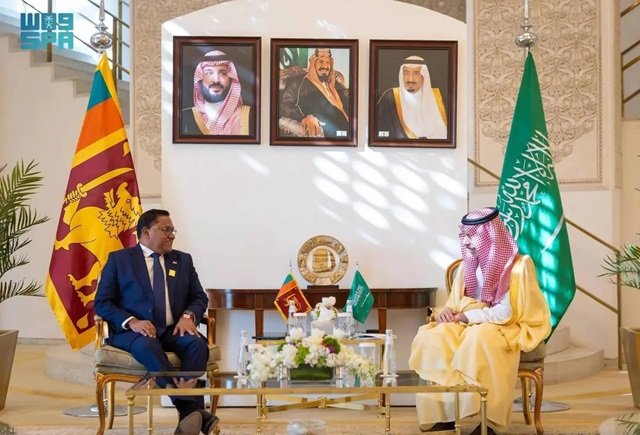
A foreign mission should not become a stage on which politicians demonstrate concern after a citizen has reached the final and most dangerous point of a foreign legal process. Its responsibility begins much earlier. Migrant workers leave Sri Lanka because their families need income, often entering unfamiliar societies where laws, judicial procedures, cultural practices and punishments may differ radically from those at home. The responsibility of the state is not merely to send them abroad and receive their remittances. It is to ensure that they understand the legal environment they are entering and that effective mechanisms exist to assist them when something goes wrong.
This is where Sri Lanka’s foreign-policy machinery deserves the hardest scrutiny. Embassies and diplomatic missions are sustained by public money. Their legitimacy rests on national responsibility, not political theatre. If a mission is unable to identify serious risks, provide meaningful assistance, facilitate legal representation and intervene before a case becomes irreversible, then its effectiveness must be questioned. The issue is not whether diplomats issue statements after a crisis. The issue is whether the system works before the cameras arrive.
Rizana’s execution should have been the warning. Anojan’s case is another test. If the response once again consists of politicians appearing beside grieving parents, making appeals and competing to demonstrate who is doing more, only to disappear when the immediate public attention fades, then Sri Lanka will have learnt nothing. The tragedy is not simply that one migrant worker may face the harshest penalty of a foreign legal system. The greater tragedy is that a country that has already experienced such a catastrophe appears to have allowed another citizen to approach the same precipice before its institutions became fully visible.
The lesson is brutally simple: foreign policy is not a press conference, an embassy plaque or a last-minute telephone call. It is a system of protection. Until Sri Lanka treats the safety and legal preparedness of its migrant workers as a national responsibility rather than a crisis to be managed after the fact, Rizana Nafeek will remain not merely a forgotten tragedy, but a warning we repeatedly choose not to hear.