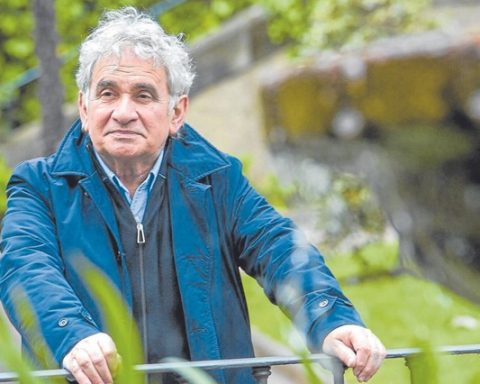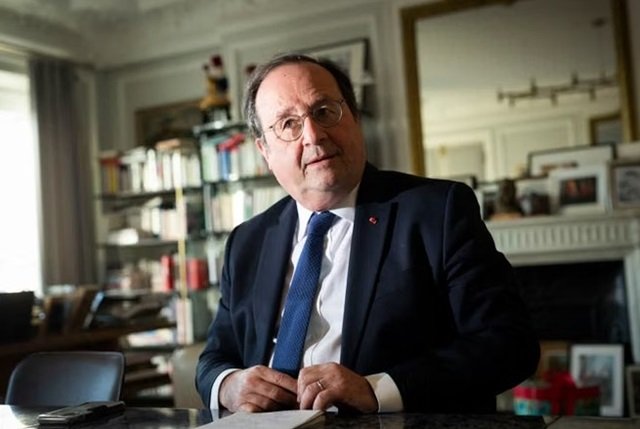
Former French president François Hollande is considering a return to the presidential race, arguing that France and Europe face a political and strategic crisis that cannot be addressed simply by defending the existing political order. In an interview with EL PAÍS and three other European newspapers belonging to the LENA media consortium, Hollande said his decision would depend on whether he could reach the second round and offer a candidate capable of uniting the country.
“Ante la proximidad de esta presidencial tan decisiva para Francia, no faltan candidatos, pero faltan proyectos,” Hollande said. “Lo importante no es simplemente ser un figurante de primera vuelta. Es ser capaz de acceder a la segunda para ganar.” He stressed that a possible candidacy would not be an attempt at revenge or to repeat his previous presidency, but would be justified by what he described as the gravity of France’s current condition. The central question, he said, was “¿quién puede mañana presidir y unir a la República, quién puede devolver la confianza a los franceses sobre su futuro y frenar a los extremos?”
Hollande, 72, left office with low popularity and did not seek re-election in 2017, when the Socialist camp was divided and Emmanuel Macron had already announced his candidacy. He said there was no longer a reason for him to consider a candidacy at that time because the prospect of Socialist primaries had lost its meaning. He remains opposed to primaries in principle, arguing that they tend to expose divisions rather than create convergence. However, he said he would support Socialist primaries if they produced a unifying candidate capable of reaching the presidential run-off.
His intervention comes as France faces severe political polarisation and pressure on its public finances. Hollande said the country’s debt had reached a historic level, unemployment was rising again, and economic and territorial inequalities had increased. At the same time, the far-right National Rally (RN) is approaching power. “La extrema derecha está a las puertas del poder,” he said, while arguing that opposition to the RN alone would not be sufficient. The response, he said, had to offer voters a credible political alternative.
Hollande attributed the growth of the far right to international uncertainty, the perceived impotence of democracies, concerns about immigration and a broader sense of national decline. He rejected the idea that France alone was responsible for the deterioration, saying: “Francia es un reflejo de Europa. ¿Conoce usted algún país al que le vaya bien?” He acknowledged Spain’s stronger economic performance, partly because of the usefulness of European funds, but noted that the far right there had also reached a high level despite the country’s historical experience under Franco.
He was critical of Macron’s record on political fragmentation and public finances, saying citizens had never felt so little considered. But Hollande said Macron was no longer the central issue. Instead, he warned against allowing former prime ministers associated with policies that contributed to the country’s financial and political deterioration to present themselves as the solution. He referred specifically to Gabriel Attal and Édouard Philippe, both presidential contenders. Hollande said France needed more than a programme of fiscal consolidation: it also required increased productivity and investment and a programme for ecological transition.
His own proposals, outlined in his 2026 book Unir. Nuevo mundo, nueva izquierda, include positions on immigration and VAT that can appear closer to the right. Hollande defended this approach on electoral grounds, arguing that the Socialist Party represents only 10 to 15 per cent of voters and the whole left, including Jean-Luc Mélenchon, no more than 30 per cent. Winning the presidency requires more than 50 per cent, he said, and therefore the left must persuade voters who have not traditionally supported it rather than simply seek formal alliances with the centre or right.
Hollande also drew a sharp distinction between Mélenchon and Marine Le Pen. He said their movements had different histories and ideological sources, while stressing that Mélenchon had no realistic route to power whereas Le Pen did. He argued that, without a credible left-wing candidacy capable of generating a prospect of victory, voters could move towards the centre-right to prevent a Mélenchon-Le Pen run-off or towards Mélenchon as a protest candidate. In his view, a Mélenchon candidacy reaching the second round would lose heavily to Le Pen and could contribute to a far-right victory.
For Hollande, the European consequences of a National Rally presidency would be particularly significant because of France’s political system. He argued that a party securing about 35 per cent in the first round could potentially obtain power alone and implement its own programme. He pointed to RN positions on reducing France’s contribution to the European budget, questioning defence policies, suspending aid to Ukraine and ending Schengen. The far right, he said, no longer necessarily advocates leaving the European Union but can instead seek to prevent further European integration in areas including defence, digital regulation and ecological investment.
Hollande described this as a return to the idea of a “Europe of nations”, in which nationalism advances as European integration recedes. He said the French RN was seeking links with Germany’s AfD, Spain’s Vox and forces further to the right in Italy, with the broader objective of transforming politics in the EU’s major states.
He also challenged the assumption that the United States remains an unquestioned ally of Europe. Referring to territorial demands, trade agreements, tariffs, Ukraine and Donald Trump’s invitation to Vladimir Putin to the G20, Hollande said: “Todo se ha convertido en una relación de fuerzas.” His response was not to break with the United States but for Europeans to assume greater responsibility for their own security, industrial capacity and technological sovereignty, including stronger European cooperation on artificial intelligence and control over European data.