


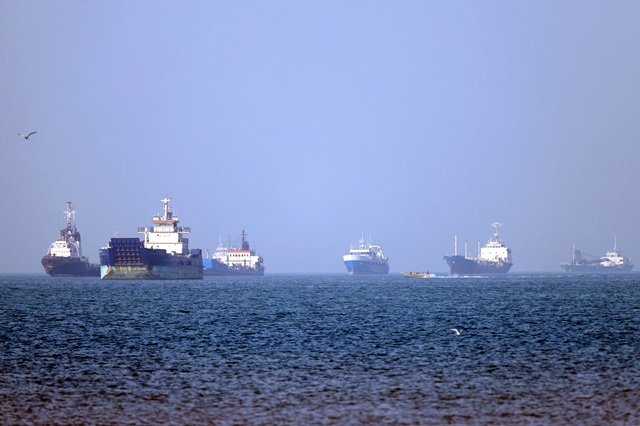
Oil prices rose sharply in Asian trading on Monday after US President Donald Trump rejected an Iranian proposal to reopen the Strait of Hormuz and resume nuclear negotiations with Washington. The move came as fresh Chinese data showed industrial profit growth slowing to its weakest pace this year, while economists and investors warned that prolonged energy prices above $100 a barrel could revive concerns about stagflation.
US crude futures for November delivery rose 1.69% to $94.10 a barrel, while international benchmark Brent gained 2.65% to $106.96. The increase followed reports that Trump had rejected Tehran’s conditional offer to reopen the strategic shipping route and told aides that he expected US strikes against Iran to resume after November’s midterm elections. The Wall Street Journal reported the claim on Saturday, citing unnamed US officials. Trump subsequently confirmed that he had rejected the Iranian proposal, telling reporters: “They made a proposal but I rejected it.”
Iranian Foreign Minister Abbas Araghchi had offered the proposal on Friday on the sidelines of the United Nations General Assembly in New York. He said Iran would reopen the Strait of Hormuz and restart nuclear negotiations with Washington within seven days if the Trump administration accepted Tehran’s conditions. “If certain conditions are met, the Strait of Hormuz will be open at the end of seven days, and talks will be restarted,” Araghchi told reporters. According to Iranian foreign ministry spokesman Esmaeil Baghaei, those conditions included an end to what Tehran describes as US “acts of aggression”, the lifting of the naval blockade and economic warfare, and the release of Iranian assets.
The security situation remained unsettled elsewhere in the region. On Saturday, Yemen’s Saudi-led coalition said it had intercepted projectiles launched by Iran-backed Houthi rebels. The conflict began with US and Israeli airstrikes on Iran on February 28. Trump said earlier this month that he expected the conflict to conclude soon after the US midterm elections, after which oil prices had declined.
The renewed oil pressure is arriving as China’s industrial sector loses momentum. Official data released on Monday showed profits at large industrial firms rose just 4.2% in August from a year earlier, the weakest pace of growth this year. It was the fourth consecutive month of deceleration, following a 24.7% expansion in April, and the weakest performance since November 2025, when industrial profits recorded a double-digit decline.
For the first eight months of 2026, industrial profits increased 15.7%, down from 17.6% growth in the January-to-July period. The figures mark a significant change from the sharp improvement earlier in the year, when industrial earnings moved from a barely positive 0.6% increase across 2025 — the first annual rise after three consecutive years of decline — to double-digit growth. That recovery was driven partly by an artificial-intelligence-fuelled boom in chips and computing equipment and coincided with the end of almost three years of factory-gate deflation.
The latest figures show that recovery remains uneven. Profits in computer, communication and electronic equipment manufacturing more than doubled during the January-to-August period, increasing 110% from a year earlier. Automobile manufacturing profits, however, fell 16% as intense competition and price pressure continued. Consumer-related industries including clothing, autos and furniture have experienced declining profits, contrasting with stronger earnings in high-tech sectors such as artificial intelligence and robotics.
Yu Weining, chief statistician at China’s National Bureau of Statistics, attributed August’s slowdown partly to a high base effect from the previous year, when industrial profits had rebounded 20.4% year on year after months of declines. That rebound followed Beijing’s efforts to curb price wars in several industrial sectors. Yu reiterated policymakers’ commitments to strengthening domestic demand and “optimizing” supplies.
China’s wider economy is also showing signs of strain. Growth slowed to its weakest pace in more than three years in the second quarter as the prolonged property downturn continued to weigh on consumer demand and investment in property and infrastructure. Manufacturing activity contracted for two consecutive months in July and August, according to the official purchasing managers’ index. Retail sales slowed further and the decline in urban investment deepened in August, while industrial output rebounded on the strength of exports.
Economists expect Beijing to increase stimulus measures as consolidation accelerates in industries facing weak demand, fierce competition and price wars. Allan von Mehren, China economist at Danske Bank, said authorities were likely to increase policy implementation during the second half of the year, including faster investment in strategic areas such as water, power grids, data centres, networks, urban pipelines and logistics infrastructure.
At the same time, China may ease access to some advanced US-made computing technology. The Information reported that Beijing could allow companies including ByteDance and Alibaba to purchase Nvidia’s RTX PRO 5500 chips, citing two people familiar with the matter. China’s Ministry of Industry and Information Technology reportedly asked companies including ByteDance and Alibaba to submit plans for purchasing the chips, while some industry executives expect the product to avoid US export restrictions. Reuters said it could not immediately verify the report. Nvidia said US companies remained restricted by US export controls while China also imposed limits on US imports.
The combination of higher energy costs and weakening demand has revived concern about stagflation. James Sullivan, managing director and co-head of global fundamental research at J.P. Morgan, said sustained oil prices above $100 a barrel could mark the beginning of a stagflationary period even without a major economic slowdown. “Reasonable levels of economic growth with higher levels of inflation start to trigger this stagflation conversation for the first time really since the 70s,” Sullivan said on CNBC’s “Squawk Box Asia”. He also pointed to rising food and energy prices, persistent core inflation, record AI-related issuance, government deficits, the effects of El Niño and the Middle East conflict as pressures on the global economic outlook.









